AI is no longer just a chat tool. It's becoming your entire team.
Here are 7 new tools this week that prove it – mailx
– drizz
– lobehub
– pollyreach
– runtime
– storeclaw
– tycoon
#AITools #FutureOfWork #AIAgents
MACHINE LEARNING
-

7 New AI Tools That Make AI Your Entire Team
By
–
-
Ultimate step-by-step projects roadmap for becoming AI researcher
By
–
The ultimate step-by-step projects roadmap for BECOMING an AI Researcher is now available online to read FOR FREE Covers building – Tokenizers / embeddings
– Positional methods
– Attention / multi-head attention
– Transformer blocks
– Training loops / objectives
– Sampling -
Knowledge Graph Extraction and Schema Design for AI Systems
By
–
Exactly. The extraction step decides everything downstream, and most systems leave it completely unguided. The moment you add typed entities and constrained edges, the graph stops behaving like a vector store and starts being queryable. Schema should be step one, not an
-
Man spells strawberry while counter tracks number of Rs
By
–
Omni: A man spells out strawberry while a counter keeps track of the number of Rs he says. pic.twitter.com/SxwJcJusMo
— fofr (@fofrAI) 26 mai 2026Omni: A man spells out strawberry while a counter keeps track of the number of Rs he says.
-
Graphiti hybrid ontology: prescribed and learned schema discovery
By
–
Graphiti supports both prescribed and learned ontology, so it can discover new types alongside your defined schema. The sweet spot is a hybrid, fixed schema for core domain, system proposes new types for patterns outside that boundary. Full auto-schema loops back to the
-
Ontology-Constrained Memory as Reasoning Boundary for Agents
By
–
Ontology-constrained memory is a great way to frame it. The key insight that clicked for me is that the schema is not just a filter on what gets stored, it is also a reasoning boundary. What the agent cannot represent, it cannot hallucinate connections about.
-
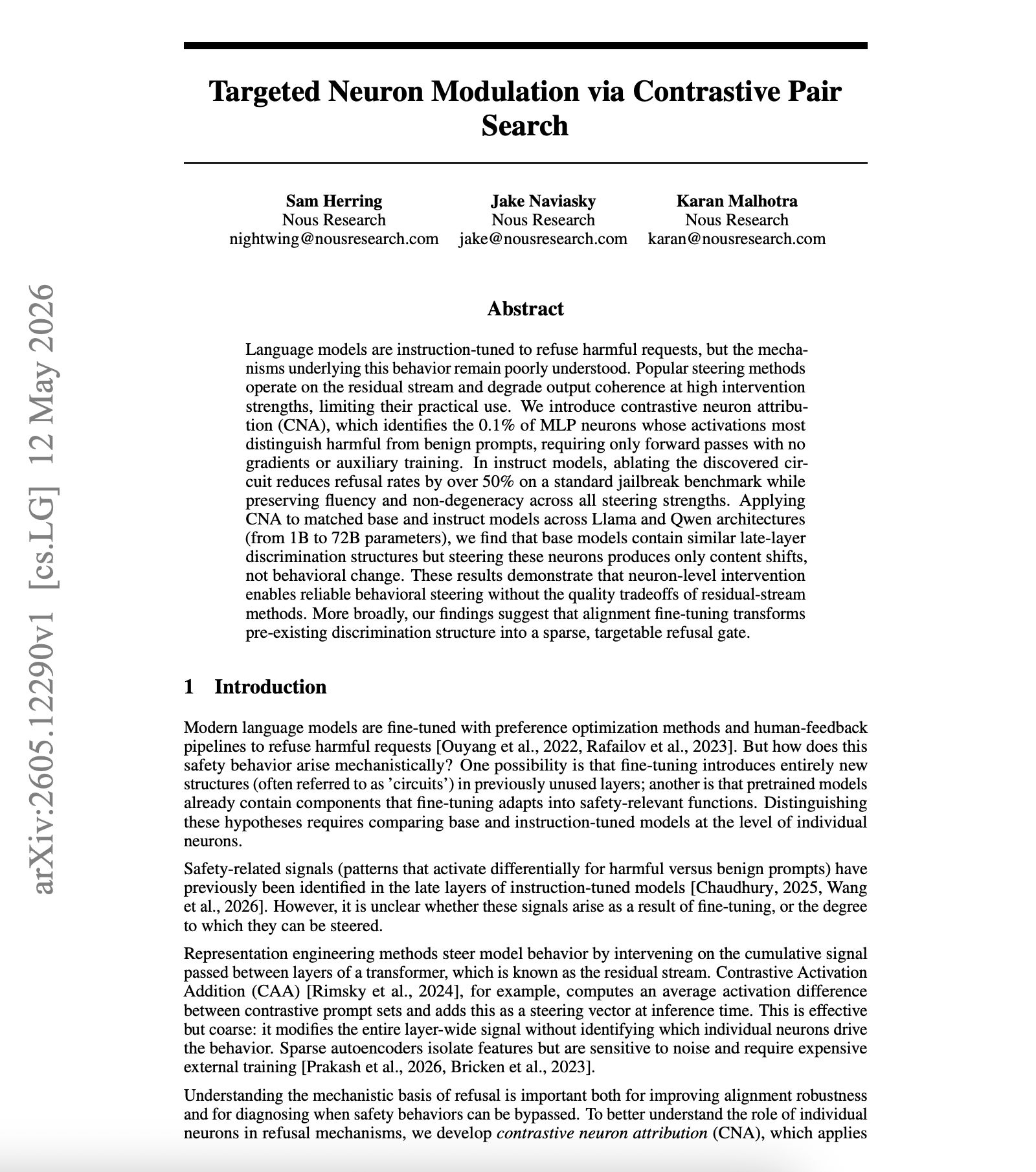
Researchers Identify Neurons Behind AI Safety Refusals
By
–
Someone just found the exact neurons that make AI say "no." Language models refuse harmful prompts, but nobody knows how that refusal works inside. Most steering methods edit the residual stream and wreck output quality. A new paper proposes a sharper fix: Contrastive Neuron
-
Multi-Turn Agent Evaluation and Context Compaction Limits
By
–
Paper does test multi-turn (24 tool calls in OfficeQA, 30 turns in SpreadsheetBench, 50 steps in ALFWorld), but mid-session auto-compaction isn't part of the eval. Skill being under 2K tokens probably helps it survive compaction, but not validated against that failure mode.
-
Optimization Stack in AI: From Weights to Skill Files
By
–
YES, Optimization keeps moving up the stack. Weights, then prompts/harness, now skill files.
-
Hundred-Page Language Models Book with PyTorch by Burkov
By
–
The Hundred-Page Language Models Book — Hands-on with PyTorch: http://
amzn.to/4sJl7YC by @burkov