You learn to see at short range and apply it at long range. Stanley did that with lidar: https://
robots.stanford.edu/papers/thrun.s
tanley05.pdf
…
MACHINE LEARNING
-
Learning Short Range Vision Applied Long Range Lidar
By
–
-
Myths and Realities About AI Training Data
By
–
No! "The entire Internet" is not used to train AI models. In reality, less than 5% of the web is used for training. Estimated sources for GPT-5:
• 50-60% web data (Common Crawl, RefinedWeb…)
• 10-15% social networks (Reddit, etc.)
• 15-20% -
How Reasoning AI Agents Are Redefining Decision-Making
By
–
How are reasoning AI agents redefining decision-making?
— NVIDIA AI (@NVIDIAAI) 25 août 2025
🧵A thread pic.twitter.com/5zzGQeXtlYHow are reasoning AI agents redefining decision-making?
A thread -

Evaluating LLMs’ Performance in Premier Programming Competitions
By
–
AetherCode Evaluating LLMs' Ability to Win In Premier Programming Competitions
-
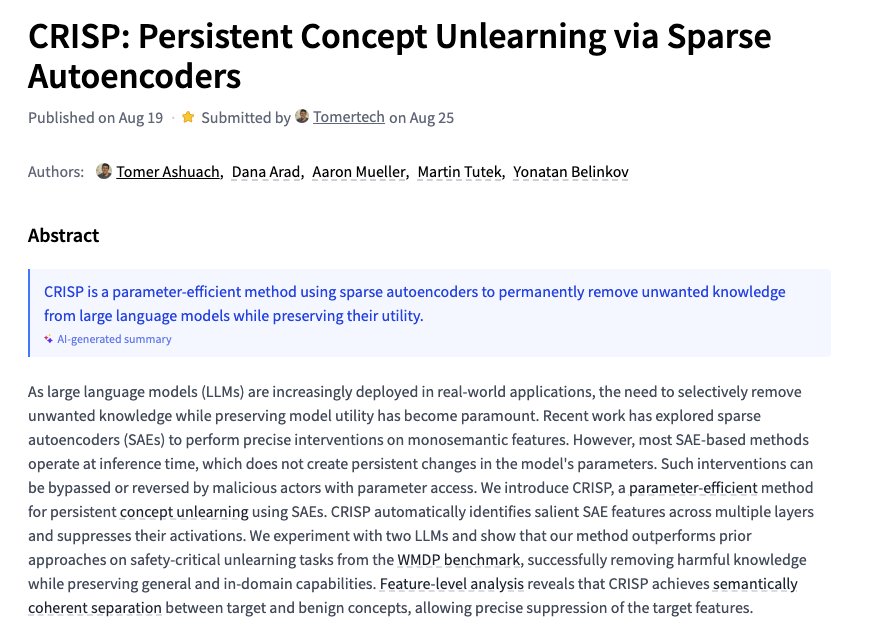
CRISP: Persistent Concept Unlearning via Sparse Autoencoders
By
–
CRISP Persistent Concept Unlearning via Sparse Autoencoders
-
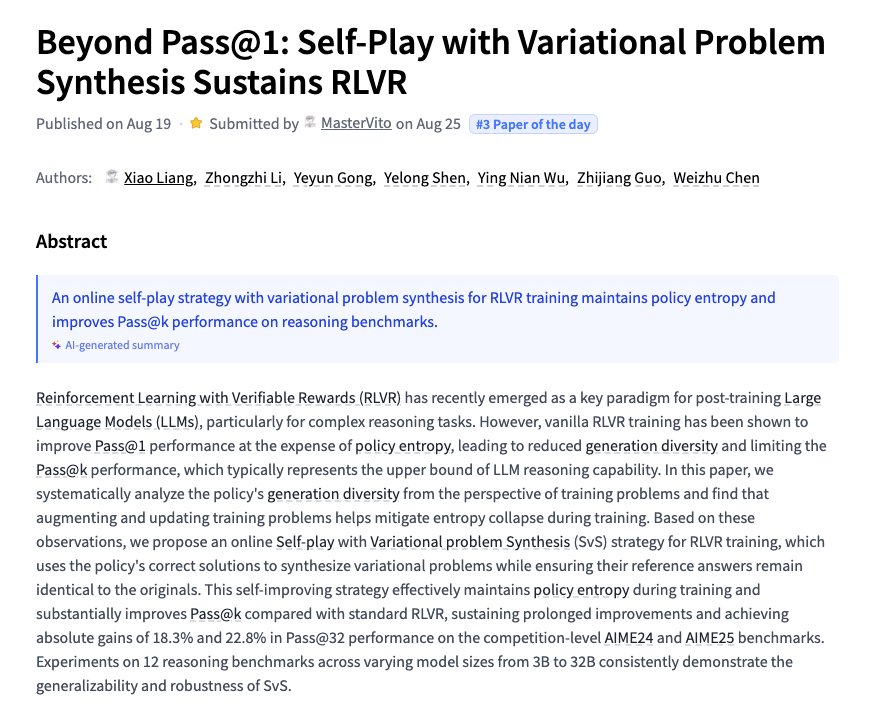
Self-Play and Variational Problem Synthesis Enhance RLVR Performance
By
–
Beyond Pass@1 Self-Play with Variational Problem Synthesis Sustains RLVR
-

ODYSSEY: Open-World Quadrupeds Exploration and Manipulation Framework
By
–
ODYSSEY Open-World Quadrupeds Exploration and Manipulation for Long-Horizon Tasks
-
Sensor Reliability Paradox: Why Multiple Sensors Increase Uncertainty
By
–
A man with a sensor always knows why the car has crashed. A man with two sensors can never be sure.
-
100+ Free AI Agents and RAG Tutorials with Code
By
–
100+ free AI Agents and RAG tutorials with code covering: AI Agents RAG Systems Voice AI Agents MCP AI Agents Multi-agent Teams Autonomous Game Playing Agents P.S: Don't forget to subscribe for FREE to access future tutorials.
-

AI Models Evolution: Adaptive Ecosystems Through Competitive Merging
By
–
Our new GECCO paper builds on our past work, showing how AI models can be evolved like organisms. By letting models evolve their own merging boundaries, compete to specialize, and find ‘attractive’ partners to merge with, we can create adaptive, robust and scalable AI ecosystems.