With IMO and ICPC solved by ML models, this is rapidly becoming true
MACHINE LEARNING
-
Science of Rubric Design for Reliable AI Evaluations
By
–
ICYMI, part 3 of our rubric series: The Science of Rubric Design. Iterate on rubrics like you iterate on models. Optimize objective alignment & expert agreement to make AI evaluations reliable & reproducible. Read → https://
snorkel.ai/blog/the-scien
ce-of-rubric-design/
… #AI #ML #RubricDesign #DataScience -

Gemini DeepThink Wins Gold at ICPC2025 Programming Contest
By
–
Yet another important milestone for Gemini #DeepThink in achieving goldat #ICPC2025, the world's most prestigious college-level programming contest. Big congrats to everyone in this great achievement! Stay tuned for more to come from DeepThink 😉
-

Reasoning System Achieves Perfect Score in 2025 ICPC Competition
By
–
perfect score on the 2025 ICPC programming competition from our latest reasoning system:
-
Gemini 2.5 Deep Think Wins Gold Medal at ICPC
By
–
After IMO gold, Gemini 2.5 Deep Think gets another gold medal at ICPC!
-
Waymo’s Autonomous Vehicles Demonstrate Revolutionary Road Safety Achievement
By
–
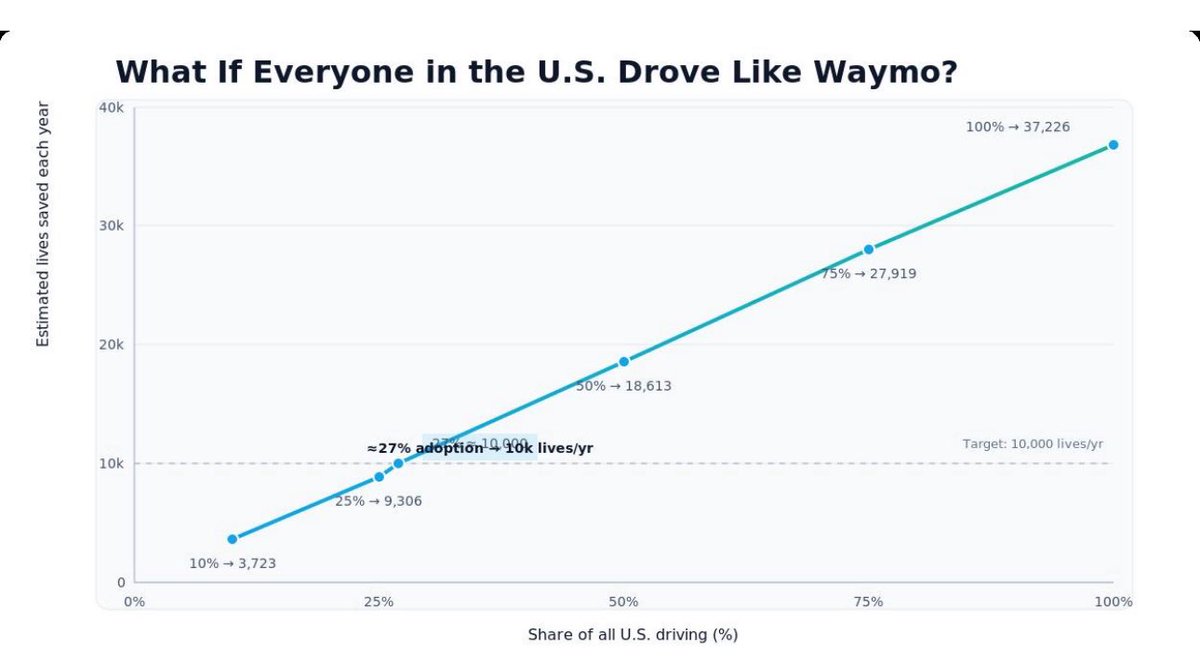
As a neurosurgeon I care a lot about road safety. By now you’ve probably seen @Waymo’s stunning safety results (like 91% fewer serious crashes). But they didn’t just publish data headlines. They released the raw CSV files and data dictionaries. I did a much deeper analysis. A fascinating story emerges when you analyze how they’re achieving this. This isn’t incremental improvement – it’s categorical. We’re looking at the potential elimination of traffic deaths as a leading cause of mortality. The intersection breakthrough: Waymo has essentially solved intersection crashes, with 95% fewer injury incidents than human drivers in the same locations. That’s transforming the deadliest driving scenario. The national math: If every US vehicle performed like Waymo, we’d prevent 33,000-39,000 deaths annually and save $0.9-1.25 trillion in societal costs. Even partial adoption at 27% would save ~10,000 lives per year. In terms of magnitude, this would be the equivalent of eliminating every pedestrian death nationally in a year. The physics signature: Here’s what fascinates me: 47% of Waymo’s contacts involve less than 1 mph delta-V. They’re not just avoiding crashes; they’re converting unavoidable incidents into gentle bumps. It’s like having physics itself on your side. We’re not talking about marginal safety gains. The data represents a fundamental shift from harm reduction to harm prevention. The methodology matters: I used their dynamic geographic benchmarks (comparing like-for-like road conditions) and verified the findings hold across San Francisco, Phoenix, LA, and Austin. The safety advantage actually increases in more complex urban environments. Link to raw data below…. Notes on my approach: Analysis based on 96 million miles of Waymo Rider-Only (RO) data through June 2025, utilizing Waymo's dynamic geographic benchmarks to compare Waymo Driver performance against human drivers under similar road conditions and operational design domains. The projections for national impact (deaths prevented, societal costs) involve several assumptions. Given Waymo's zero reported fatalities, the direct serious injury reductions were mapped to national fatality statistics using established NHTSA-derived ratios that correlate serious injury crash rates with fatality rates. This extrapolation assumes that Waymo's observed serious injury prevention capability would translate proportionally to fatality prevention. Societal cost savings are estimated by applying average per-fatality and per-injury economic costs (e.g., medical, lost productivity, quality of life) as published by NHTSA, scaling these national averages to the projected number of avoided fatalities and injuries based on Waymo's safety performance. These figures represent the potential annual impact if the Waymo Driver's safety profile were widely integrated into the national fleet. @ethanteicher
→ View original post on X — @mattlynley, 2025-09-17 18:29 UTC
-
GPT-5 Solves ICPC Problems with Experimental Reasoning Model
By
–
11 out of 12 problems were correctly solved by GPT-5 solutions on the first submission attempt to the ICPC-managed and sanctioned online judging environment The final and most challenging problem was solved by our experimental reasoning model after GPT-5 encountered
-

AI Solves All ICPC World Finals Problems Achieving First Place
By
–
Our general-purpose reasoning models solved all 12 problems at the 2025 International Collegiate Programming Contest (ICPC) World Finals, the world’s top university programming competition which was enough for a 1st-place human ranking.
-
OpenAI o1 Models Achieve Top Marks in Math Coding Competitions
By
–
This caps a run of steady progress across math and coding competitions. Just over a year ago we introduced OpenAI o1-preview and OpenAI o1-mini. Since then our general-purpose reasoning models have made steady progress. Today they’re earning top marks in some of the world’s
-

Self-Correcting AI Agents Enable Exponential Task Horizon Gains
By
–
I think the significance of this is under-appreciated: the assumption has often been that AI agents are brittle as one failure in a chain breaks a task But this paper shows smart models are self-correcting & that small gains in accuracy lead to exponential gains in task horizons