NVIDIA just killed the awkward pause in voice AI PersonaPlex 7B is a real-time conversational model that listens AND speaks simultaneously. Like actually interrupts you mid-sentence like a human. Beat Gemini Live on dialog naturalness. 18x faster interruptions. 100% open
Quick reminder that Sonnet 4.8 and Opus 4.7 were already tested internally, as seen with the large Claude Code leak. The release should therefore be imminent.
Math got much better for sure. Coding improved too, but less good at SVGs. They are also testing a lot of agentic use cases – working with docs, health data, etc. pic.twitter.com/w81OdmAxh7
— 🚨 AI News | TestingCatalog (@testingcatalog) 6 avril 2026
Math got much better for sure. Coding improved too, but less good at SVGs. They are also testing a lot of agentic use cases – working with docs, health data, etc.
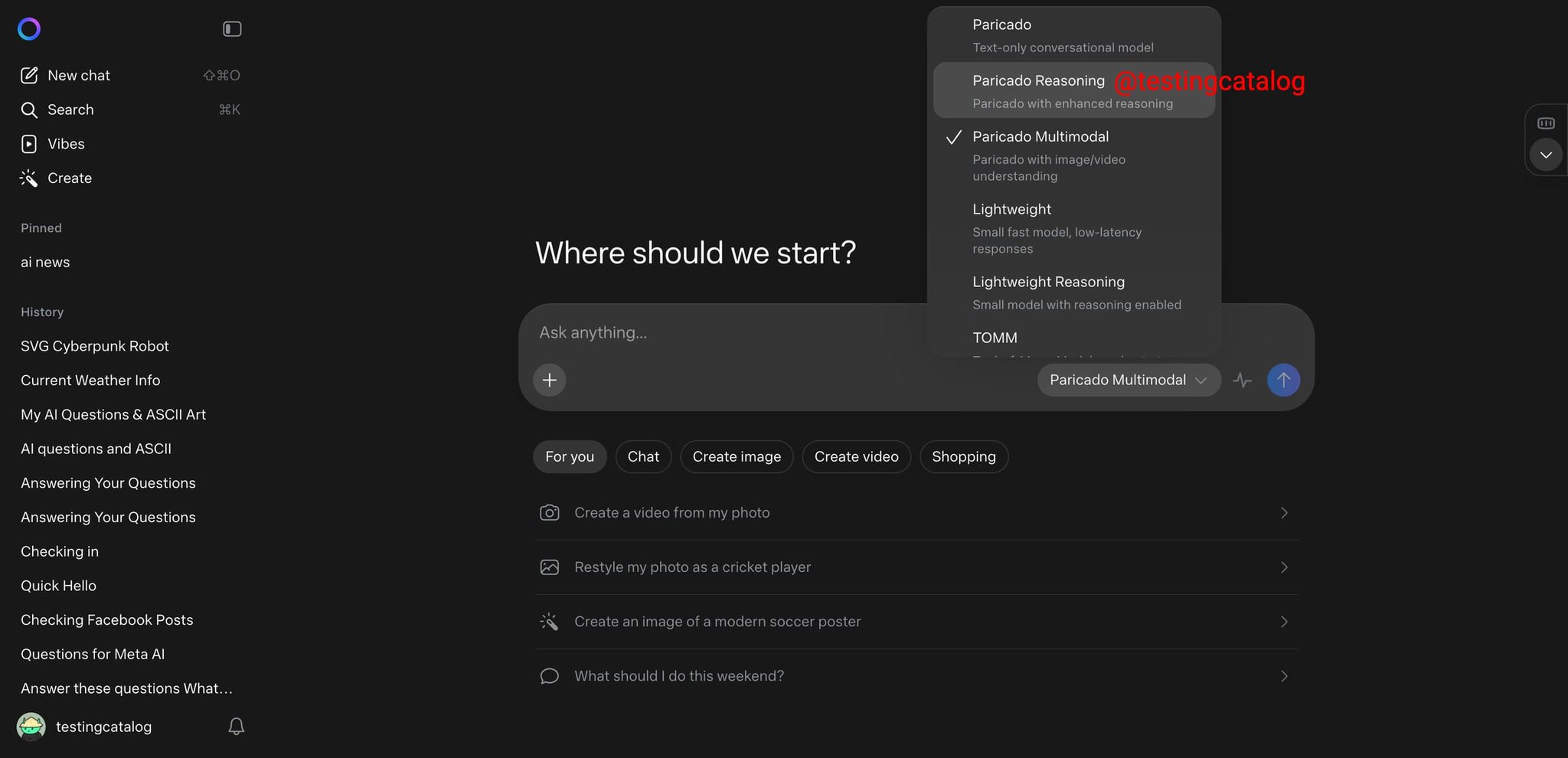
Meta still plans to release open-source versions of their upcoming models, but later, according to Axios. Their upcoming release will be a huge improvement for all the Metas' products that integrate AI, even though they are behind frontier models. Is Paricado an open-source
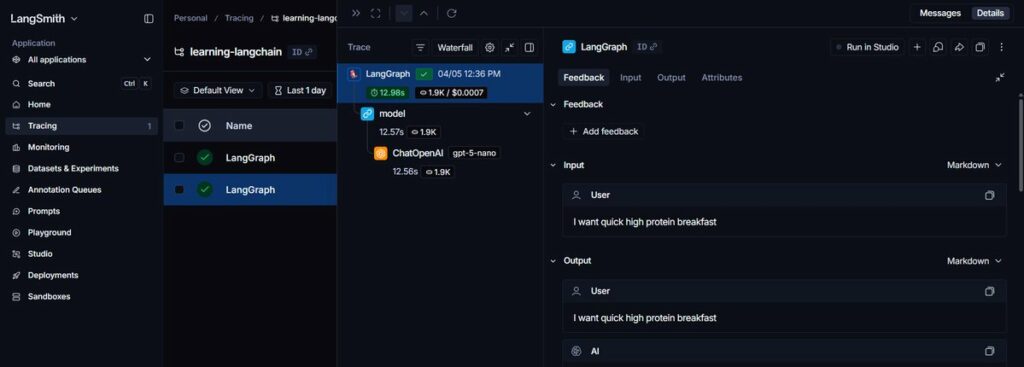
Day 3 of becoming 100xdevs: – make a travel agent with mcp – learn about the state – learn about runtime context – making multiagents – tracking sub-agents from Langsmith Akash (@akashcorex) Day 2 of becoming 100xdevs: – LangSmith tracking of each agent – how to create MCP – run MCP locally and use it – create a travel agent with mcp + ai — https://nitter.net/akashcorex/status/2040872532816154958#m
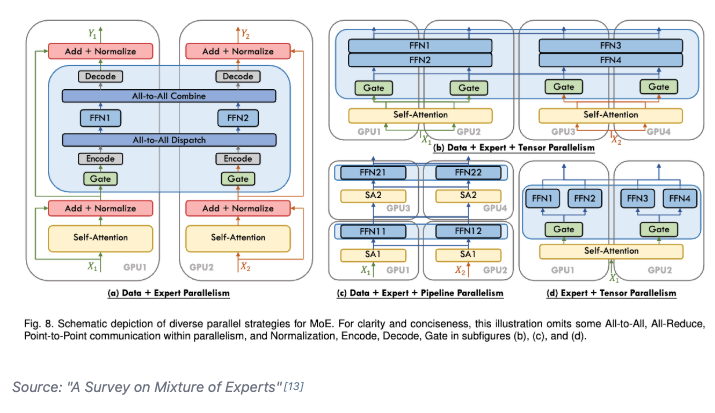
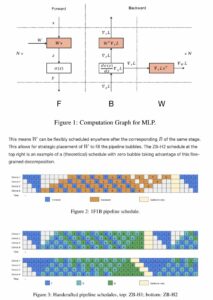
Day 93/365 of GPU Programming Studying parallelism today and stumbled upon this incredible blog post/book The Ultra-Scale Playbook: Training LLMs on GPU Clusters by Hugging Face that dives deep into data parallelism, expert parallelism, tensor parallelism, pipeline parallelism and context parallelism. I've read a bit about each of these methodologies before but this is the best resource I've found that really pieces them all together into a unified coherent picture. Kinda like its name implies, the team goes into actual empirical examples based on the 4000 scaling experiments (across up to 512 GPUs!) they conducted. E.g. how does tensor parallelism reduce activation memory for matmuls but still require gathering full activations for LayerNorm? When does pipeline parallelism's bubble overhead outweigh its memory savings? When and why would you combine TP/PP/DP on a specific cluster topology? What's the real memory breakdown between params, gradients, optimizer states and activations and which parallelism strategy targets which? et cetera Also loved all the beautiful and sometimes interactive diagrams that reminded me of distill.pub (which makes sense given they used distill's template to create the post). I wish more blog posts in ML would use a similar approach to help visual learners understand the content at an intuitive level. Especially now that rich visualizations/animations are so easy to spin up with LLMs. Really wonderful work by @Nouamanetazi @FerdinandMom @xariusrke @mekkcyber @lvwerra @Thom_Wolf. In times when things are going more and more closed source in, this is such a good example of what great open source AI education and research can look like. levi (@levidiamode) Day 92/365 of GPU Programming Taking a closer look at disaggregated LLM inference today, which I've been wanting to survey more after listening to the Dean <> Daly discussion at GTC. The best resource I found on the topic was this great talk by @Junda_Chen_ on the past, present and future of prefill decode disaggregation. In the lecture, Junda goes through Nvidia's dynamo, the intrinsic tradeoff spectrum between throughput & latency, TTFT, TPOT, the "goodput" metric, distinct characteristics between prefill vs decode, chunking P&D, the problem of interference, pipeline parallelism, resource & parallelism coupling, disaggregation and DistServe. — https://nitter.net/levidiamode/status/2040938107604742640#m
Ones I've tried were quite good, even though they are behind the frontier models. When Meta will power their products with Avacado, it will already become a huge improvement for their users. Now curious what they have under Paricado here 👀
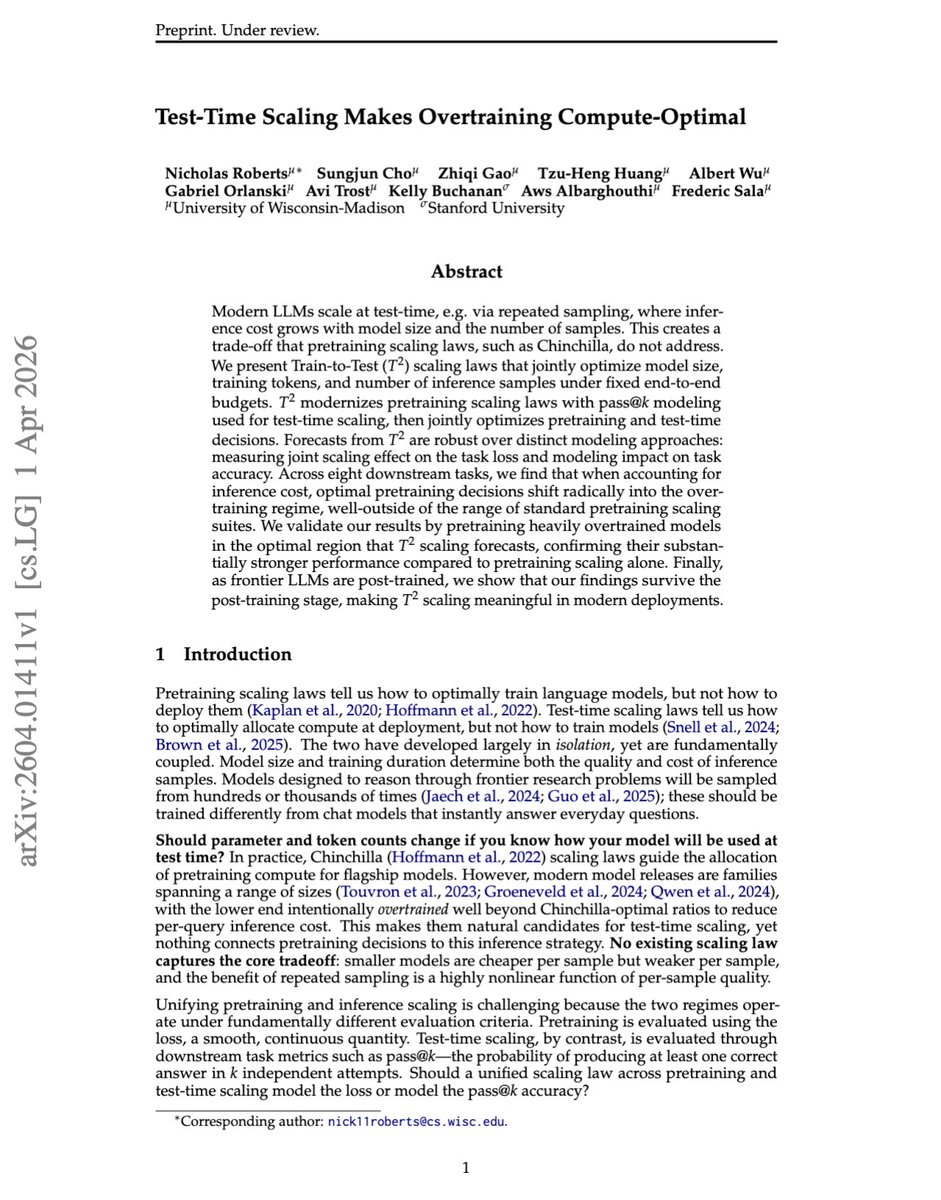
Most scaling laws assume you train once and answer once. But this paper says that if you already know you'll spend extra compute at test time by sampling many answers, then you should train a different model. So instead of a bigger model trained the usual way, it can be better to train a smaller model for much longer. As smaller models are cheaper to sample many times, those extra tries can beat one expensive shot from a larger model. So the real thing to optimize is not just training compute, but training + inference together. And this paper shows overtraining can actually become the compute-optimal choice. [Translated from EN to English]