Abacus Claw Is Now Ultra Efficient – runs on small models
– super easy to connect to WhatsApp, Telegram and Discord
– will automatically sleep when not being used The best OPEN CLAW implementation on the cloud
LLMS
-
Abacus Claw: Ultra Efficient with Small Models
By
–
-
Hermes CTO Space: Five Key Advantages Over OpenClaw
By
–
Probably a good idea to join @Scobleizer space in about 45 minutes to hear from the Hermes CTO, I'd expect them to address the differences between Hermes and OpenClaw. But from my own perspective here are my top five observations: 1. Easier to setup initially 2. Easier to upgrade 3. Lower token usage over time due to less bloated system prompts and less "rework" on assigned tasks 4. Better skill system out of the box 5. Self improving without having to setup a ton of "pointers" like with OpenClaw The only thing I can say that's negative about Hermes is that it is still mostly for the bleeding edge tech crowd and non technical people will still struggle and still need to learn new concepts. But hey, that's why every Tom, Dick and Harry out there is building a custom agent platform that's GUI driven 100 percent…
-
Running Quantized Local Models with Atomic Chat and OpenClaw
By
–
Now you can use Atomic Chat to power OpenClaw with quantized local models! It takes several commands to set it up, and you will get a much higher context window.
— 🚨 AI News | TestingCatalog (@testingcatalog) 8 avril 2026
Mac Mini + Gemma 4 + OpenClaw combo 🦞 https://t.co/lGsm1QBOBs pic.twitter.com/HK5vmIdF5KNow you can use Atomic Chat to power OpenClaw with quantized local models! It takes several commands to set it up, and you will get a much higher context window. Mac Mini + Gemma 4 + OpenClaw combo
-
Namanopedia: AI-Generated Personal Wikipedia from Just a Name
By
–
This is Namanopedia.
— Naman Ambavi (@namanambavi) 8 avril 2026
I built lifewiki [https://t.co/dU2e2ffCcx].
Paste a name, get their entire Wikipedia. An AI agent researches the web and compiles 40-50+ articles with infoboxes, wikilinks, citations, and categories. Takes about 3 minutes.
Inspired by @karpathy's LLM Wiki… https://t.co/lIqGkTbO2L pic.twitter.com/AKKMWU8Ge0This is Namanopedia. I built lifewiki [mylife.wiki]. Paste a name, get their entire Wikipedia. An AI agent researches the web and compiles 40-50+ articles with infoboxes, wikilinks, citations, and categories. Takes about 3 minutes. Inspired by @karpathy's LLM Wiki pattern and @FarzaTV's Farzapedia. Except this one works for anyone, from just a name. mylife.wiki/naman-ambavi Andrej Karpathy (@karpathy) LLM Knowledge Bases Something I'm finding very useful recently: using LLMs to build personal knowledge bases for various topics of research interest. In this way, a large fraction of my recent token throughput is going less into manipulating code, and more into manipulating knowledge (stored as markdown and images). The latest LLMs are quite good at it. So: Data ingest: I index source documents (articles, papers, repos, datasets, images, etc.) into a raw/ directory, then I use an LLM to incrementally "compile" a wiki, which is just a collection of .md files in a directory structure. The wiki includes summaries of all the data in raw/, backlinks, and then it categorizes data into concepts, writes articles for them, and links them all. To convert web articles into .md files I like to use the Obsidian Web Clipper extension, and then I also use a hotkey to download all the related images to local so that my LLM can easily reference them. IDE: I use Obsidian as the IDE "frontend" where I can view the raw data, the the compiled wiki, and the derived visualizations. Important to note that the LLM writes and maintains all of the data of the wiki, I rarely touch it directly. I've played with a few Obsidian plugins to render and view data in other ways (e.g. Marp for slides). Q&A: Where things get interesting is that once your wiki is big enough (e.g. mine on some recent research is ~100 articles and ~400K words), you can ask your LLM agent all kinds of complex questions against the wiki, and it will go off, research the answers, etc. I thought I had to reach for fancy RAG, but the LLM has been pretty good about auto-maintaining index files and brief summaries of all the documents and it reads all the important related data fairly easily at this ~small scale. Output: Instead of getting answers in text/terminal, I like to have it render markdown files for me, or slide shows (Marp format), or matplotlib images, all of which I then view again in Obsidian. You can imagine many other visual output formats depending on the query. Often, I end up "filing" the outputs back into the wiki to enhance it for further queries. So my own explorations and queries always "add up" in the knowledge base. Linting: I've run some LLM "health checks" over the wiki to e.g. find inconsistent data, impute missing data (with web searchers), find interesting connections for new article candidates, etc., to incrementally clean up the wiki and enhance its overall data integrity. The LLMs are quite good at suggesting further questions to ask and look into. Extra tools: I find myself developing additional tools to process the data, e.g. I vibe coded a small and naive search engine over the wiki, which I both use directly (in a web ui), but more often I want to hand it off to an LLM via CLI as a tool for larger queries. Further explorations: As the repo grows, the natural desire is to also think about synthetic data generation + finetuning to have your LLM "know" the data in its weights instead of just context windows. TLDR: raw data from a given number of sources is collected, then compiled by an LLM into a .md wiki, then operated on by various CLIs by the LLM to do Q&A and to incrementally enhance the wiki, and all of it viewable in Obsidian. You rarely ever write or edit the wiki manually, it's the domain of the LLM. I think there is room here for an incredible new product instead of a hacky collection of scripts. — https://nitter.net/karpathy/status/2039805659525644595#m
-
Hermes Discussion with Nous Research CTO
By
–
Bummer, am talking about Hermes with the CTO of @NousResearch then. Will join after if you are till running.
-
Google Integrates NotebookLM Directly into Gemini Interface
By
–
BREAKING 🚨: Google has integrated NotebookLM directly into Gemini!
— 🚨 AI News | TestingCatalog (@testingcatalog) 8 avril 2026
It will enable users to work with notebooks directly in the Gemini UI and use Gemini chats as sources for NotebookLM.
"We're rolling out notebooks in Gemini today, starting with Google AI Ultra, Pro, and Plus… https://t.co/657BXJTjNN pic.twitter.com/dzvmzwCBKaBREAKING : Google has integrated NotebookLM directly into Gemini! It will enable users to work with notebooks directly in the Gemini UI and use Gemini chats as sources for NotebookLM. "We're rolling out notebooks in Gemini today, starting with Google AI Ultra, Pro, and Plus
-
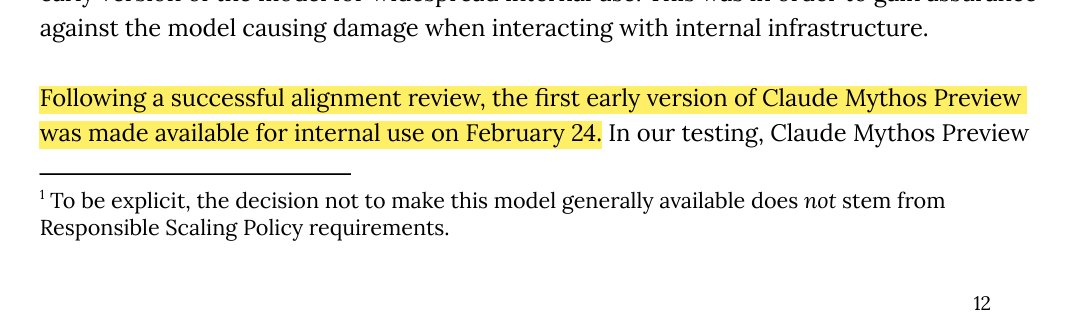
Anthropic Had Mythos Internally Since February 2024
By
–
ANTHROPIC HAD MYTHOS INTERNALLY SINCE FEB 24
-
AI models performing real-world professional tasks
By
–
Also note that ex-chatbot these things can do Real Work (TM) which doesn't look like systems engineering and you can check that Real Work (TM) in the typical ways that one checks Real Work (TM). They can compile a balance sheet from source documents.
-
Local AI Models for Everyone: OpenClaw Adds Inferrs Support
By
–
We absolutely LOVE local models. Have been talking about this for years, it is my favorite thing. Most people cannot afford luxury AI tokens. Yet, everyone on earth should have a personal AI. The only way that this happens for EVERYONE ON EARTH is with amazing local models. Peter Steinberger 🦞 (@steipete) Some folks try to spin a narrative that I don't like local models, meanwhile I spent a lot of time making it easy to use OpenClaw with them. Latest release adds support for inferrs, which is a new super efficient TurboQuant inference server: docs.openclaw.ai/providers/i… — https://nitter.net/steipete/status/2041935840935371034#m
-
Expert adoption and risk management of LLMs in professional domains
By
–
I think better calibrated experts use LLMs in e.g. adjacencies to their professional domain fairly pervasively these days, accepting some risk of a hallucination based on e.g. cost of checking evidentiary trail, how important that output is and where it is exposed, etc.