Define reward functions In GRPO we use deterministic functions to validate the response and assign a reward. No manual labelling required! The reward functions: – Match format exactly
– Match format approximately
– Check the answer
– Check numbers Check this out
LLMS
-
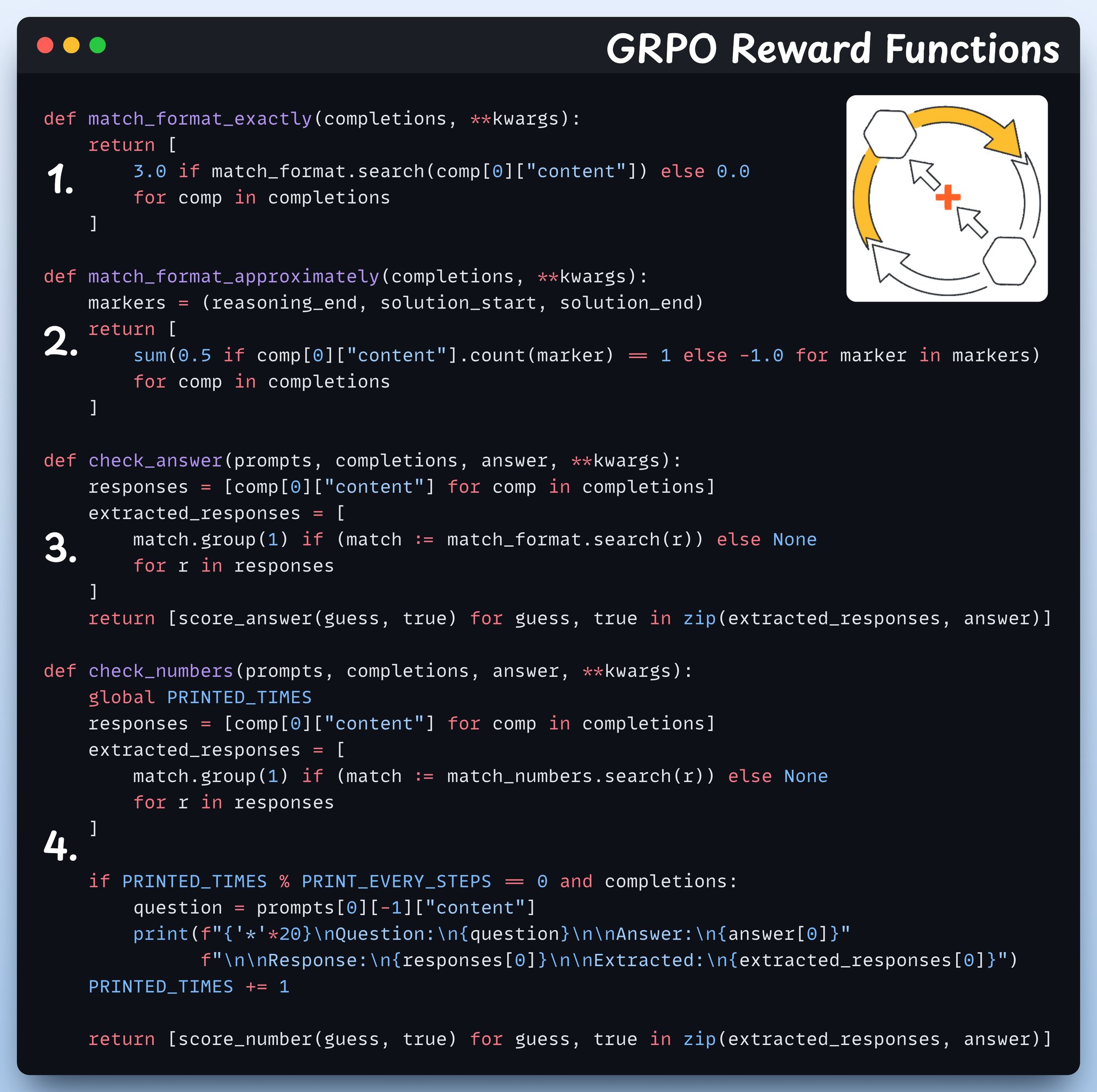
GRPO Reward Functions: Format Matching and Answer Validation
By
–
-
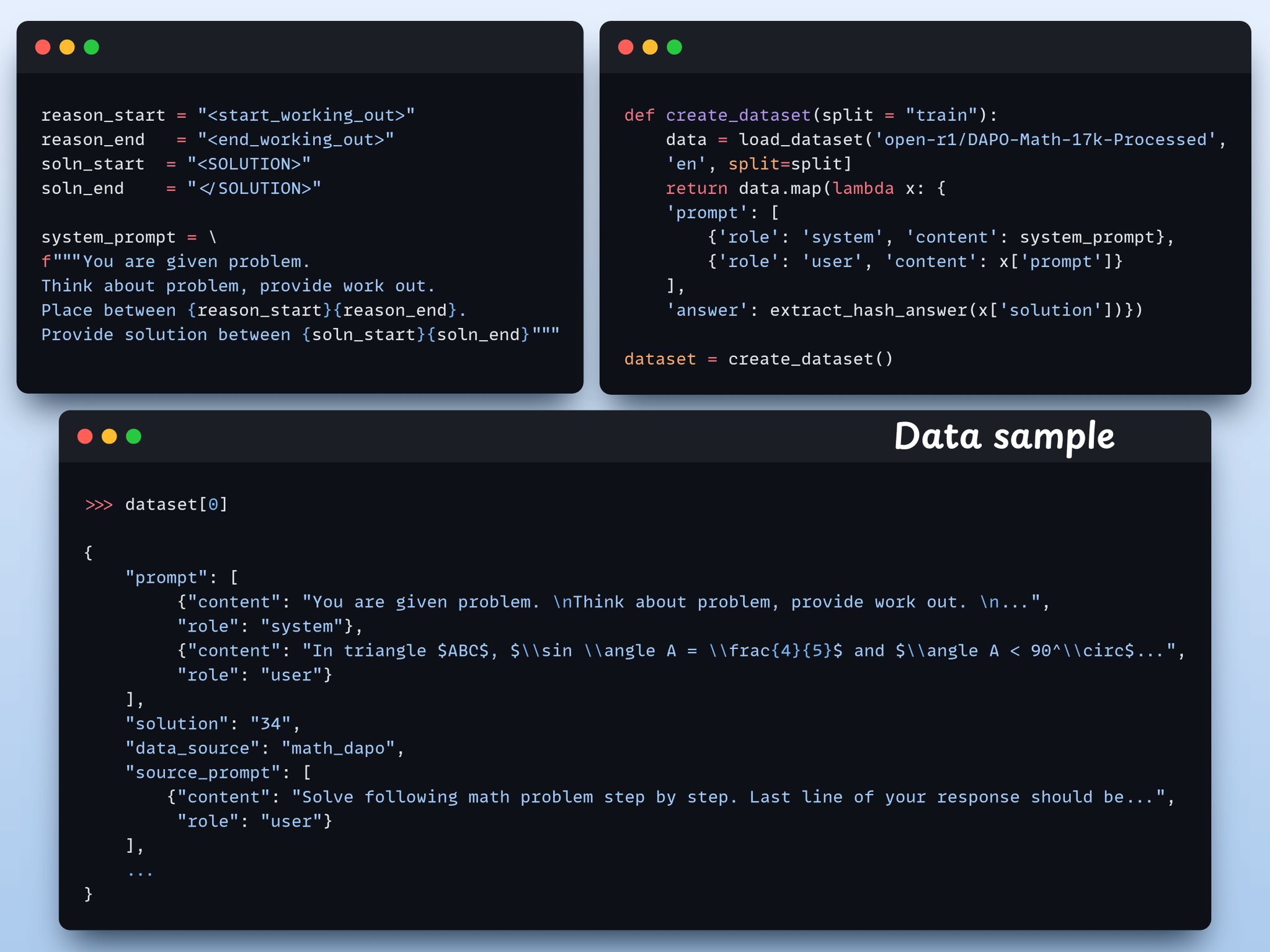
Formatting Open R1 Math Dataset for Reasoning Training
By
–
Create the dataset We load Open R1 Math dataset (a math problem dataset) and format it for reasoning. Each sample includes:
– A system prompt enforcing structured reasoning
– A question from the dataset
– The answer in the required format Check this code -
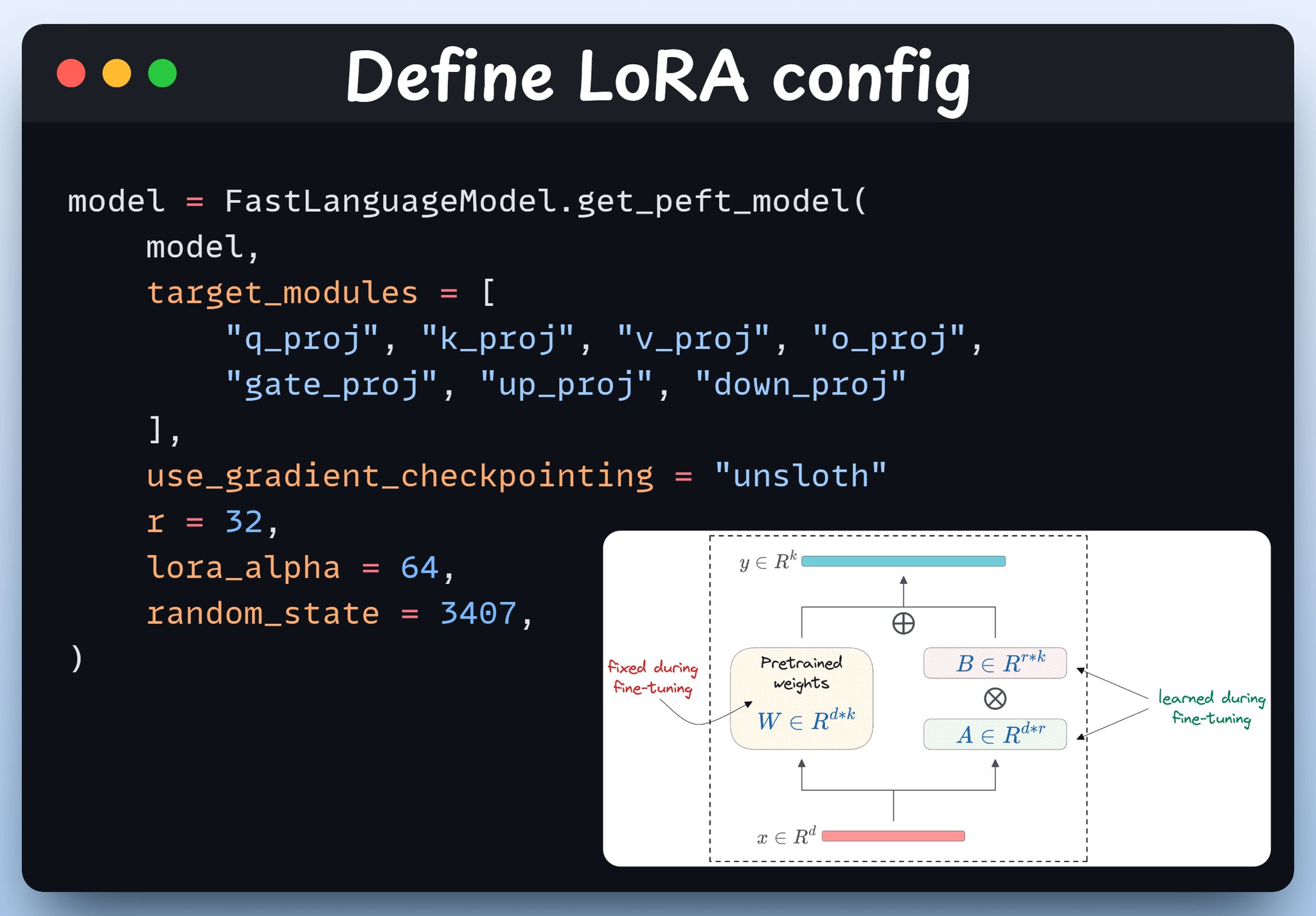
Configuring LoRA for Fine-Tuning with Unsloth PEFT
By
–
Define LoRA config We'll use LoRA to avoid fine-tuning the entire model weights. In this code, we use Unsloth's PEFT by specifying: – The model
– LoRA low-rank (r)
– Modules for fine-tuning, etc. Check this -
GRPO: Reinforcement Learning Method for Fine-Tuning LLMs Explained
By
–
What is GRPO?
— Akshay 🚀 (@akshay_pachaar) 2 mai 2026
Group Relative Policy Optimization is a reinforcement learning method that fine-tunes LLMs for math and reasoning tasks using deterministic reward functions, eliminating the need for labeled data.
Here's a brief overview of GRPO before we jump into code: pic.twitter.com/EX8hI5eEAIWhat is GRPO? Group Relative Policy Optimization is a reinforcement learning method that fine-tunes LLMs for math and reasoning tasks using deterministic reward functions, eliminating the need for labeled data. Here's a brief overview of GRPO before we jump into code:
-
Building a Reasoning Model Without Manual Labels Using Verifiable Outputs
By
–
When outputs are verifiable, labels become optional.
— Akshay 🚀 (@akshay_pachaar) 2 mai 2026
Maths, code, and logic can be automatically checked and validated.
Let's use this fact to build a reasoning model without manual labelling.
We'll use:
– @UnslothAI for parameter-efficient finetuning.
– @HuggingFace TRL to… pic.twitter.com/0FVo2aKfSUWhen outputs are verifiable, labels become optional. Maths, code, and logic can be automatically checked and validated. Let's use this fact to build a reasoning model without manual labelling. We'll use: – @UnslothAI for parameter-efficient finetuning.
– @HuggingFace TRL to -
Fine-Tuning Alone Won’t Make LLMs Better at Math Reasoning
By
–
You're in a Research Scientist interview at Google. Interviewer: We have a base LLM that's terrible at maths. How would you turn it into a maths & reasoning powerhouse? You: I'll get some problems labeled and fine-tune the model. Interview over. Here's what you missed:
-
OpenAI Rumored to Launch More Natural Voice Model
By
–
A new voice model from OpenAI confirmed? Rumor has it that it will be significantly more natural in conversation with the user (latency, interruption).
-

API Cost Math Behind AI Agents Using DeepSeek Tokens
By
–


Let's look at the API math behind AI agents. Someone just ran 831,962,136 tokens through DeepSeek for only $10.57. When building tools like OpenCode, output tokens dictate your burn rate because the agent must constantly re-read your codebase. If we migrate those 831.9M
-
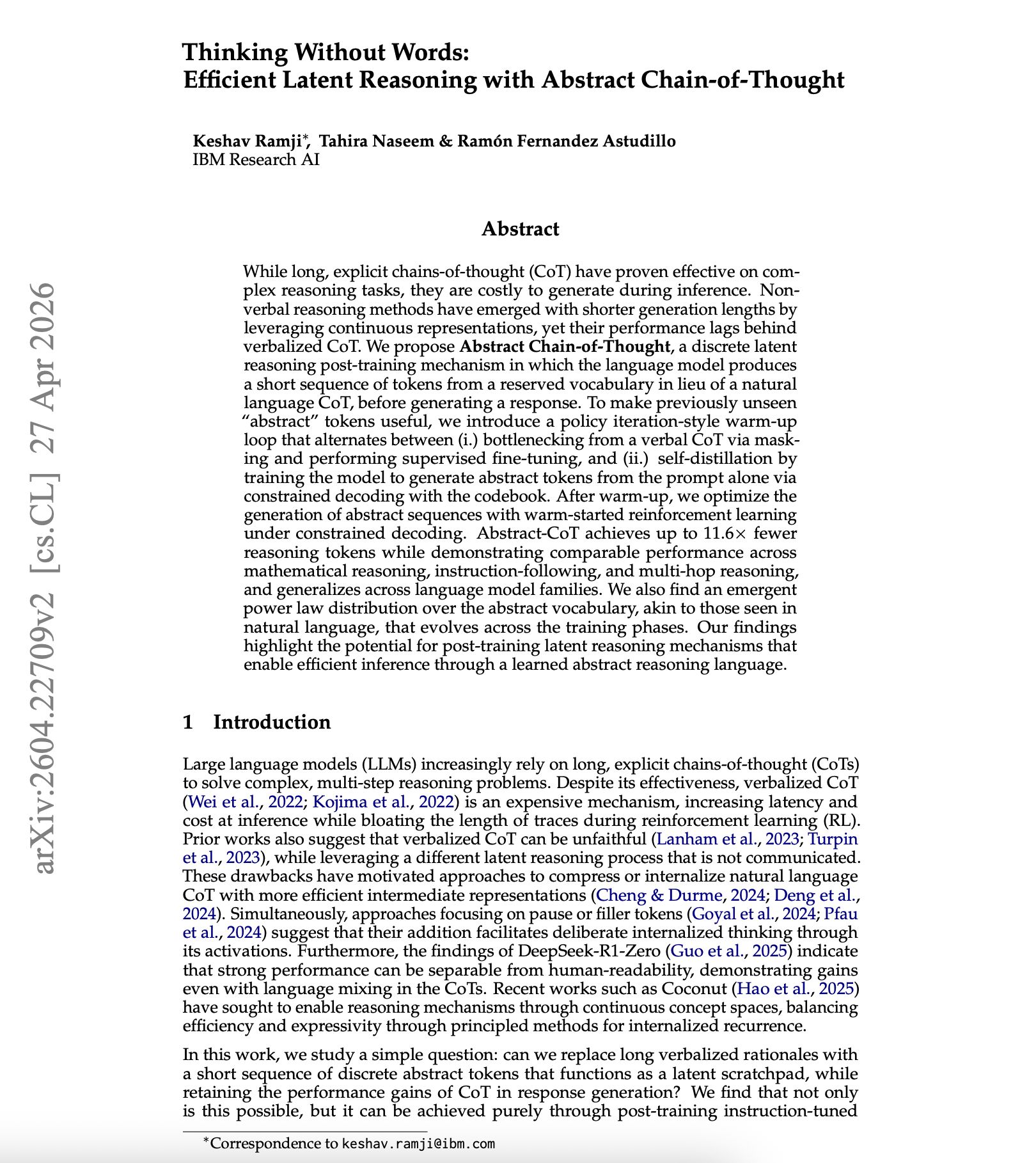
Abstract Chain-of-Thought Enables AI to Reason 12x Faster
By
–
Researchers just taught AI to think 12x faster without using words. Reasoning chains are powerful but expensive. Every token a model "thinks" costs time and money. A new paper called Abstract Chain-of-Thought proposes a fix. Instead of reasoning in full sentences, the model
-
Claude Code Three-Layer Memory System Explained
By
–
Claude Code doesn't dump everything into your context window. It uses a three-layer memory system that keeps it coherent across sessions lasting days.
— Louis-François Bouchard 🎥🤖 (@Whats_AI) 2 mai 2026
Layer 1 is a lightweight index, always in context. Layer 2 is topic files, loaded only when needed. Layer 3 is full session… pic.twitter.com/3udnaP1x9MClaude Code doesn't dump everything into your context window. It uses a three-layer memory system that keeps it coherent across sessions lasting days. Layer 1 is a lightweight index, always in context. Layer 2 is topic files, loaded only when needed. Layer 3 is full session