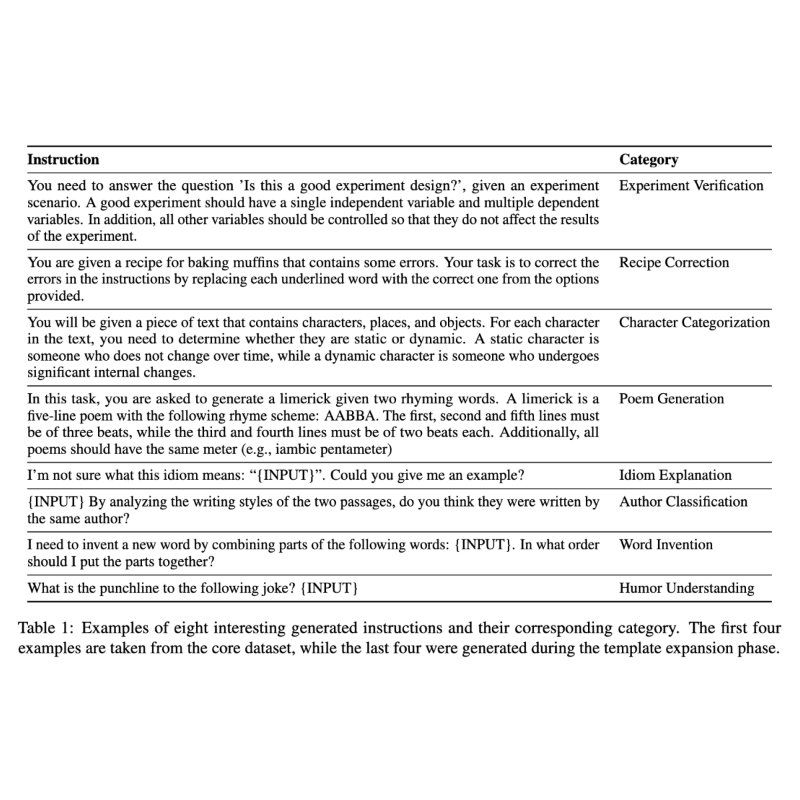
New paper — In ‘Unnatural Instructions’ we propose a new method to automatically generate natural language instructions, allowing us to scale up to 240K diverse instructions & train models that rival the performance of contemporary instruction-tuned models. Read on ArXiv
LLMS
-
Perplexity AI: Modern Wolfram Alpha with Language Interface
By
–
Yesterday, @amasad said @perplexity_ai gave him a similar search experience to Wolfram Alpha. The ability to go beyond just answers but also plots and visualize is a significant step to building the modern version of Wolfram with a language interface. https://t.co/n2oWvzUFHz
— Aravind Srinivas (@AravSrinivas) 20 décembre 2022Yesterday, @amasad said @perplexity_ai gave him a similar search experience to Wolfram Alpha. The ability to go beyond just answers but also plots and visualize is a significant step to building the modern version of Wolfram with a language interface.
-
LLMs Reliability Limitations and Twitter Indexing Accuracy
By
–
LLMs aren't yet 100% reliable, and our Twitter indexing isn't exhaustive. So Bird SQL may not be accurate on all queries.
— Perplexity (@perplexity_ai) 20 décembre 2022
Help us improve by sharing suggestions and feedback via Twitter, Discord (https://t.co/R4G21AmwQ7), support@perplexity.ai
Also seehttps://t.co/wgT9djadYnLLMs aren't yet 100% reliable, and our Twitter indexing isn't exhaustive. So Bird SQL may not be accurate on all queries. Help us improve by sharing suggestions and feedback via Twitter, Discord (
https://
discord.com/invite/kWJZsxP
DuX
…), support@perplexity.ai Also see -

Bird SQL: Natural Language SQL Statistics and Plotting Tool
By
–
Bird SQL generates insightful statistics and plots directly from natural language with embedded code. Bird SQL is a step towards a modern Wolfram Alpha, powered by LLMs. “top 10 "technology brother" accounts bar plot” being led by @tszzl https://
perplexity.ai/sql?uuid=33a4f
ded-7437-450b-aee5-a7bd3f92e634
… -

LangChain Enables Selective LLM Caching Control
By
–
Caching improvements Previously, caching was enabled for either all LLMs or None But @devonbrackbill pointed out you may want to turn off caching for certain LLM calls – eg in recursive summarization This is now possible Docs: https://
langchain.readthedocs.io/en/latest/exam
ples/prompts/llm_caching.html
… -
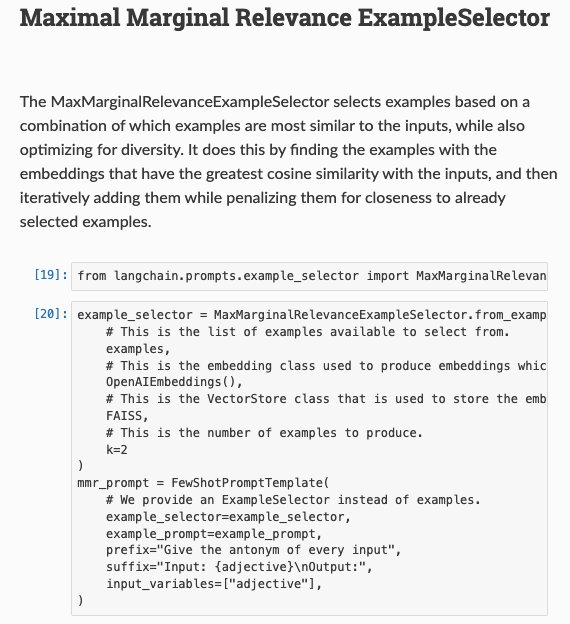
MMR Example Selector for Optimal Contextual Diversity
By
–
Max Marginal Relevance (MMR) Example Selector Based on this preprint by @xiye_nlp et al, the MMR example selector chooses diverse, in-context examples H/t @johnjnay for surfacing this paper Docs: https://langchain.readthedocs.io/en/latest/examples/prompts/prompt_management.html Original Paper: https://x.com/xiye_nlp/status/1603821850592628738?s=20&t=wQPcRd8IJ8URbmytuYP7QA
-
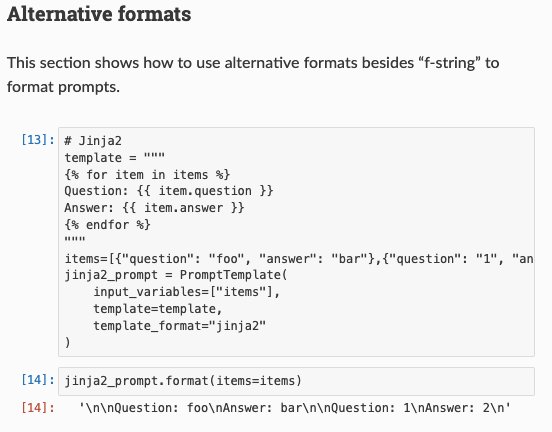
LangChain Extends Prompt Formatting with Jinja Support
By
–
Jinja Formatting Up until now, all the formatting in prompts has been done using Python f-strings But the template_format abstraction is pretty flexible, and @benderville easily extended it to support Jinja, a more advanced formatter Docs: https://
langchain.readthedocs.io/en/latest/exam
ples/prompts/prompt_management.html#Alternative-formats
… -
LangChain v0.0.42 Release: Documentation, Formatting, and Caching Updates
By
–
LangChain v0.0.42 Doc fixes by @YouSearchEngine team, @_abi_ Jinja formatting – @benderville Max Marginal Relevance example selector (based on paper by @xiye_nlp Caching improvements (h/t @devonbrackbill for idea) These are sneaky some awesome updates, lets
-
Gradient Backpropagation and Frequent Word Prioritization in Training
By
–
Because we sum, the gradients for each token get backpropagated to all the rows that were used for it. So with enough training, the model ends up at a good compromise. Frequent words are naturally prioritised in this, because they'll simply have more gradients.
-
Hashing Unknown Words to Shared Vector Rows for Rare Words
By
–
Imagine we gave the unknowns the last 100 rows instead. When we see an unknown word, we'll hash its word form, and mod the result to pick a row for it. Each unknown word will share its vector with lots of others, but its vector-mates are probably rare.