The Generative AI ecosystem is evolving into a full tech stack — powering autonomous AI agents.
From infrastructure and LLMs to RAG pipelines, agent behaviors and orchestration layers, this framework shows the 6 layers driving next-gen AI systems. Credit: @goyalshalini #AI
LLMS
-

Generative AI Tech Stack Framework for Autonomous Agents
By
–
-
Specialized vs. Generalist AI Models: Why Specialization Wins
By
–
Here's the thing about specialized AI. It's faster. It's better. It doesn't try to be good at everything. While everyone's building wrappers on general models, they built something that actually works for the one job it was designed to do. Specialist beats generalist when the
-
Raven v3 AI Agent Capabilities and Conversational Experience
By
–
Raven v3 doesn't pause awkwardly. Doesn't give you three paragraphs when you need a simple answer.
— God of Prompt (@godofprompt) 15 décembre 2025
It sounds like someone who actually gives a shit.
Books your reservation. Processes your payment. Checks your order status. fixes your account.
All while you're talking to it. pic.twitter.com/EokXukc59bRaven v3 doesn't pause awkwardly. Doesn't give you three paragraphs when you need a simple answer. It sounds like someone who actually gives a shit. Books your reservation. Processes your payment. Checks your order status. fixes your account. All while you're talking to it.
-
PolyAI’s outcome-based benchmark approach for AI models
By
–
Most AI companies test their models on generic benchmarks.
— God of Prompt (@godofprompt) 15 décembre 2025
"Can it code?" "Can it do math?" "Can it write an essay?"
PolyAI built their own test: did the customer's issue get resolved?
That's it. That's the whole benchmark.
And it's even trusted with suicide hotlines and… pic.twitter.com/wUR9Pk1DqRMost AI companies test their models on generic benchmarks. "Can it code?" "Can it do math?" "Can it write an essay?" PolyAI built their own test: did the customer's issue get resolved? That's it. That's the whole benchmark. And it's even trusted with suicide hotlines and
-
PolyAI develops Raven v3, a specialized model for customer service
By
–
PolyAI built their own model from scratch.
They called it Raven v3. Trained it on one thing only: 500,000 customer service phone calls. Not general intelligence. Specialized intelligence. It doesn't know how to write poetry or solve equations. It knows how to handle someone -
Enterprise-focused AI model for customer call automation
By
–
Everyone's prompting ChatGPT
— God of Prompt (@godofprompt) 15 décembre 2025
Meanwhile, there's an AI trained on 500,000 real customer calls. Not Reddit. Not Wikipedia.
It solves your problem in 45+ languages
Marriott, Caesars, FedEx all use it
Watch it switch languages 👇 pic.twitter.com/xFbyHgWanUEveryone's prompting ChatGPT Meanwhile, there's an AI trained on 500,000 real customer calls. Not Reddit. Not Wikipedia. It solves your problem in 45+ languages Marriott, Caesars, FedEx all use it Watch it switch languages
-

MIT’s DisCIPL: Steering Smaller LMs for Complex Problem-Solving
By
–
LMs can struggle w/open-ended tasks that have constraints, such as advanced puzzles & math proofs. MIT’s "DisCIPL" uses an LLM to steer smaller LMs to collaborate on these prompts. It achieves accuracy & efficiency comparable to much leading models: https://
bit.ly/4rLcYmi -
AI Technology C-Suite Actually Uses and Wants Next
By
–
The AI Technology The C-Suite Is Actually Using, And What They Want Next
#AI #AIio #AIInnovation #ML #DataScience #Futureofwork @lexfridman @sama @kaifulee @ID_AA_Carmack @karpathy @2morrowknight @ylecun http://
ow.ly/IsB330sRQtn -

Mixture-of-Agents Boosts Large Language Model Performance
By
–
Mixture-of-Agents Enhances Large Language Model Capabilities Wang et al.: https://
arxiv.org/abs/2406.04692 #ArtificialIntelligence #DeepLearning #MachineLearning -
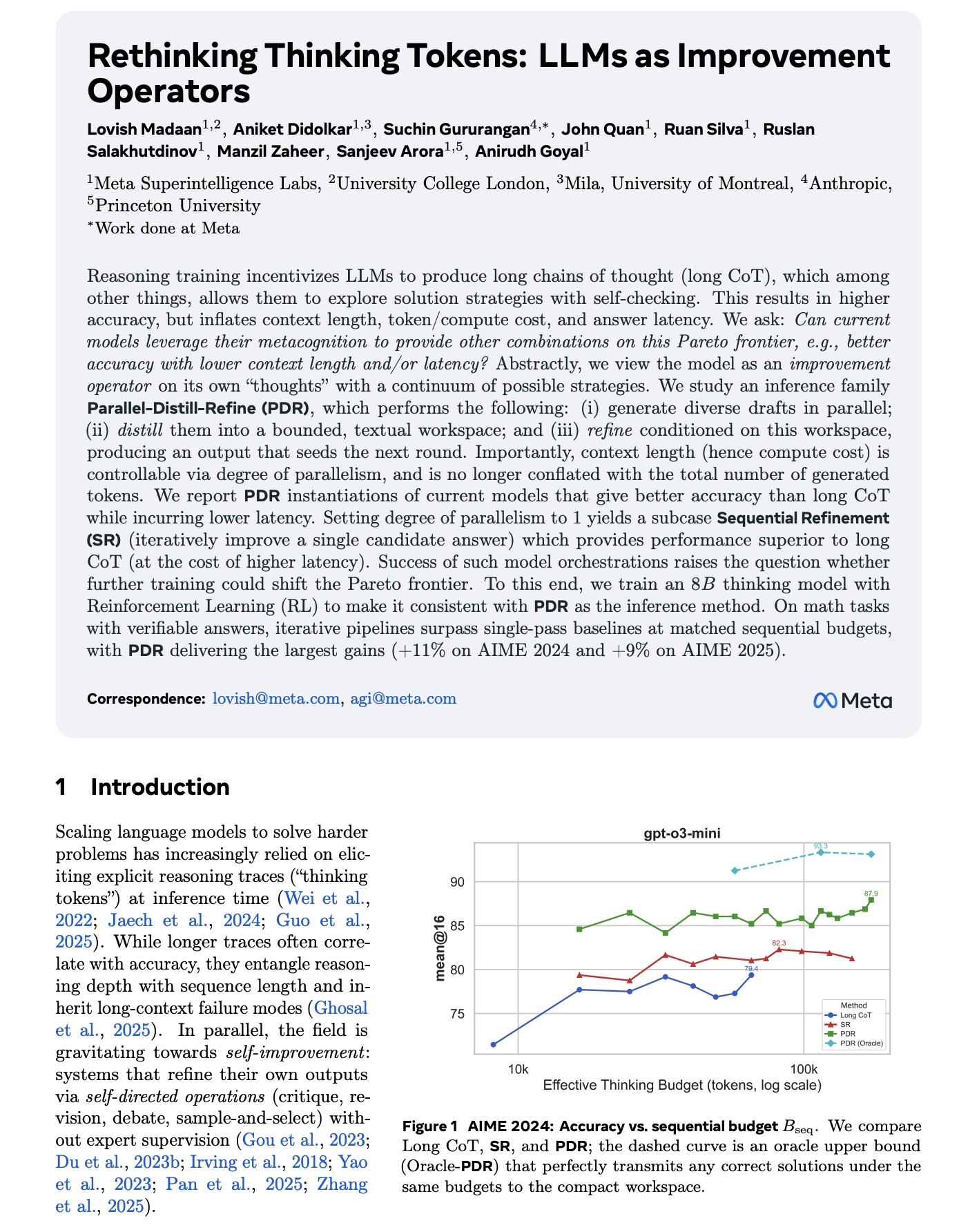
Meta Research Challenges Chain-of-Thought Reasoning Approach
By
–
NEW Research from Meta Superintelligence Labs and collaborators. The default approach to improving LLM reasoning today remains extending chain-of-thought sequences. Longer reasoning traces aren't always better. Longer traces conflate reasoning depth with sequence length and