Positive about where LLMs are going based on the last few weeks: – Amazing non-thinking model (Opus 4.5) – Impressive super long thinking model (GPT-5.2-xHigh) – Genuinely good smaller model (Gemini 3 Flash) Progress on all fronts!
LLMS
-
Technical Preview of Claude Task Mode Agent Workflow
By
–
BREAKING 🚨: Early look at Claude Task Mode agent workflow. What do we know so far?
— 🚨 AI News | TestingCatalog (@testingcatalog) 18 décembre 2025
– Claude Tasks will operate various Skills and MCPs to achieve the goal.
– Claude will ask clarifying questions before the execution or skip it after a timeout.
– Claude will generate an action… pic.twitter.com/JvKN9G8H2TBREAKING : Early look at Claude Task Mode agent workflow. What do we know so far? – Claude Tasks will operate various Skills and MCPs to achieve the goal.
– Claude will ask clarifying questions before the execution or skip it after a timeout. – Claude will generate an action -

Scaling Laws and Symmetry in Neural Networks Research
By
–
Scaling Laws and Symmetry The common belief is that scaling outperforms inductive biases. Give the model enough data and compute, and it will learn the structure on its own. But this new research finds the opposite. Researchers conducted comprehensive scaling experiments on
-

Optimizing ChatGPT Custom Instructions for Maximum Usefulness
By
–
I want my ChatGPT to be very useful for me, so over time, this is how I optimized the custom instructions: Be extremely accurate. Be brutally honest and call out misconceptions. No sycophancy. Tell me when I'm wrong. Think from first principles. Be encouraging. Take a
-
Prompt Engineering Over Model Scale in AI Performance
By
–
I've seen this turn mediocre responses into genuinely excellent analysis. The first pass might score 60% accuracy. After two rounds of adversarial revision? 85%+. The entire AI industry is about to realize that better prompting beats bigger models. This is just the beginning.
-
Understanding Probabilistic Response Generation in LLMs
By
–
The real breakthrough isn't the technique itself it's understanding why it works.
— God of Prompt (@godofprompt) 18 décembre 2025
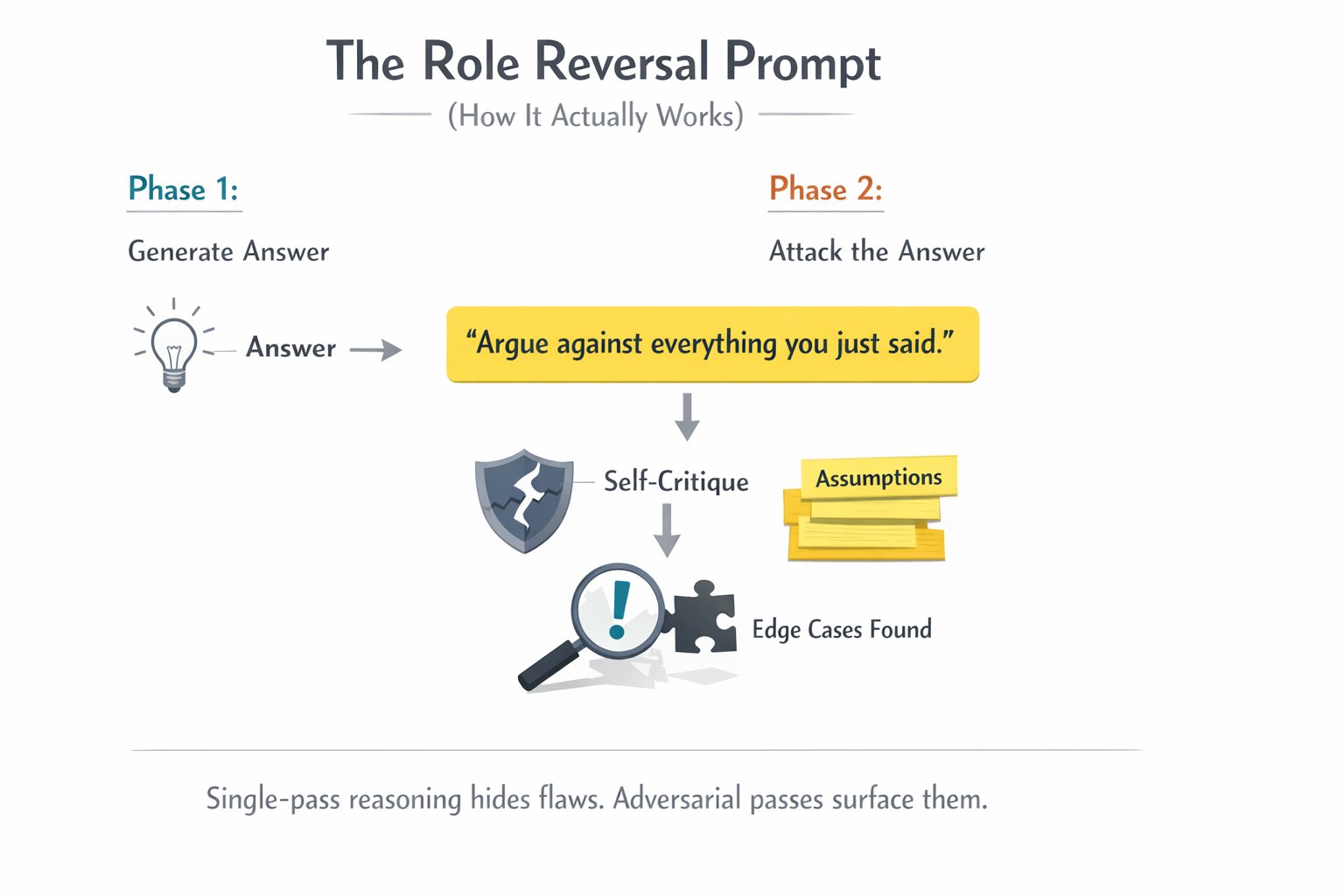
LLMs generate responses probabilistically. The first answer is just the highest-probability path through their training data. But "most probable" doesn't mean "most correct."
When you introduce… pic.twitter.com/6aANnq7UHNThe real breakthrough isn't the technique itself it's understanding why it works. LLMs generate responses probabilistically. The first answer is just the highest-probability path through their training data. But "most probable" doesn't mean "most correct." When you introduce
-
Improving AI Model Reasoning Through Adversarial Prompting Techniques
By
–
But here's where it gets insane. The technique doesn't just improve accuracy on the current problem. It actually teaches the model better reasoning patterns for future questions.
When you force devil's advocate mode repeatedly, the model starts internalizing that adversarial -
Improving AI Reasoning Through Self-Critique Techniques
By
–
I've tested this on coding problems, business strategy, research analysis anywhere logic matters.
— God of Prompt (@godofprompt) 18 décembre 2025
The self-critique consistently surfaces issues that would've caused failures downstream. It's like having a second expert review your work, except it's the same model thinking… pic.twitter.com/j4bO57iqSkI've tested this on coding problems, business strategy, research analysis anywhere logic matters. The self-critique consistently surfaces issues that would've caused failures downstream. It's like having a second expert review your work, except it's the same model thinking
-
Optimizing Prompt Structure for Model Performance
By
–
Listen, most people waste the technique by using it wrong. They ask for criticism but accept vague pushback. "This might not work in all cases" tells you nothing useful. You need the model to be brutally specific about what fails and why. The prompt structure matters: "Identify
-
A Simple Prompt Engineering Technique for Improving AI Reasoning
By
–
The technique is absurdly simple but nobody's talking about it. After the AI generates its initial response, you immediately hit it with: "Now argue against everything you just said. Find the weakest points in your logic." That's it. No complex prompt engineering. No