
2025 is the year of agents. Here’s why We’ve hit the ceiling of what pretraining alone can do (what many experts think, but not all!). Scaling laws are flattening. Benchmarks are plateauing. LLMs are great, but they still face two fundamental limitations: 1. LLMS are passive;
LLMS
-
Integrating LLMs into wearable AI devices
By
–
Imagine combining these with GPT-4o or Claude. Real-time, private, wearable intelligence? Wild potential.
-
CS Agent Outperforms LLM: Human Detection Through Writing Patterns
By
–
Five stars for the CS agent; had it sorted in less than a minute. And you know they’re not AI because an LLM would have matched speaking style and presence/absence of punctuation and capital letters.
-
Smart Web Search Chatbot with LangGraph and Azure OpenAI
By
–
Smart Web Search Chatbot Build a chatbot that combines LangGraph with Azure OpenAI, featuring Tavily-powered web search capabilities. Includes state management and conditional routing for seamless search integration. Check out the tutorial https://
medium.com/@akshay_raut/l
anggraph-with-azure-openai-b6d85c514acc
… -

Contexture Theory: Understanding Foundation Model Representation Learning
By
–
Contextures: The Mechanism of Representation Learning This work introduces contexture theory, a unified mathematical framework that explains what foundation models actually learn during pretraining and why these learned representations generalize to diverse downstream tasks.
-

WebThinker: Deep Research Agent for Large Reasoning Models
By
–
WebThinker: Empowering Large Reasoning Models with Deep Research Capability WebThinker is a deep research agent that enhances large reasoning models (LRMs) by enabling them to autonomously search the web, navigate pages, and write research reports in real time—overcoming the
-
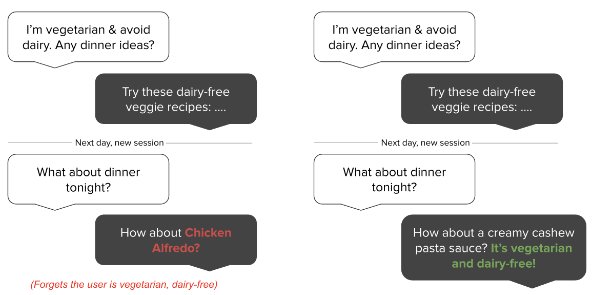
Mem0: Scalable Long-Term Memory for Production AI Agents
By
–
Mem0: Building Production-Ready AI Agents with Scalable Long-Term Memory The paper introduces Mem0, a scalable memory architecture for AI agents that enables long-term conversational coherence by dynamically extracting, consolidating, and retrieving salient information across
-
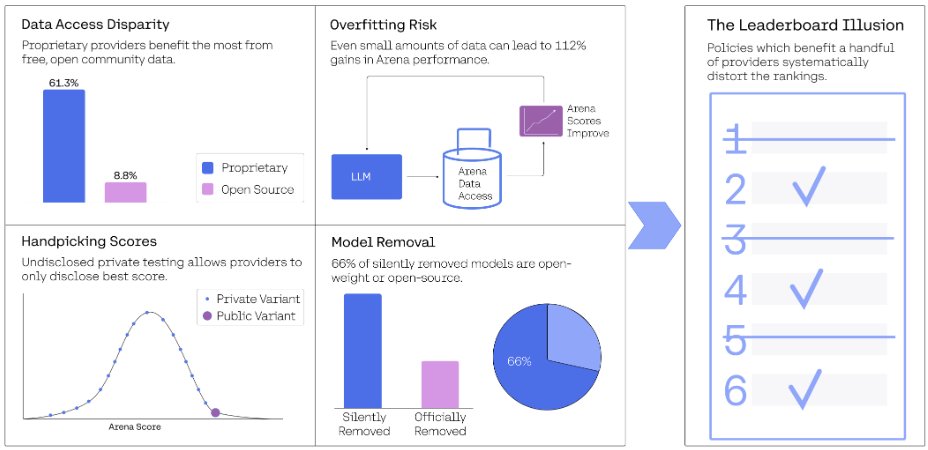
Chatbot Arena Leaderboard Biases Distort LLM Quality Perception
By
–
The Leaderboard Illusion This study investigates structural biases in Chatbot Arena, a widely used leaderboard for evaluating large language models (LLMs), revealing how selective testing practices and data access asymmetries distort perceptions of model quality. Problem: While
-
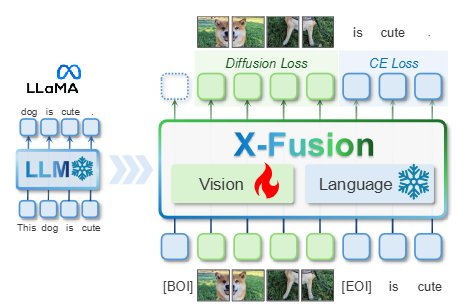
X-Fusion Adds Vision to Frozen Language Models
By
–
X-Fusion: Introducing New Modality to Frozen Large Language Models X-Fusion is a dual-tower framework that introduces vision capabilities to pretrained large language models (LLMs) without altering their language weights, enabling unified multimodal understanding and generation.
-
Reinforcement Learning Enhances LLM Mathematical Reasoning
By
–
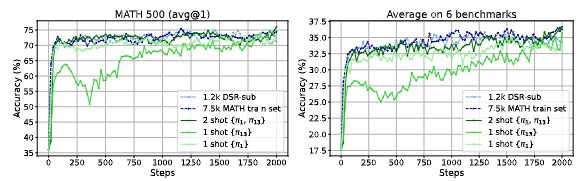
Reinforcement Learning for Reasoning in Large Language Models with One Training Example This paper demonstrates that Reinforcement Learning with Verifiable Reward (RLVR) using just one training example (1-shot RLVR) can significantly enhance the mathematical reasoning abilities