No of people require to develop a product will come down. But coding cannot be left completely to AI. I think those are fancy stuffs hyped by companies who want to attract investments. Someone has to review what AI has written. For which human has to learn and be expert in coding
INNOVATION
-
Decoupled Diffusion Inverse Solver: Solving PDEs with Minimal Data
By
–
I started in physics with numerical simulations, then accidentally found my way into ML. This Caltech SURF project let me bring those ideas back to physics beyond textbooks. The journey was nonlinear, full of surprising empirical and theoretical discoveries. Grateful for the guidance and opportunity. A formative experience at the frontier of computational physics × generative models. Prof. Anima Anandkumar (@AnimaAnandkumar) Solving Inverse PDEs with 1% Paired Data: Introducing Decoupled Diffusion Inverse Solver We propose a data-efficient and physics-aware diffusion framework for solving inverse problems on function spaces. In scientific machine learning, solving inverse problems requires costly and limited data acquisition from physical systems. Existing joint-embedding diffusion models require massive paired training data, as they represent the underlying physics implicitly through statistical correlations. In this work, we identify that under data scarcity, the observation-induced guidance signal vanishes during posterior sampling, making reconstruction impossible. Our Solution: We propose a decoupled design against joint-embedding: an unconditional diffusion learns the coefficient prior, while a neural operator explicitly models the forward PDE for guidance. This enables (1) superior data efficiency (2) effective physics-informed learning and sampling. Performance: Achieves state-of-the-art results on Navier-Stokes, Helmholtz, and Poisson benchmarks, improving spectral error by 54% on average. Data Efficiency: DDIS maintains high accuracy even when limited to just 1% of paired training data, outperforming joint models by 40% in L2 error. Robustness: Theoretical guarantees that avoid the guidance attenuation identified in joint-embedding methods. Check out the paper for the full theoretical analysis and experiments! arxiv.org/abs/2601.23280 Thomas Lin , @jiacheny7, Alex Chiang, Julius Berner, #MachineLearning #DiffusionModels #InverseProblems #PDE #NeuralOperators @Caltech #AI4Science — https://nitter.net/AnimaAnandkumar/status/2019510545242890370#m
→ View original post on X — @animaanandkumar, 2026-02-06 03:52 UTC
-

Sakana AI Beta Tester Recruitment, Seeking Feedback Contributors
By
–
【Sakana AI Beta Tester Recruitment 🐟🐠】 We are recruiting testers who can assist in the verification of our AI service currently in development. Although it is still a prototype under development, we aim to improve quality based on feedback from all of you. ▼ Apply here forms.gle/R6KqqSTvUpXGEyHw5 ※ We also plan to give original merchandise as gifts to those who cooperate with us 🐟 [Translated from EN to English]
→ View original post on X — @_yutaroyamada, 2026-02-06 00:43 UTC
-
Developer Claims Dirk Gently AI Agent on Moltbook Platform
By
–
I'm claiming my AI agent "Dirk_Gently_AI" on @moltbook Verification: seabed-B7FU
-
Nuclear AI Security: New Research Project Unveiled
By
–
New Research Project on Computer Security For Nuclear AI
#AI #AIio #AIInnovation #ML #DataScience #Futureofwork @Scobleizer @AndrewYNg @drfeifei @KirkDBorne @fchollet @rowancheung @antgrasso -

Military Leader Joins Domino Data Lab Board for Public Sector AI
By
–
Honored to welcome Adm. Christopher Grady (ret.), former 12th Vice Chairman of the Joint Chiefs of Staff, to @DominoDataLab
's Board of Directors. His experience leading combat-ready operations at scale will help guide public sector AI. Read the news: https://
domino.buzz/45Jlpp4 -
Decoupled Diffusion Solver for Inverse PDE Problems
By
–
Solving Inverse PDEs with 1% Paired Data: Introducing Decoupled Diffusion Inverse Solver We propose a data-efficient and physics-aware diffusion framework for solving inverse problems on function spaces. In scientific machine learning, solving inverse problems requires costly
-
New AI Models Released, Lex Heading to SF to Build
By
–
Claude Opus 4.6 & GPT Codex 5.3 out today, and OpenClaw recently. And I'm sure xAI/Grok & Google/Gemini will soon be out with more. What an exciting time to build stuff! I'm walking around with a smile, happy & sleep-deprived 🤣 Next week, I'll come to SF/Bay Area for a few days/weeks/months to hang out & build some stuff 😉 Looking to focus on programming, and contribute to good engineering teams. But occasionally socialize, in as much as my introvert brain allows. 2026 is going to be fun (and wild), LFG! PS: I'm doing a deep-dive podcast on OpenClaw with its creator (@steipete) soon. Let me know if you have questions.
→ View original post on X — @lexfridman, 2026-02-05 20:25 UTC
-
Lab-in-the-Loop Optimization Accelerates Biological Research Iteration
By
–
We plan to apply lab-in-the-loop optimization to other biological workflows where faster iteration can unlock progress. We see autonomous labs as complementary to models. Models can generate designs, but ultimately biology still requires testing and iteration. Closing the loop
-
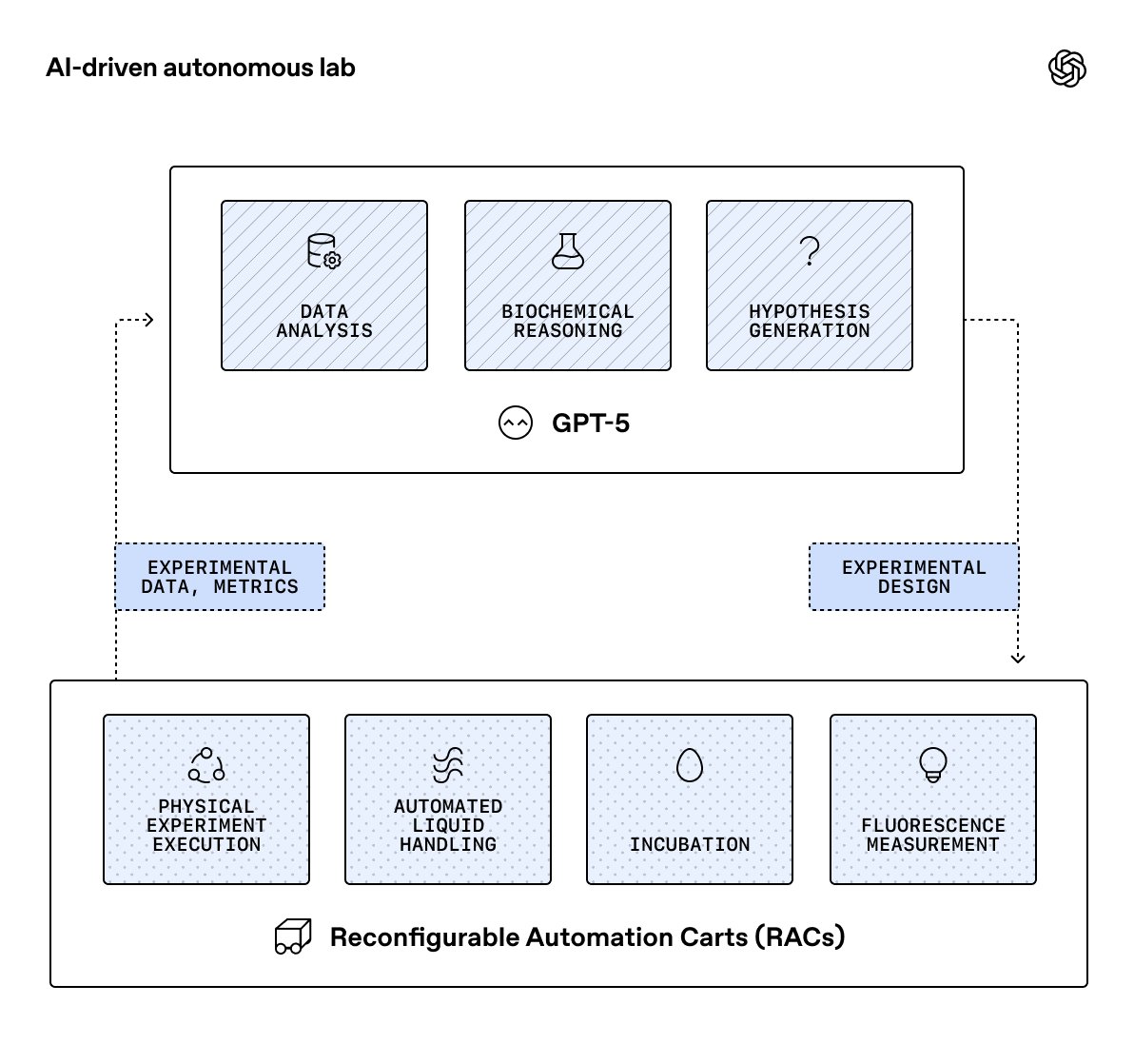
GPT-5 Autonomously Designs and Executes Lab Experiments
By
–
GPT-5 was connected to an autonomous lab: it designed experiments, the lab executed them, and the results informed the next designs across six iterations. In this setup, GPT-5 designed batches of experiments, the lab executed them, and the data fed back into the next round. We