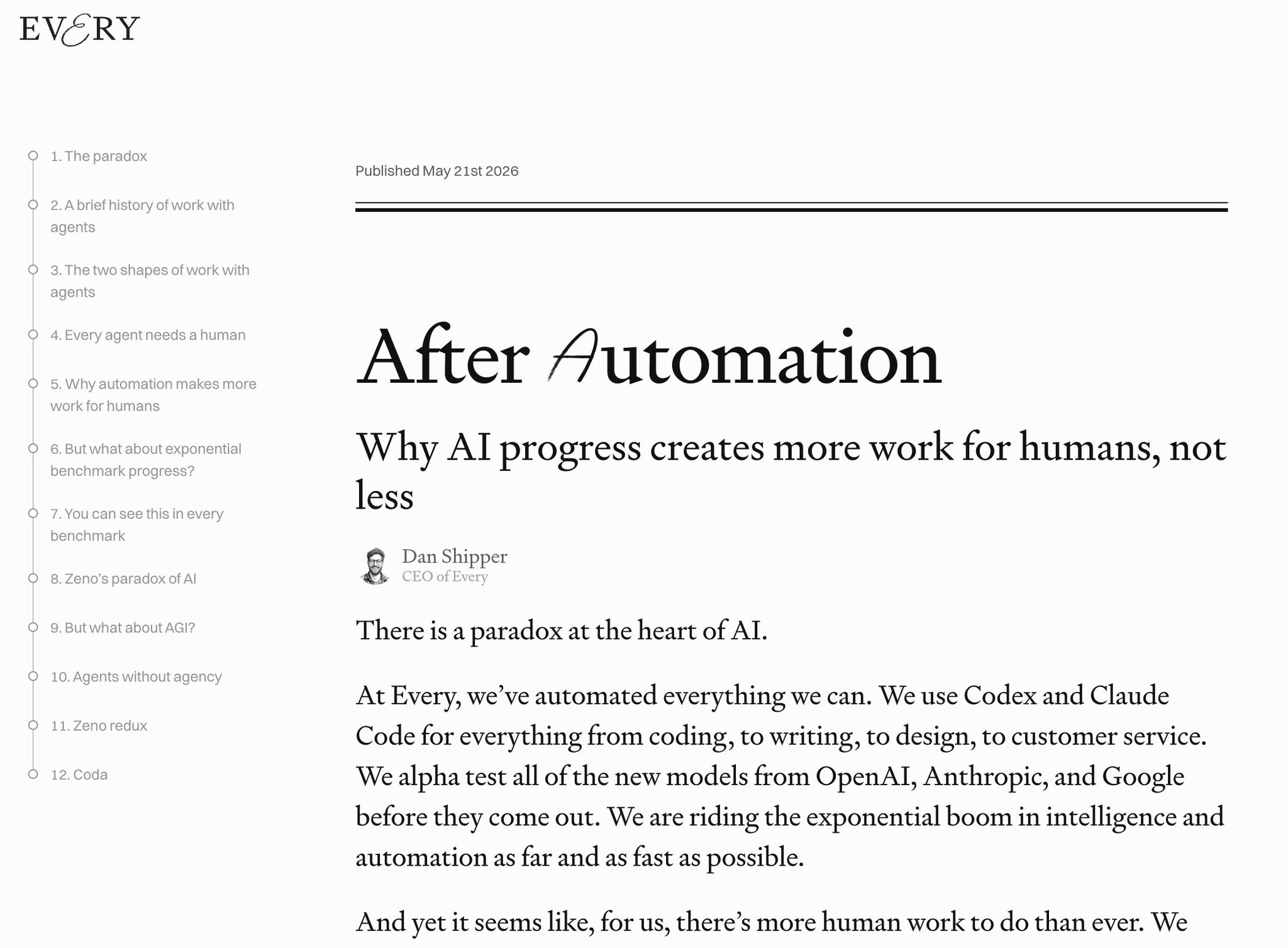
We’ve automated every single thing we could with AI agents. And yet, there’s way more human work to do than ever. We’ve grown from 4 to 30 human employees since GPT-3. I wrote a report on the structural reasons: how AI makes expert competence cheap and why that drives up demand.
INNOVATION
-
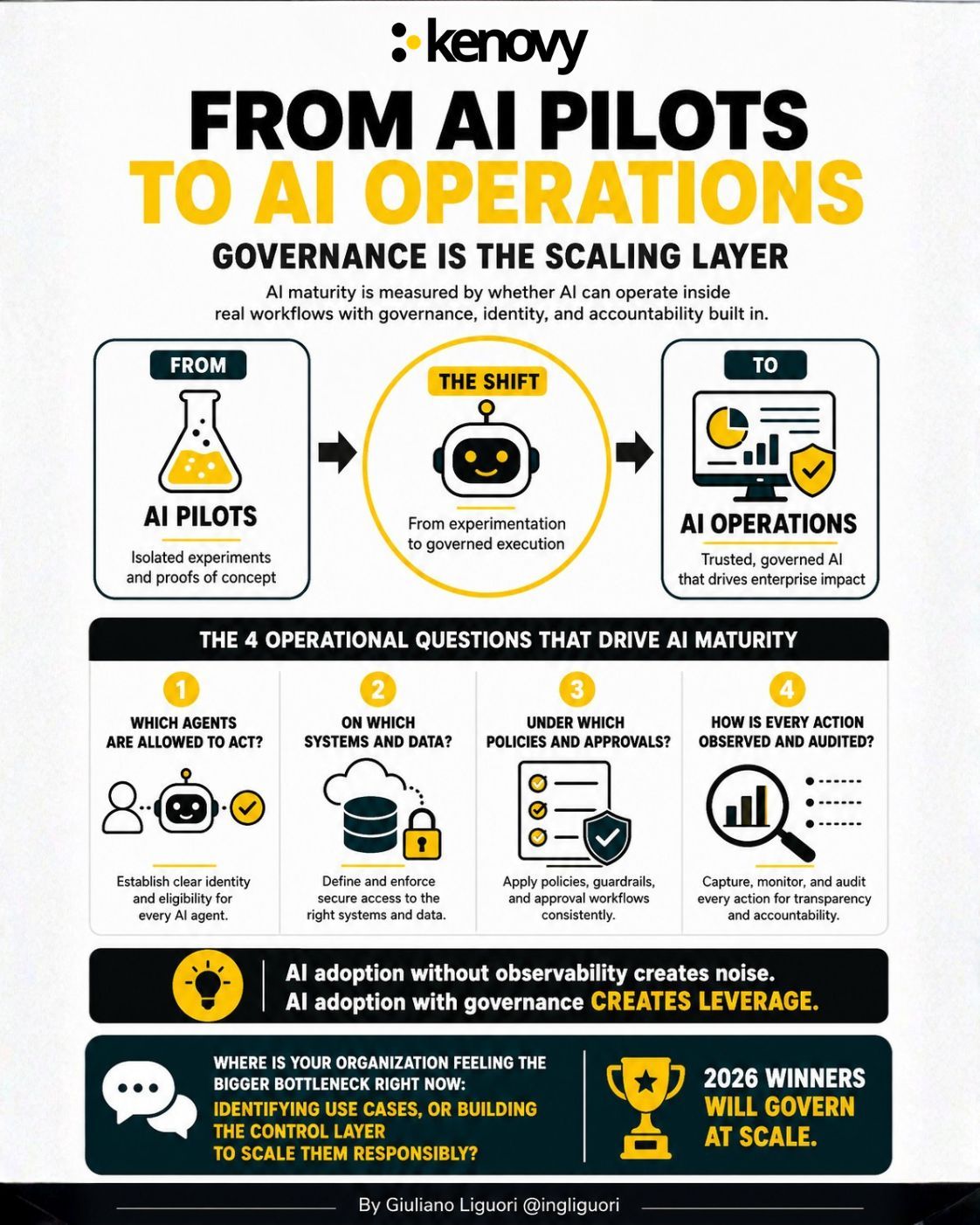
Scaling AI Operations Through Governance and Workflow Integration
By
–
AI maturity is no longer about how many copilots a company has deployed. It is about whether AI can operate inside real workflows with: Identity Policy Workflow Audit The market is moving from AI pilots to AI operations. Governance is the scaling layer. The key
-
Optimize Your AI Agents with the Right Context
By
–
This applies to any AI coding agent, not just Codex. Cursor, Claude Code, and Antigravity all follow the same approach. Stop asking it to write code from scratch. Provide it with the elements that help you focus on the problem you actually want to solve.
-
Building a news dashboard with KroWork’s thought process
By
–
1/ I finally tried building my own tool with KroWork to see if this "Chat-to-software" thing is as easy as they say.
— Chubby♨️ (@kimmonismus) 21 mai 2026
I asked the agent, Kro, for a news dashboard, and updating to the latest version lets you see the full KroWork thought process mapping out the system logic. It… pic.twitter.com/vC6LPMym2D1/ I finally tried building my own tool with KroWork to see if this "Chat-to-software" thing is as easy as they say. I asked the agent, Kro, for a news dashboard, and updating to the latest version lets you see the full KroWork thought process mapping out the system logic. It
-

Google TurboVec: Shrink Vector Embeddings from 31GB to 4GB
By
–
Google's new algorithm just shrunk 31GB of vectors into 4GB. Storing embeddings for RAG eats memory fast. Ten million documents in float32 takes 31 GB of RAM. A new open-source Rust vector index changes that math. TurboVec fits the same corpus into 4 GB. It runs on
-
Fixing trusted AI benchmark standards
By
–
feels like a real problem we as an ecosystem need to fix, how do you get deeply trusted and rigorous benchmarks, at the end of the day this is what researchers use to hill climb (plus live experiments)
-

DreamLite: ByteDance’s compact 0.39B model for fast image generation and editing
By
–
What if your phone could generate or edit images in under a second? ByteDance’s Intelligent Creation Lab presents DreamLite, a compact 0.39B parameter model that unifies text-to-image generation and editing in one network. It uses a simple trick: concatenating images
-
Gemini’s focus on real-world use cases
By
–
we are deeply focused on real world use cases for Gemini, its also exciting to see so many benchmarks get better at capturing these use cases
-
Frameworks and Prompts to Validate an AI MVP
By
–
7 prompts. 3 frameworks. One Perplexity deep research session. You go from "what should I build?" to validated MVP scope with a launch plan. Before writing a single line of code. I built these from Christensen's Jobs-to-Be-Done and Kim & Mauborgne's Blue Ocean Strategy. The
-
Apply JTBD Demand Detector to an AI Opportunity
By
–
Prompt 5: "The JTBD Demand Detector" "For the strongest opportunity you identified, apply
Clayton Christensen's Jobs-to-Be-Done framework. Research what 'job' the target user is actually hiring
a product to do. Not features. The underlying progress
they're trying to make.