What Is Tiny ML? A Simple Explanation For Anyone TinyML: Big Power in Small Devices! Explore the world of TinyML – machine learning on tiny, low-powered devices. From smart agriculture to wearable health tech, see how this innovation is revolutionizing AI applications.
HARDWARE
-
Ultra-Scale Parallelism Guide for Advanced AI Training
By
–
You can read a bit more in the "expert Parallelism" section in the Ultra-Scale Playbook: https://
huggingface.co/spaces/nanotro
n/ultrascale-playbook
… -
EgoMimic: Georgia Tech’s Framework for Humanoid Robot Development
By
–
Inspired by Project Aria and Ego-Exo4D from Meta FAIR, researchers at @GeorgiaTech developed EgoMimic, a new algorithmic framework that utilizes human data and robot data for humanoid robot development ➡️ https://t.co/tYZOVwgYYm pic.twitter.com/D0EHF58vZF
— AI at Meta (@AIatMeta) 25 février 2025Inspired by Project Aria and Ego-Exo4D from Meta FAIR, researchers at @GeorgiaTech developed EgoMimic, a new algorithmic framework that utilizes human data and robot data for humanoid robot development https://
go.fb.me/96j5ba -
Apple’s $500B US AI Infrastructure Investment Strategy Unveiled
By
–
Apple’s $500 billion investment in the U.S. over the next four years is the biggest story in AI and geopolitics right now. This is deliberate, massive push by @apple to build and own their entire AI infrastructure from the ground up: custom-designed chips, a new Houston
-
Ultra-Scale Playbook: Training Large Language Models GPU Clusters
By
–
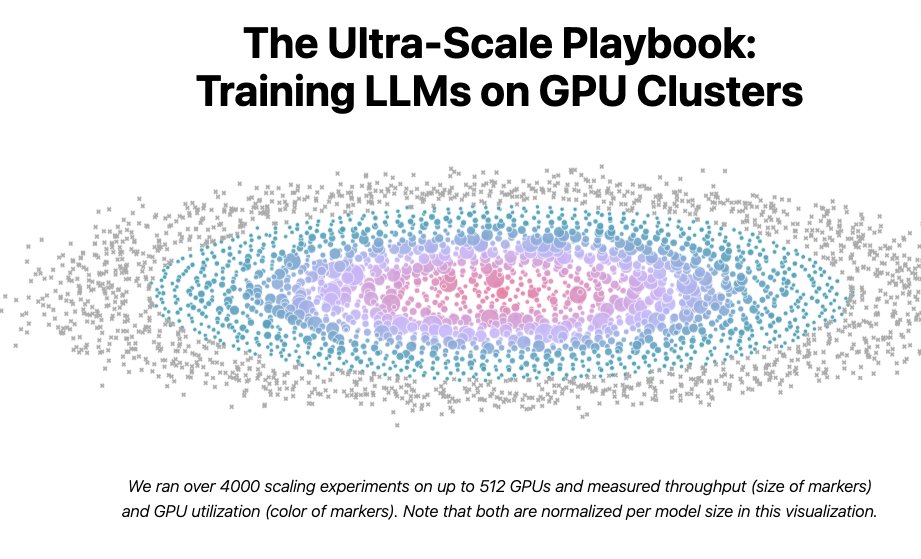
The Ultra-Scale Playbook: Training LLMs on GPU Clusters
-
Distributed Training Playbook: LLM Infrastructure Fundamentals and Benchmarks
By
–
Excellent playbook on the intricacies of distributed training. Covers basics of LLM training infra from the very ground-up, practicals/code, and efficiency benchmarks grounded on 4100 distributed experiments. Topics covered include:
– Data parallelism
– Tensor parallelism
– More -
CUDA through PyTorch sufficient for most training scenarios
By
–
Yes, I mean 99% of the time it's fine to just use CUDA through PyTorch (eager or compiled). If you train million-dollar-expensive LLMs, then maybe writing your own optimized CUDA kernels and custom NCCL would probably worthwhile so you can shave off some $$$ off your training
-
CUDA: NVIDIA GPU C++ Extension Behind PyTorch
By
–
CUDA is basically a C++ extension for NVIDIA GPUs. Basically what PyTorch uses under the hood.
-
Wafer-Scale Processors: Yield, Defect Tolerance Solutions
By
–
🟧 How do we achieve a usable yield with a wafer-scale processor?
— Cerebras (@cerebras) 21 février 2025
❓ How good is our defect tolerance vs. GPUs?
💡 How do we manage defect tolerance?
Sean Lie breaks down the answers for us. 📽️ ⬇️ pic.twitter.com/K33UZTSzXDHow do we achieve a usable yield with a wafer-scale processor? How good is our defect tolerance vs. GPUs? How do we manage defect tolerance? Sean Lie breaks down the answers for us.
-
CUDA Programming: Mindset Shift for Thread-Based Development
By
–
Fortunately, it's C-inspired. And I kind of know some CUDA basics but yeah, it's a bit of a mindset shift when working with threads I guess.