not really, the point of the guide isn't to sound like katie! it's to get as much information about making writing that sounds like katie—quite a different use case not all writing needs to sound like a human!
GENERATIVE AI
-
Self-Orchestrating AI Agents: The Next Major Breakthrough in LLM Performance
By
–
It’s happening: nitter.net/nousresearch/status/20… Matt Shumer (@mattshumer_) Agents that natively self-orchestrate, managing their own context, tools, and sub-agents, are the next big unlock in LLM performance. Right now, a skilled engineer building an optimized harness, with thoughtful data flow, separation of concerns, sub-agent management, etc., can make dramatic improvements over baseline for specific tasks. If a model could do this itself, that’d be a major step forward. You give it an objective and a set of tools, and it figures out the optimal way to orchestrate itself to do the task. For example, I’m building a very primitive AI scientist that I’ll open-source soon. Most of the work isn’t in the prompt, it’s in the harness… what the orchestrator sees, what sub‑agents see, what gets shared between them and when, where we summarize vs. pass raw data, and which tools each agent controls. Doing this allows me to dramatically improve what the model can do on its own. If a model can effectively design its own harness for a given problem, it’d be a huge step forward. My bet: self-orchestrating models… ones that manage their own context, tools, and sub-agents, will move the frontier almost as much as the jump from chatbot → reasoning did. Maybe more. — https://nitter.net/mattshumer_/status/1991942387145322715#m
→ View original post on X — @mattshumer_, 2026-03-19 21:48 UTC
-
M²RNN: Non-Linear RNNs with Matrix-Valued States for Language Modeling
By
–
Excited to share our latest work: M²RNN! We’ve revisited non-linear RNNs and found that expanding the hidden state to a matrix (Matrix-to-Matrix) significantly improves language modeling while the non-linear recurrence enables expressivity beyond TC⁰. Key highlights: – Efficient Scaling: Our expansion mechanism leverages. Tensor Cores for high-throughput training. – Better Long-Context Performance: Beats SOTA hybrid linear attention models by 8 points on LongBench. – Hybrid Models: Replacing just ONE layer in a hybrid stack gives massive gains with minimal overhead. This establishes non-linear RNNs as a primary building block for the next generation of LLMs. Mayank Mishra (@MayankMish98) Introducing M²RNN: Non-Linear RNNs with Matrix-Valued States for Scalable Language Modeling We bring back non-linear recurrence to language modeling and show it's been held back by small state sizes, not by non-linearity itself. 📄 Paper: arxiv.org/abs/2603.14360 💻 Code: github.com/open-lm-engine/lm… 🤗 Models: huggingface.co/collections/o… — https://nitter.net/MayankMish98/status/2034681226217595333#m
→ View original post on X — @berkeley_ai, 2026-03-19 21:41 UTC
-
AI struggles transferring coding knowledge across programming languages
By
–
Very reasonable! But isn't that kinda the point of this discussion? AI can't take what it knows about coding in languages with lots of data, and re-use it for coding in a different language effectively. Even if I add reference docs, examples, etc to prompt context.
-
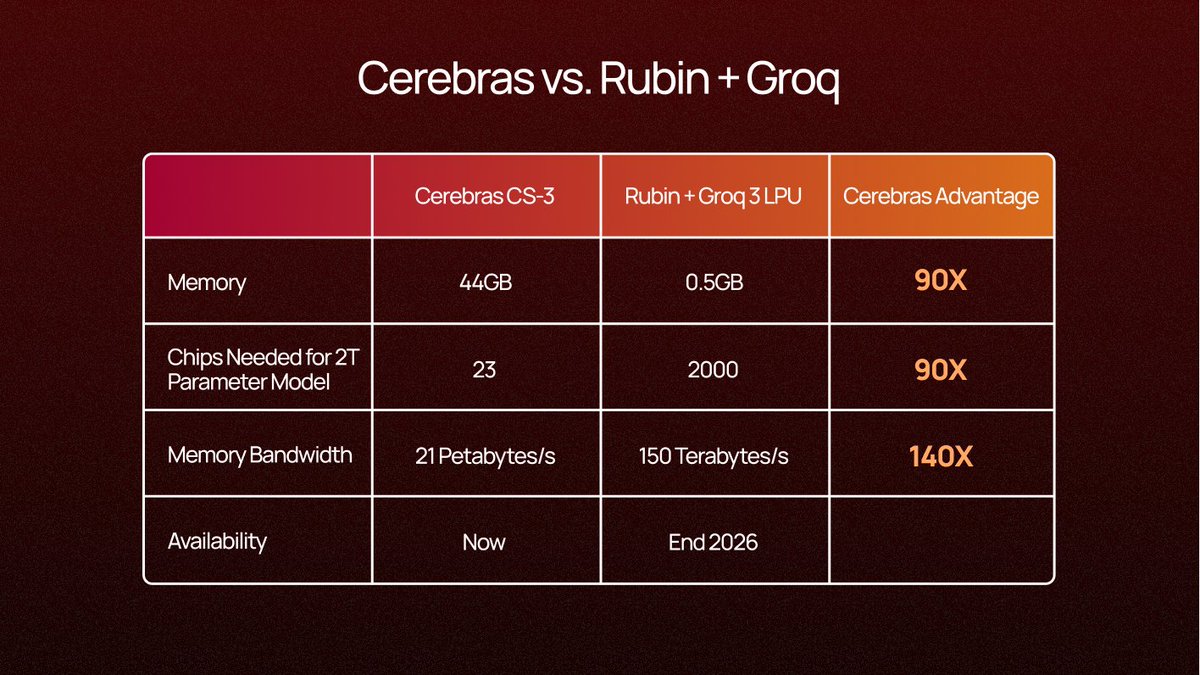
Cerebras Wafer Scale Advantage Over NVIDIA Groq Inference Chips
By
–
Problem solved. ✅ Andrew Feldman (@andrewdfeldman) NVIDIA's biggest GTC announcement was a $20 billion bet on the same problem we solved 6 years ago. Their next-gen inference chip – not available yet – has 140x less memory bandwidth than @cerebras. To run a single 2 trillion parameter model, you need 2,000+ Groq chips. On Cerebras, that's just over 20 wafers. Even paired with GPUs, Groq maxes out at ~1,000 tokens per second. We run at thousands of tokens per second today. And every day. In production now. Why? When you connect 2,000 chips together, every interconnect has latency. Every cable has overhead. It doesn't matter what your memory bandwidth is on paper if you're bottlenecked by the wiring between thousands of tiny chips. We solved this with wafer scale. One integrated system. Little interconnect tax. Jensen told the world that fast inference is where the value is. He’s right – it’s why the world’s leading AI companies and hyperscalers are choosing Cerebras. — https://nitter.net/andrewdfeldman/status/2034015373595672594#m
-
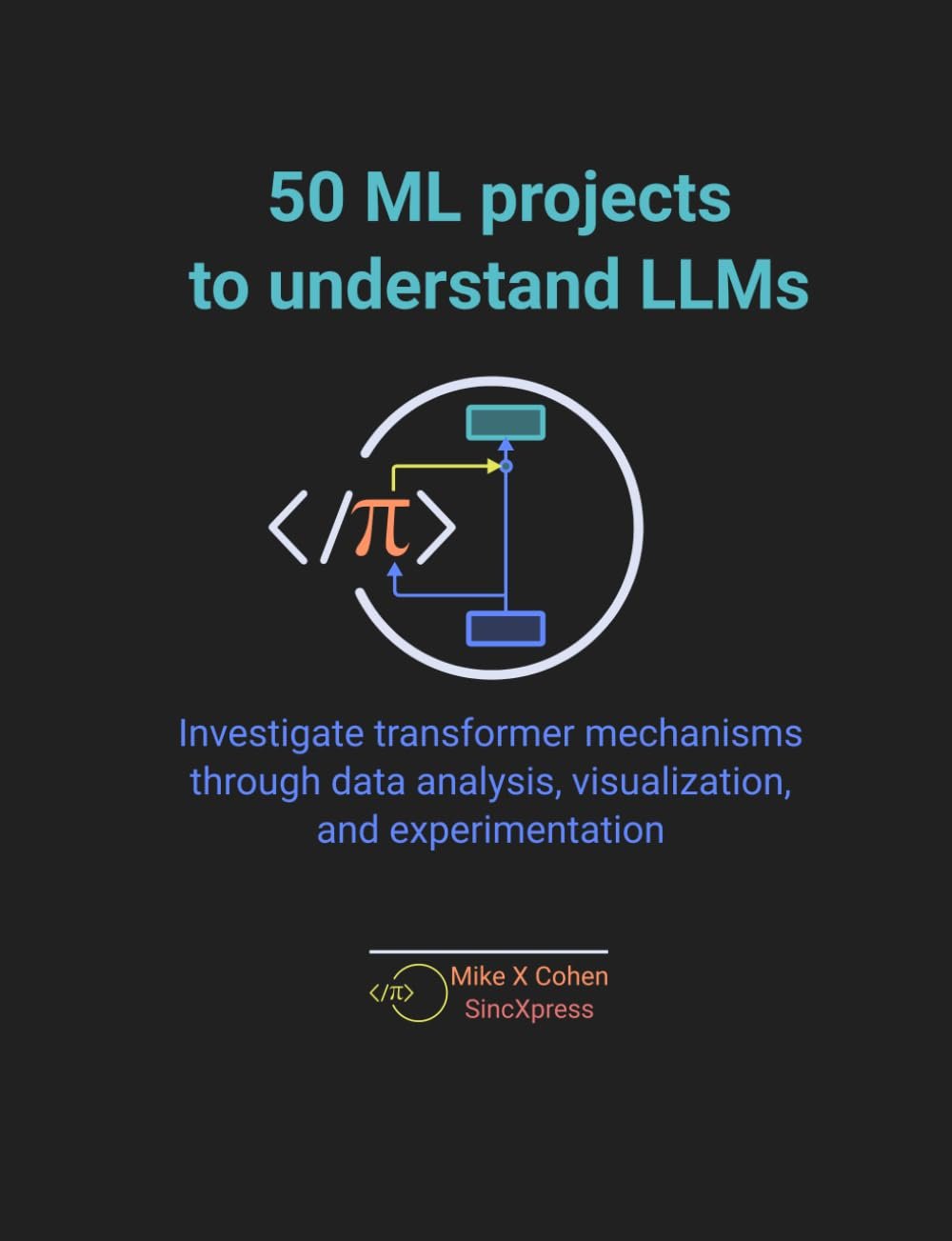
50 ML Projects to Understand LLMs and Transformer Mechanisms
By
–
50 ML projects to understand LLMs — Investigate transformer mechanisms through data analysis, visualization, and experimentation: http://
amzn.to/4aPfP7q
—————
#AI #GenAI #MachineLearning #DataScientist #DataScience -
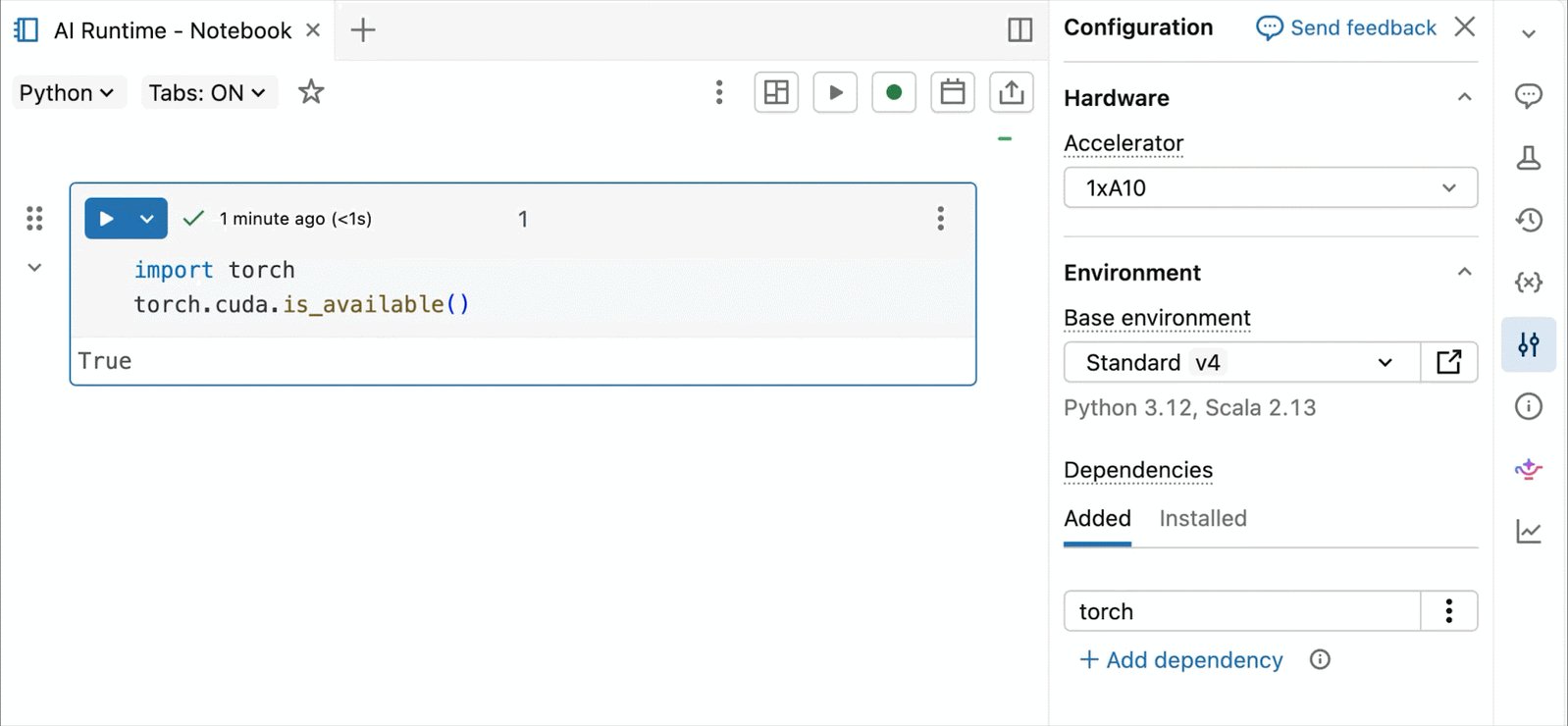
NVIDIA Launches AI Runtime with A10 H100 GPUs on Databricks
By
–
Today at #NVIDIAGTC, we’re introducing AI Runtime, with serverless NVIDIA A10 and H100 GPUs now available on Databricks for training and fine-tuning.
— Databricks (@databricks) 19 mars 2026
GPU infrastructure has been one of the biggest blockers for teams building advanced AI, from long procurement cycles to complex… pic.twitter.com/dWouC8G76vToday at #NVIDIAGTC, we’re introducing AI Runtime, with serverless NVIDIA A10 and H100 GPUs now available on Databricks for training and fine-tuning. GPU infrastructure has been one of the biggest blockers for teams building advanced AI, from long procurement cycles to complex
-
Platform dependency risk with proprietary AI APIs
By
–
The platform dependency risk is real. Same worry with any tool built entirely on top of someone else's API. I see myself a bit too dependent on anthropic these days with nothing working as well as cowork for some of my workflows.
-
Frontier AI Coding API Pricing at $0.50 per Million Tokens
By
–
$0.50/M input for frontier-level coding is next level for the cost side. Curious how it stacks up for longer multi-step tasks!