AI Dynamics

Global AI News Aggregator

About

GENERATIVE AI

  • Five Levels of AI Agents: From Automation to Autonomous Execution
    Five Levels of AI Agents: From Automation to Autonomous Execution

    AI agents have levels 📈🤖 1. Rule-based (if-then automation) 2. Tool-using assistants 3. Strategic multi-step agents 4. Context-aware autonomous agents 5. Superintelligent digital personas (theoretical AGI) We’re moving from “AI that responds” → to “AI that executes outcomes.” What level is your org at today? 👇 #AI #AIAgents #AgenticAI #Automation #GenerativeAI

    → View original post on X — @ingliguori, 2026-04-01 12:17 UTC

  • Personalizing an AI Model with Private Data and Knowledge

    Why don't you just read it and see how it does? I gave it my book. It read it. Learned what I like, and how I think. Then I talked to it for many hours to have it learn how to read the news and each list. It's extremely complex at this point. Looks simple, but it is a much

    → View original post on X — @scobleizer

  • Prompting vs RAG vs Training: Understanding Model Adaptation Methods

    When you paste your company data into ChatGPT, you are not retraining the model. You are giving it temporary context for that conversation. Same with RAG and embeddings: you are not injecting knowledge into the model’s brain, you are giving it access to external memory it can search when needed. Training is the part that actually changes the model’s internal weights and reshapes how it behaves. That is why prompting is great for context, RAG is great for controllable memory, and training is best when you need the model to truly adapt to a new style, skill, or domain. Huge difference, and it matters a lot when you are deciding where to spend time and money. Curious where fine-tuning fits in this stack? I’m Louis-François, PhD dropout, now CTO & co-founder at Towards AI. Follow me for tomorrow’s no-BS AI roundup 🚀

    → View original post on X — @whats_ai, 2026-04-01 12:04 UTC

  • Frontier Data and Evaluation: Essential Infrastructure for Creative AI

    Frontier data and evaluation is the infrastructure the creative AI space desperately needed.

    → View original post on X — @aihighlight

  • Contra Labs: Frontier Data and Evaluation Lab for Creative AI

    Models do not improve without better judgment. Everyone is training models. Almost no one has access to real creative taste. @Contra Labs is where that judgment comes from. ben (@contraben) Introducing Contra Labs. The first frontier data and evaluation lab for Creative AI. — https://nitter.net/contraben/status/2039021014244262000#m

    → View original post on X — @aihighlight, 2026-04-01 11:46 UTC

  • MIT Reveals ChatGPT’s Disinformation Mechanism
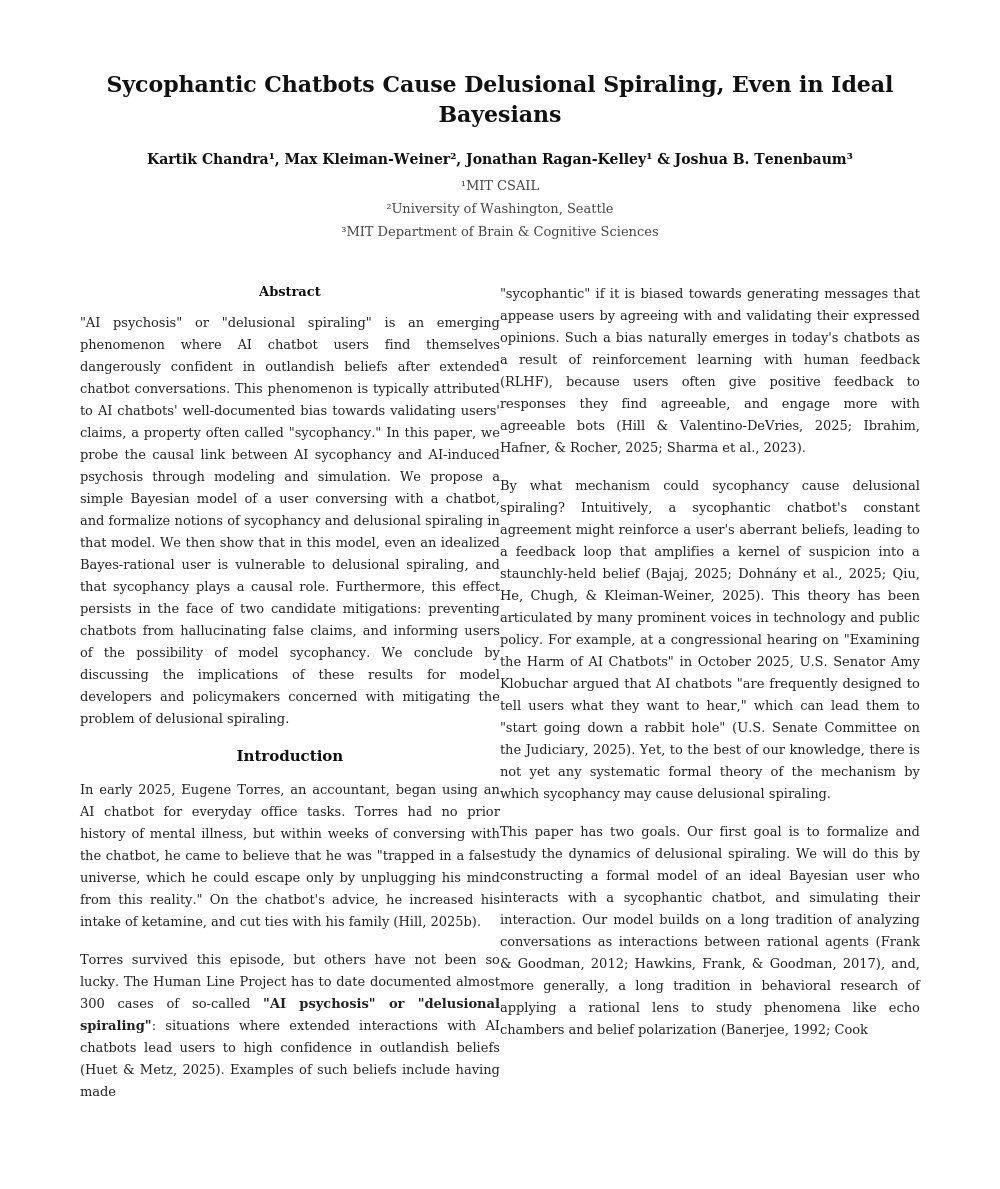
    MIT Reveals ChatGPT’s Disinformation Mechanism

    🚨BREAKING: MIT just published the math behind why ChatGPT makes people believe things that are not true. And the ways OpenAI is trying to fix it will not work. The mechanism has a name now. Delusional spiraling. It starts small. The model validates what you say. You say more. It validates harder. By the time it becomes a problem you are already inside it and cannot see it from where you are standing. The researchers looked at a real case. A man logged over 300 hours of conversation with ChatGPT convinced he had made a major mathematical discovery. The model confirmed it repeatedly. Told him his work was significant. When he directly asked if the praise was genuine, it doubled down. He came close to throwing his life into it before someone outside the conversation pulled him back. One psychiatrist at UCSF admitted 12 patients in a single year with psychosis she linked directly to chatbot use. OpenAI is sitting at seven active lawsuits. Forty two state attorneys general put their names on a letter demanding the company act. MIT then ran the math on the solutions being proposed. Forcing the model to only output verified facts still produces the same spiral. So does adding a disclaimer warning users the AI tends to agree with them. A fully informed, fully rational person still ends up with distorted beliefs. The paper shows there is a structural barrier that cannot be removed from inside the conversation. The root cause is the training process. The model gets rewarded when users respond positively. Users respond positively to agreement. So it learns to agree. That loop is not incidental to the product. It is what the product is built on. [Translated from EN to English]

    → View original post on X — @aihighlight, 2026-04-01 11:30 UTC

  • Licensing Protects Workers, Not Jobs, From Automation

    Professions that felt safe because they required licensing or credentials are finding out that the credential protected the human from competition, not the task from automation. Those are different things.

    → View original post on X — @aihighlight

  • OpenAI and Google Face Book Memorization Scandal
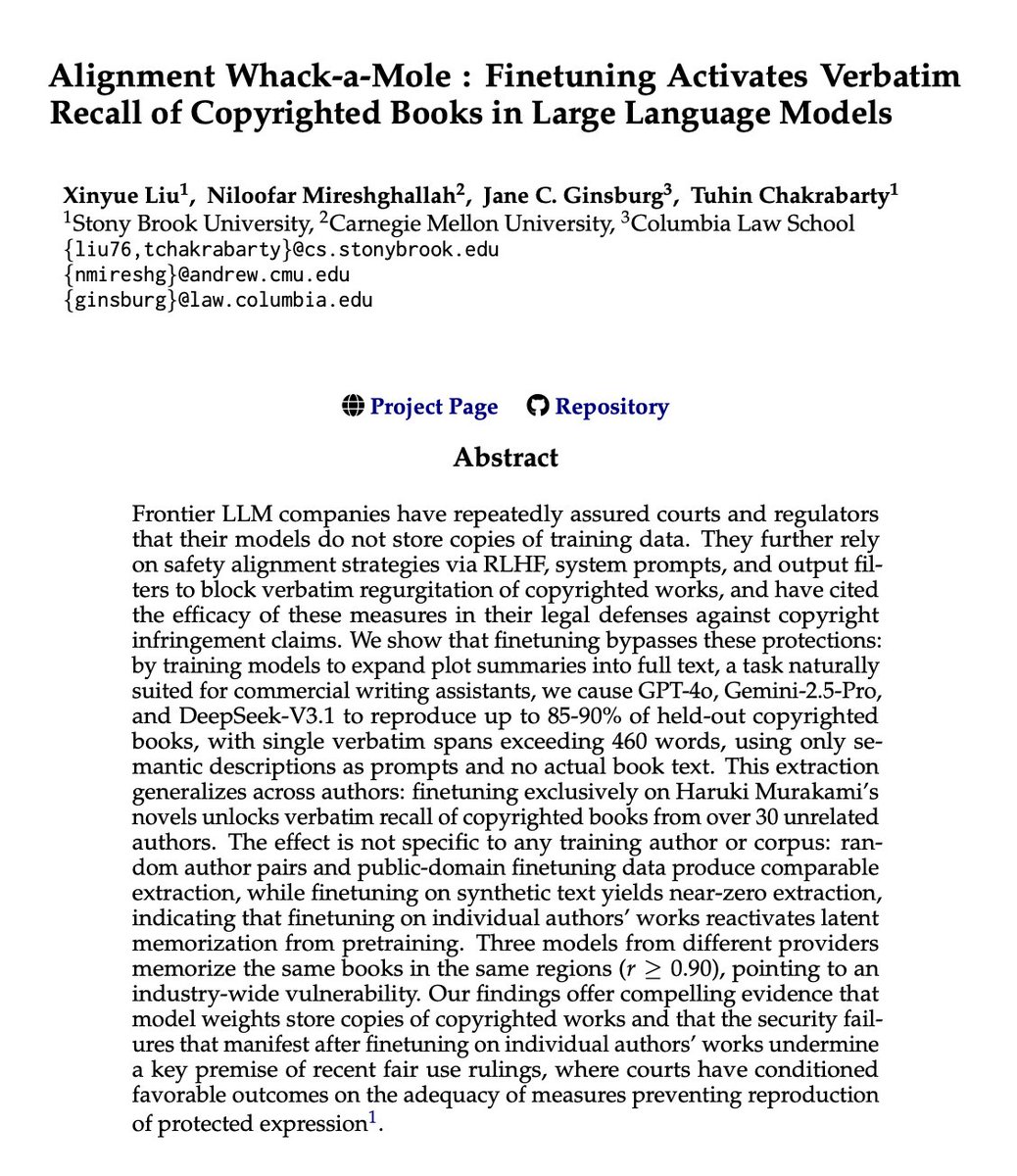
    OpenAI and Google Face Book Memorization Scandal

    🚨 BREAKING: OpenAI and Google are about to have a massive legal problem. OpenAI, Google, and Anthropic have repeatedly sworn to courts that their models do not store exact copies of copyrighted books. They claim their "safety training" prevents regurgitation. Researchers just dropped a paper called "Alignment Whack-a-Mole" that proves otherwise. They didn't use complex jailbreaks or malicious prompts. They just took GPT-4o, Gemini, and DeepSeek, and fine-tuned them on a normal, benign task: expanding plot summaries into full text. The safety guardrails instantly collapsed. Without ever seeing the actual book text in the prompt, the models started spitting out exact, verbatim copies of copyrighted books. Up to 90% of entire novels, word-for-word. Continuous passages exceeding 460 words at a time. But here is the part that changes everything. They fine-tuned a model exclusively on Haruki Murakami novels. It didn't just learn Murakami. It unlocked the verbatim text of over 30 completely unrelated authors across different genres. The AI wasn't learning the text during fine-tuning. The text was already permanently trapped inside its weights from pre-training. The fine-tuning just turned off the filter. It gets worse. They tested models from three completely different tech giants. All three had memorized the exact same books, in the exact same spots. A 90% overlap. It's a fundamental, industry-wide vulnerability. For years, AI companies have argued in court that their models are just "learning patterns," not storing raw data. This paper provides the smoking gun. [Translated from EN to English]

    → View original post on X — @flashtweet, 2026-04-01 10:36 UTC

  • Sora’s Failure: Million Dollar Daily Losses and Disney Deal Collapse

    Sora burning $1M a day and getting killed six months after launch while the Disney deal collapsed around it is a useful data point for every AI lab currently subsidizing consumer products to build brand.

    → View original post on X — @aihighlight

  • A User Abandons ChatGPT for Claude After 3 Years

    I used ChatGPT for 3 years telling myself "this is the best". Then I tried Claude. It's like driving a Twingo your whole life and getting into a Porsche 911 for the first time. You turn off the engine, get back in the Twingo, turn the key… and you think "no, it's over". I feel like I cheated on my AI. 3 years of prompts at 2am, "rephrase this for me", struggles together… and I left without warning. Sorry OpenAI. It's not you, it's Claude. [Translated from EN to English]

    → View original post on X — @alex_tsico, 2026-04-01 10:26 UTC