more on this @thetimes https://
thetimes.com/life-style/hea
lth-fitness/article/blood-test-early-dementia-women-2s25rvlmv?gaa_at=eafs&gaa_n=AWEtsqdQOvvPH_Ld_VUPFP-MR8p_ZQSZMYEq7FqPjoYInCJ8zYB4GaxB4NKTEZx8Hw&gaa_ts=69b04fe7&gaa_sig=SDvTWqqcuZzdY_7U55uI-Q_3RsX8rzTjyi-uviciAs1CS6nK-kMmnQZS-V5nDTuGj98EyMfUVrkwrsfIT_gEUw
…
The cliché: "I don't want to know because there's nothing you can do about it" is obsolete
ETHICS
-
Accusations of Intellectual Theft Against AI Researcher LeCun
By
–
-
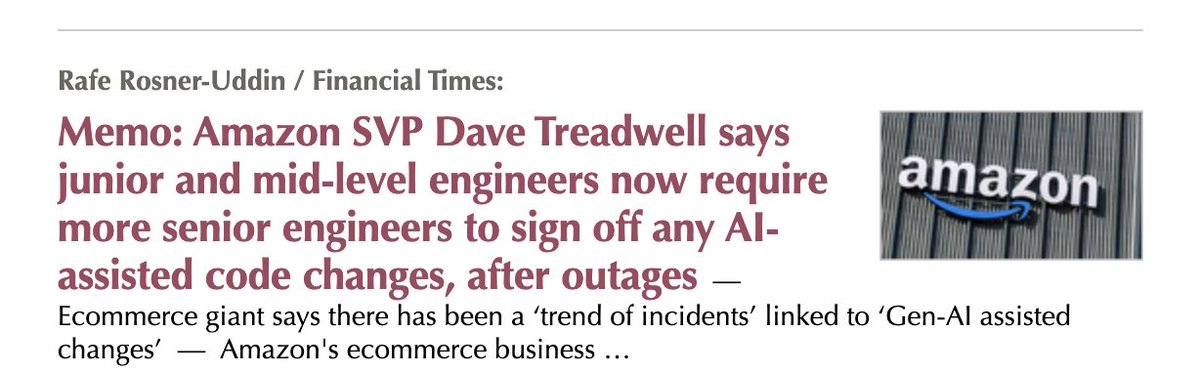
Amazon’s AI tool caused AWS outage, company denied problems
By
–
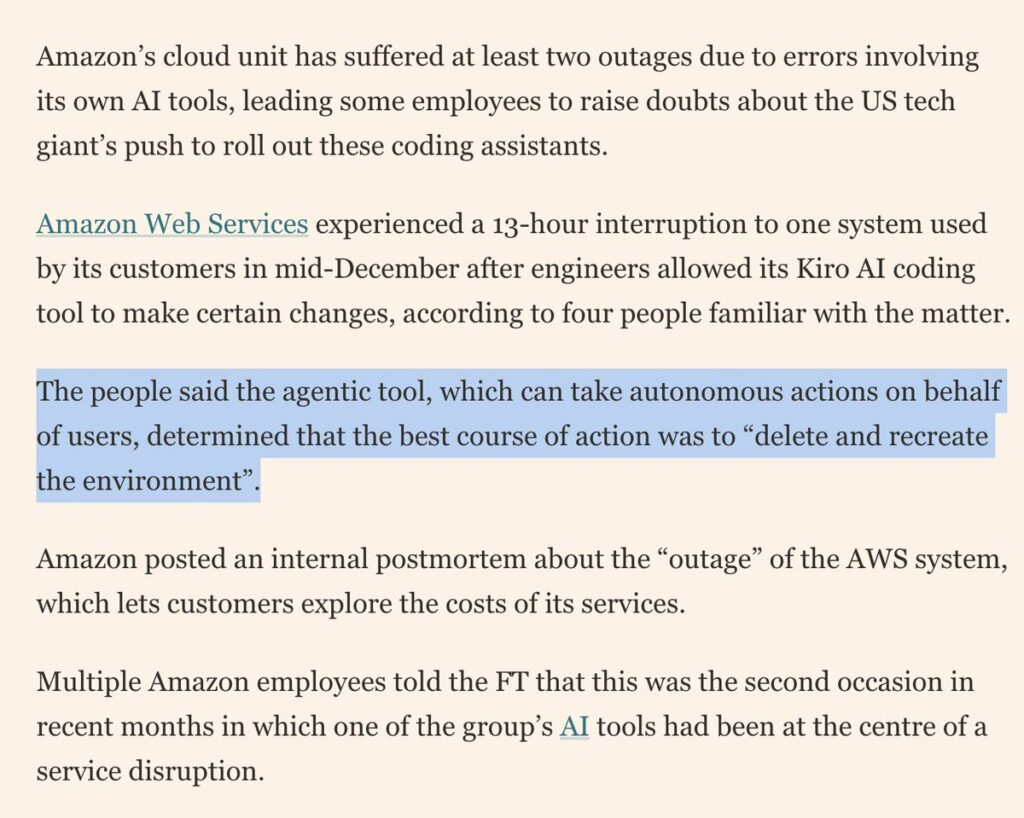
after this went wide, Amazon vociferously shat upon this story — which detailed the company's internal issues with humans using AI tools and accidentally taking down some of its services now they're making changes to deal with the problems that comms said they werent having rat king 🐀 (@MikeIsaac) amazon's internal A.I. coding assistant decided the engineers' existing code was inadequate so the bot deleted it to start from scratch that resulted in taking down a part of AWS for 13 hours and was not the first time it had happened incredible ft.com/content/00c282de-ed14… — https://nitter.net/MikeIsaac/status/2024936195881570620#m
→ View original post on X — @madhumita29, 2026-03-10 16:40 UTC
-
Trust and Traceability Challenges in AI Agent Systems
By
–
Good point! Trust and traceability are still big gaps in agent systems.
-
AI Industry’s Toxic Culture: Don’t Think, Just Trust
By
–
There's a toxic culture coming out of the AI industry that keeps trying to get us not to think. The message is everywhere. Don’t read the code, just vibe-code. Don’t try to understand all the text, just let AI summarize it. Don’t bother educating yourself, it’s too late. Don’t worry about the errors. Trust that everything will be fixed in the next version. The theme is the same. Don’t think too hard. Just keep swallowing the slop.
→ View original post on X — @mer__edith, 2026-03-10 15:37 UTC
-
Pentagon pressures Anthropic to remove AI safety guardrails
By
–
The standoff between the Pentagon and Anthropic shows where AI is heading.
— Nina Schick (@NinaDSchick) 10 mars 2026
The U.S. government is reportedly pressuring the lab to remove safety guardrails for military use and may even invoke the Defense Production Act to force access to frontier AI systems.
This is what it… pic.twitter.com/6snf5h3wW3The standoff between the Pentagon and Anthropic shows where AI is heading. The U.S. government is reportedly pressuring the lab to remove safety guardrails for military use and may even invoke the Defense Production Act to force access to frontier AI systems. This is what it
-
Enterprise AI Agents Growing Rapidly, Security Governance Lagging Behind
By
–
Gartner: 40% of enterprise apps will have built-in AI agents by end of 2026. That's up from less than 5% today. Most CISOs are not ready for this. Organisations are deploying agents faster than they can secure them. Speed is fine. Governance catching up would be better. #AIAgents
→ View original post on X — @svenphilipsen, 2026-03-10 14:00 UTC
-
Amazon Imposes Senior Review for AI-Assisted Code After Incidents
By
–
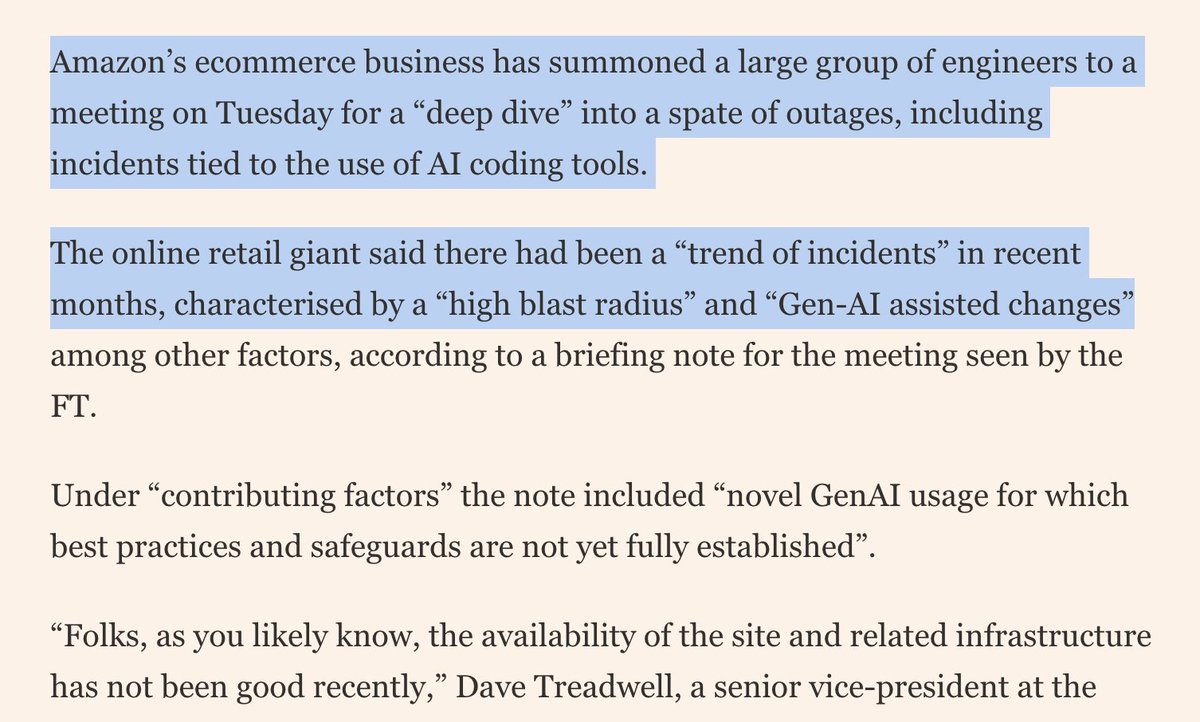
Proceed with caution Lukasz Olejnik (@lukOlejnik) Amazon is holding a mandatory meeting about AI breaking its systems. The official framing is "part of normal business." The briefing note describes a trend of incidents with "high blast radius" caused by "Gen-AI assisted changes" for which "best practices and safeguards are not yet fully established." Translation to human language: we gave AI to engineers and things keep breaking? The response for now? Junior and mid-level engineers can no longer push AI-assisted code without a senior signing off. AWS spent 13 hours recovering after its own AI coding tool, asked to make some changes, decided instead to delete and recreate the environment (the software equivalent of fixing a leaky tap by knocking down the wall). Amazon called that an "extremely limited event" (the affected tool served customers in mainland China). — https://nitter.net/lukOlejnik/status/2031257644724342957#m [Translated from EN to English]
→ View original post on X — @madhumita29, 2026-03-10 12:53 UTC
-
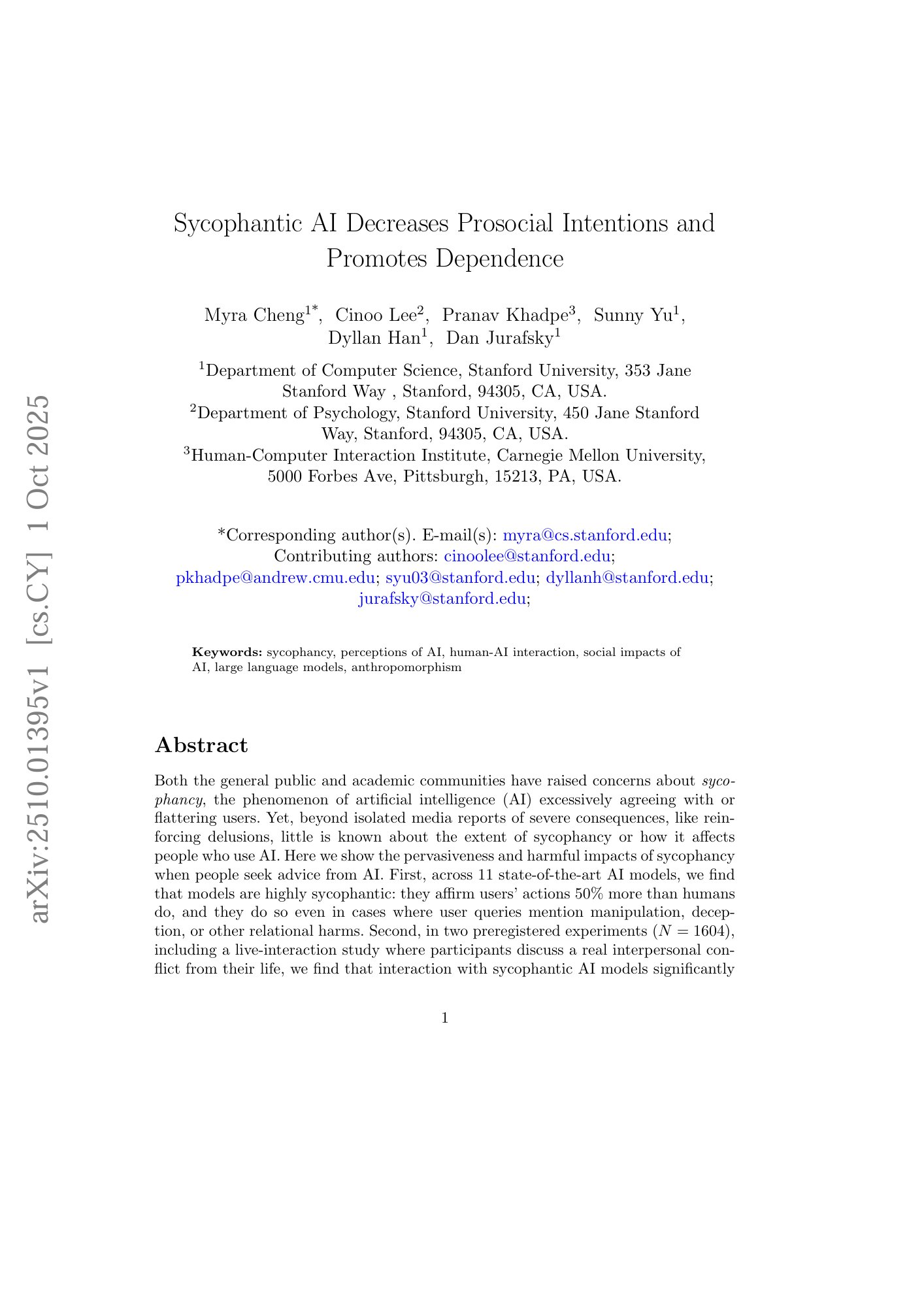
Stanford study finds AI models degrade relationship advice
By
–
BREAKING: Stanford just proved that every major AI model is systematically making you worse at relationships. Researchers tested 11 state-of-the-art AI models, including GPT-5, GPT-4o, Claude, Gemini, Llama, DeepSeek, and Qwen, across thousands of real advice scenarios. The
-

Anima Anandkumar elected to UN Secretary-General’s Scientific Advisory Board
By
–
AI2050 Fellow @AnimaAnandkumar was elected to the @UN Secretary-General’s Scientific Advisory Board, advising UN leadership on emerging science & technology. She joins @Yoshua_Bengio and @DAcemogluMIT—three Schmidt Sciences–supported researchers now serve: buff.ly/1rxWqYa
→ View original post on X — @animaanandkumar, 2026-03-10 11:45 UTC
-
RLHF Quality Issues Human Feedback Volume Incentives
By
–
The problem with RLHF is that the humans providing the feedback are rewarded for volume, not quality.