Stanford scientists developed an AI that turns messy brain scans into "movies" of your thoughts moving through your brain in real-time. This new approach could change how we understand and treat diseases – from depression to brain tumors: https://
hai.stanford.edu/news/ai-reveal
s-how-brain-activity-unfolds-over-time
…
EDUCATION
-
AI and the need for evolving rules in technology and education
By
–
-
Universities Redefining Regional Innovation Ecosystems Role
By
–
In this episode of #ThoughtLeadership in Practice, Dmitrii Malkov from #Elsevier and Renee Westenbrink from #EindhovenUniversityofTech discuss what it means to redefine how universities measure their role in regional innovation ecosystems https://
bit.ly/4rUc86x
#TLIP #Podcast -
Man Builds Camera Hat, Grok Explains It to a Nine-Year-Old
By
–
This guy built a hat with cameras.
— Robert Scoble (@Scobleizer) 5 mars 2026
What does it all mean? I asked Grok to explain it like if I was a nine-year-old: https://t.co/yjJWALOLqV
Helping translate nerd to English. 🙂 https://t.co/dXH0QEditSThis guy built a hat with cameras. What does it all mean? I asked Grok to explain it like if I was a nine-year-old: https://
x.com/i/grok/share/0
7288a1006aa4d20958b173fd3a64315
… Helping translate nerd to English. 🙂 -

New JAX Course: Build and Train LLMs from Scratch
By
–
New course: Build and Train an LLM with JAX, built in partnership with @Google and taught by @chrisachard.
— Andrew Ng (@AndrewYNg) 4 mars 2026
JAX is the open-source library behind Google's Gemini, Veo, and other advanced models. This short course teaches you to build and train a 20-million parameter language… pic.twitter.com/iBJTIjTOIWNew course: Build and Train an LLM with JAX, built in partnership with @Google and taught by @chrisachard. JAX is the open-source library behind Google's Gemini, Veo, and other advanced models. This short course teaches you to build and train a 20-million parameter language model from scratch using JAX and its ecosystem of tools. You'll implement a complete MiniGPT-style architecture from scratch, train it, and chat with your finished model through a graphical interface. Skills you'll gain: – Learn JAX's core primitives: automatic differentiation, JIT compilation, and vectorized execution – Build a MiniGPT-style LLM using Flax/NNX, implementing embedding and transformer blocks – Load a pretrained MiniGPT model and run inference through a chat interface Come learn this important software layer for building LLMs! deeplearning.ai/short-course…
→ View original post on X — @andrewyng, 2026-03-04 18:41 UTC
-
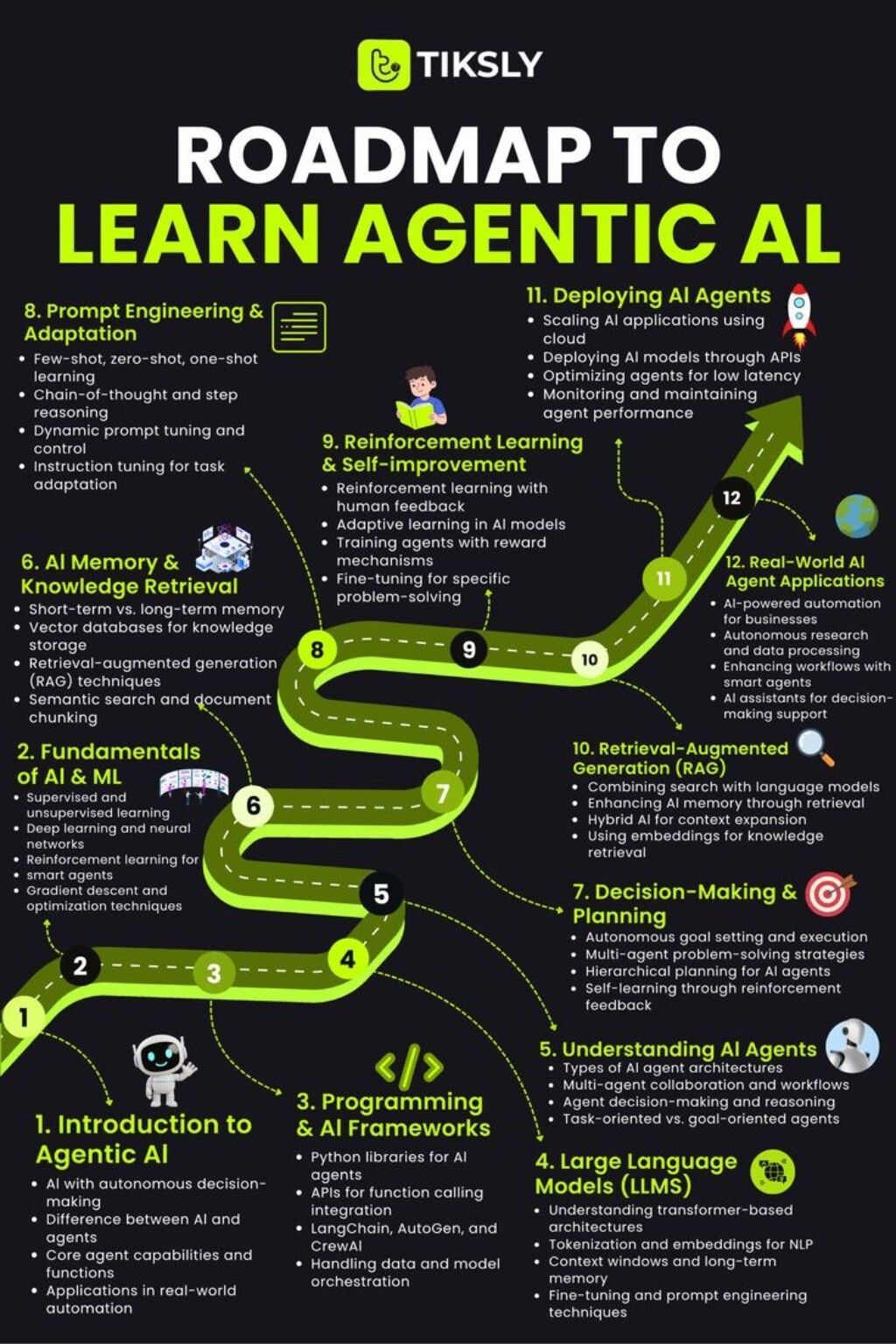
Complete Roadmap to Master Agentic AI Development
By
–
Roadmap to learn Agentic AI AI fundamentals
Python + frameworks
LLMs
Agents architecture
Memory + RAG
Planning & decision-making
RL & self-improvement
Deployment
Real-world automation
Agentic AI = full-stack intelligence.
Credit: Tiksly
#AgenticAI #LLM #RAG #A -
AI Learning Risks and Rewards in Student Education
By
–
Students using AI sometimes fail to learn. But it’s not a given.
— SAS Software (@SASsoftware) 4 mars 2026
In this episode of Pondering AI, Master’s student Seth Rabinowitz demonstrates that risks and rewards of AI in education are not lost on students. On topics ranging from intentional learning to interpersonal skills… pic.twitter.com/ab357SgcVoStudents using AI sometimes fail to learn. But it’s not a given. In this episode of Pondering AI, Master’s student Seth Rabinowitz demonstrates that risks and rewards of AI in education are not lost on students. On topics ranging from intentional learning to interpersonal skills
-
Modern Time Series Analysis with R: ARIMA, Tidyverse, and Causal Inference
By
–
I’ve recently been diving into Modern Time Series Analysis with R, and it has been a game-changer for how I approach sequential data. As someone deeply invested in the intersection of Machine Learning and Data Science, seeing a structured bridge between traditional statistical theory and modern computational techniques is incredibly refreshing. Why this book stands out for me: 1. The "Arima" of it all: Understanding the Logic What I found most fascinating was the deep dive into ARIMA (AutoRegressive Integrated Moving Average) models. While we often jump straight to LSTMs or Transformers in deep learning, this book reinforces why ARIMA remains a powerhouse for business applications. The way it breaks down: Autoregression (p): Using past values to predict the future. Integration (d): Differencing data to achieve stationarity—a crucial step I’ve applied in my own research. Moving Average (q): Modeling the error term as a linear combination of past errors. Understanding these components isn't just about math; it’s about understanding the "memory" of the data. 2. Structured Learning with R & Tidyverse The book doesn’t just throw code at you; it teaches a structured workflow. Using the tidyverse and specific time-series wrappers makes data wrangling—which is usually 80% of the work—feel intuitive. From handling hierarchical models to automating reproducible reports in RStudio, the focus is on building a pipeline that is production-ready. 3. Beyond Simple Forecasting It was eye-opening to see time series applied to Causal Inference and Change Point Analysis. In complex domains like healthcare or finance, knowing when a structural change occurred is often more valuable than just predicting the next data point. If you are someone who's looking to deep dive into time series modelling using R, then this book is just right for you! Link: lnkd.in/gfRxu7zp
→ View original post on X — @avikumart_, 2026-03-03 21:19 UTC
-
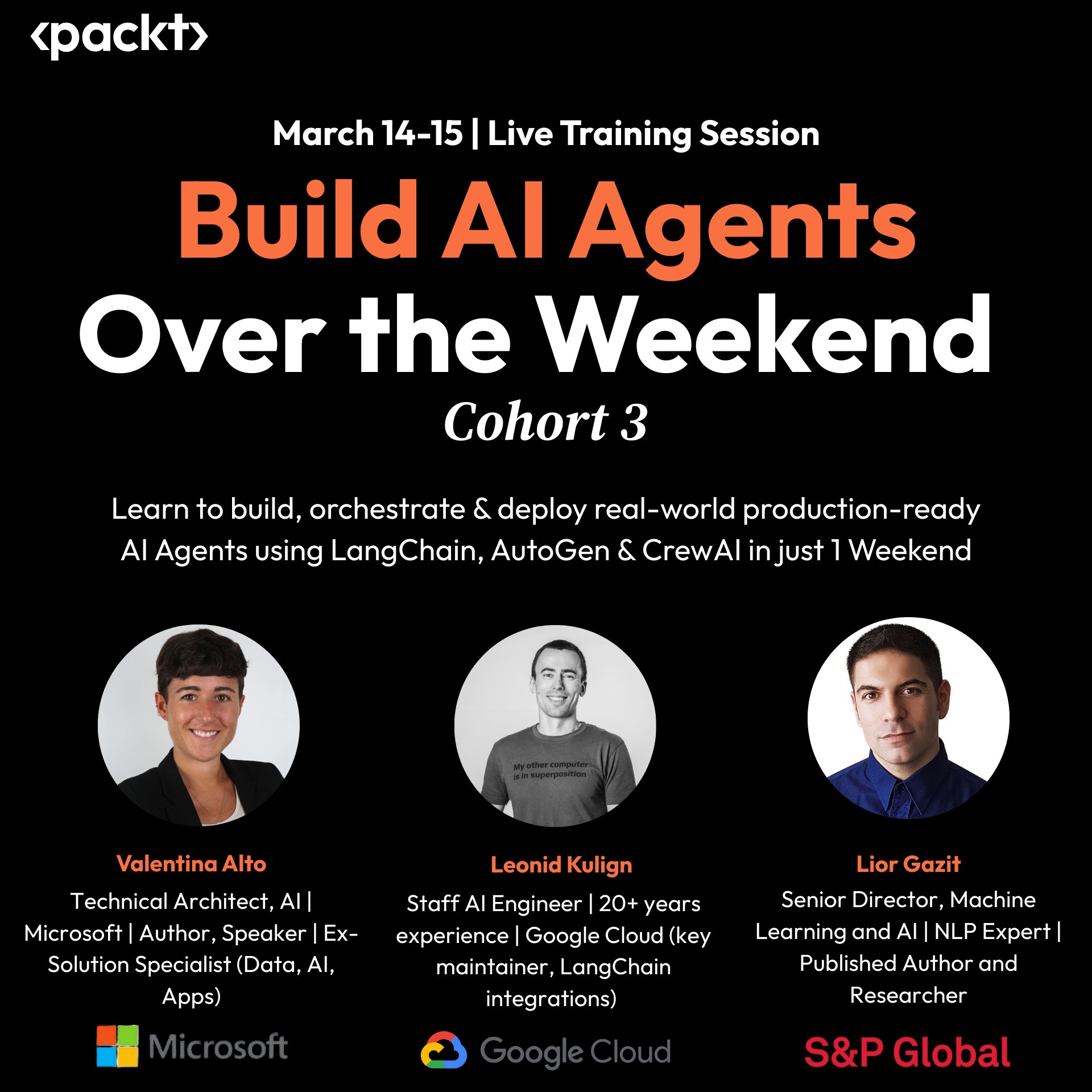
Live Training Session on Building AI Agents Announced
By
–
On March 14-15, @PacktPublishing will host a live training session on "Building AI Agents" over the weekend, led by Valentina Alto, Leonid Kuligin, and Lior Gazit Register here: https://
landing.packtpub.com/ai-agents-over
-the-weekend/
… another great offering from @PacktDataML -
Free Anthropic courses on Claude with certificates
By
–
stop satisfying yourself with random youtube tutorials. Anthropic just released free courses on building with Claude. with certificates. prompt engineering, tool use, RAG, evaluations. built by the people who made the model. not some influencer who read the docs once. $0.00.
-
Lean community contributions to proof tooling and Mathlib development
By
–
RT @Robertljg: Honestly, a huge part of this is thanks to the incredible Lean community @leanprover ! Mathlib, proof tooling, and years of…
→ View original post on X — @animaanandkumar, 2026-03-02 00:12 UTC