
We're teaming up with @cerebras to build the fastest possible inference. Coming soon to Amazon Bedrock, we’re delivering inference performance an order of magnitude faster than what’s available today by connecting AWS Trainium3 for compute-intensive prefill with Cerebras CS-3 to power decode. Learn more about the partnership. go.aws/3Pzcota
COMPUTING
-
AI Transforms Internet Infrastructure for AI Supercycle Era
By
–
AI Will Change the Internet Forever — Why Networks Must Evolve for the AI Supercycle AI isn’t just increasing internet traffic — it’s fundamentally changing how data flows across networks, forcing infrastructure to evolve for a new AI-driven era. Read more
-
Viola-Jones Algorithm: The Foundation of Camera Vision
By
–
The Algorithm That Taught Cameras to See
— Satya Mallick (@LearnOpenCV) 13 mars 2026
Think your phone's face detection is magic? It actually started with a clever trick from 2001. Before the era of GPUs and AI, two researchers-Viola and Jones-changed everything by looking at simple patterns of light and shadow rather… pic.twitter.com/hdhLJ4Q0TnThe Algorithm That Taught Cameras to See Think your phone's face detection is magic? It actually started with a clever trick from 2001. Before the era of GPUs and AI, two researchers-Viola and Jones-changed everything by looking at simple patterns of light and shadow rather
-
HOG: The Algorithm That Powered Early Human Detection
By
–
HOG: The Algorithm That Powered Early Human Detection
— Satya Mallick (@LearnOpenCV) 13 mars 2026
In 2005, before deep learning dominated computer vision, researchers introduced Histogram of Oriented Gradients (HOG) – a powerful technique for detecting people in images. Instead of analyzing raw pixels, HOG focused on… pic.twitter.com/vCcvn6IjdDHOG: The Algorithm That Powered Early Human Detection In 2005, before deep learning dominated computer vision, researchers introduced Histogram of Oriented Gradients (HOG) – a powerful technique for detecting people in images. Instead of analyzing raw pixels, HOG focused on
-
Replit HQ Live Event: Agent 4 Launch, Demos, and Future Plans
By
–
For the first time ever, we're going live from the ground floor at Replit HQ! Live guests from Leadership, Engineering, and Product. Behind the scenes from launch day, live demos, Q&A, and what's next. Join us to celebrate Agent 4 w/ @MannyBernabe
, @raymmar
, and @Franciscocrz
. -

New Framework Challenges Electron’s Long Dominance in Development
By
–
Is there finally a new framework bold enough to challenge Electron's dominance? Pretty interesting—"the old fogey" has indeed been in power for far too long. More lightweight, faster, TS-first, and an Electron alternative based on the system's WebView—essentially trading some
-
Codex Sessions Folder Storage Issue Fixed
By
–
You might want to check the .codex/sessions folder if you're using Codex. Was rapidly running out of storage and trying to figure out why. That folder was growing exponentially: one of the sessions grew to 40gb+. As far as I can tell this is fixed now in the latest update.
-
SN50 Dataflow Architecture Maps AI Models Directly on Processor
By
–
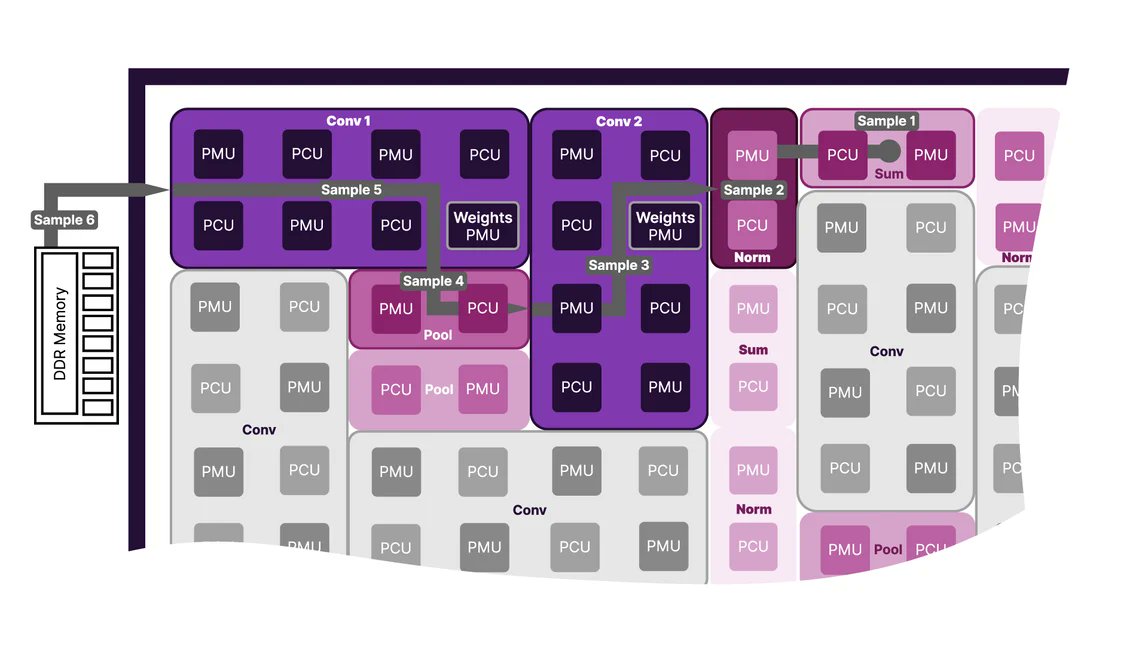
The SN50’s Dataflow Architecture approach. Instead of repeatedly calling external memory, our Reconfigurable Dataflow Units (RDUs) map the entire AI model graph directly onto the processor. This minimizes data movement to memory, the most expensive and power-hungry part of
-
Building Industrial-Scale AI Compute Infrastructure for Economic Growth
By
–
reach out to Sachin (srk@openai.com) if you’d like to help build industrial-scale compute to power economic growth, entrepreneurship, and AI benefits in health, science, and beyond:
-
Post-Cloud AI Infrastructure: Rebuilding the Agent Stack
By
–
What does post-cloud AI infrastructure actually look like? Our co-founder and CEO @hwchase17 sat down with the MAD Podcast at Daytona COMPUTE in SF to go deep on how the agent stack is being rebuilt from scratch — including context windows, memory, orchestration, observability,