Training AI on Amazon Electronic Reviews Using #Python for Natural Language! – by – @gp_pulipaka
! JupyterLab/Jupyter Notebook WordNet, Lexical Semantic Relation Analyzer
Thesaurus, 155,000 Words
Synset 115,000, 205,000 word-Sense Pair. NLTK Library, spaCy, TextBlob
CODE
-
Training AI on Amazon Electronic Reviews with Python NLP
By
–
-
AI-Powered File Reader with RAG and LLM
By
–
RAG with LLM: Creating an AI-Powered File Reader! #BigData #Analytics #DataScience #AI #MachineLearning #NLProc #IoT #IIoT #PyTorch #Python #RStats #TensorFlow #Java #JavaScript #ReactJS #GoLang #CloudComputing #Serverless #DataScientist #Linux #Programming #Coding
-
The great experience of building with Codex
By
–
it’s great to build with codex https://t.co/PwVdq0WthJ
— Greg Brockman (@gdb) 30 mai 2026it’s great to build with codex
-
Chat tools hit ceiling when context window full; become CI pipeline
By
–
That's a good way to frame it. Chat tools hit a ceiling when the task outgrows what one context window can hold. Once the plan lives in executable code with parallel agents, resumability, and convergence loops, it's closer to a CI pipeline than a conversation.
-
Workflows change behavior; reusability via team commands in .claude/workflows
By
–
Exactly right. Benchmarks get attention, workflows change behavior. And the reusability angle is underrated. You can save workflows to .claude/workflows/ as team commands. So once someone figures out the right audit or migration pattern, the whole team gets it without
-
Claude Code execution plan and JS script diffing for guardrails
By
–
That's a sharp point. Claude Code already does this partially. The first time a workflow triggers, it shows the execution plan and asks for confirmation. But diffing the actual JS script across runs is a different level of control. Especially for teams trying to set guardrails
-
Dynamic Workflows solve context bloat by moving results to JS
By
–
Exactly. That's the architectural insight most people gloss over. In a normal subagent setup, every result flows back into Claude's context window. More agents = more context bloat = earlier compaction = degraded quality. Dynamic Workflows solve that by moving results into JS
-
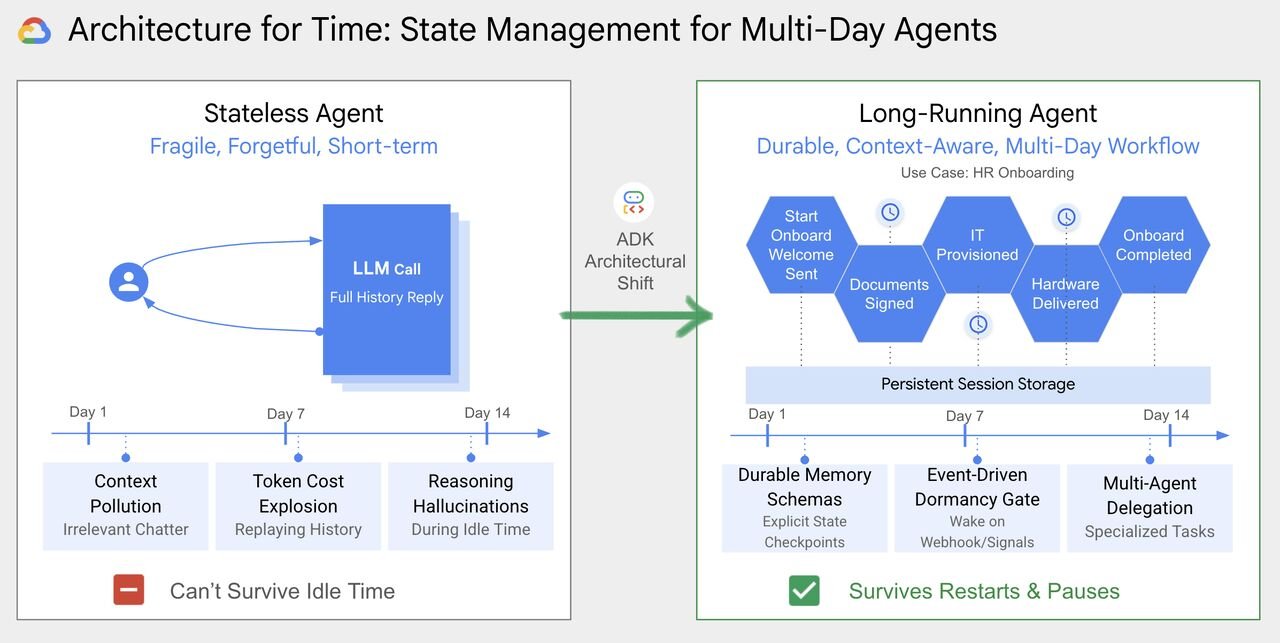
Build Persistent AI Agents with Google ADK and CLI
By
–
Build long-running AI agents that pause for days, survive restarts, and resume without losing context using Google Agent Development Kit and Agents CLI. Step-by-step tutorial with 100% Opensource code.
-
Big splats for city-scale 3D, glTF extension, future of Google Earth
By
–
i like big splats and i cannot lie.
— Bilawal Sidhu (@bilawalsidhu) 30 mai 2026
you can now compress, tile and stream city scale 3d gaussian splats — glTF has an official 3DGS extension now too.
this is what the future of google earth looks like. no more broccoli trees. no more melted powerlines. immaculate ground… pic.twitter.com/XK6TP5x1W6i like big splats and i cannot lie. you can now compress, tile and stream city scale 3d gaussian splats — glTF has an official 3DGS extension now too. this is what the future of google earth looks like. no more broccoli trees. no more melted powerlines. immaculate ground
-
Using AI Agents for Code Orchestration and Workflows
By
–
this! codex can create and interact with threads across projects and tasks – all you need to do is ask
— Vaibhav (VB) Srivastav (@reach_vb) 29 mai 2026
I’ve used this recently orchestrate multiple worktrees and implement a feature with different PoVs using subagents
and ofcourse to archive, unarchive and find relevant threads… https://t.co/LmIKytkCz6this! codex can create and interact with threads across projects and tasks – all you need to do is ask I’ve used this recently orchestrate multiple worktrees and implement a feature with different PoVs using subagents and ofcourse to archive, unarchive and find relevant threads