One thing I wonder about APL is whether the right-to-left precedence would cause problems for an LLM. In practice folks tend to write APL using a number of steps of creating small blocks then building them up. Perhaps LLMs need some tooling to help them…
CODE
-

MiniMax-M2.7 Self-Evolving Model Launches for Software Engineering
By
–
MiniMax-M2.7 is live on Poe! A next‑gen self‑evolving model built for autonomous software engineering and agent workflows. M2.7 can iteratively improve its own agent scaffolds, optimize task performance over repeated runs, and deliver major gains on real-world coding benchmarks
-
Self-Orchestrating AI Agents: The Next Major Breakthrough in LLM Performance
By
–
It’s happening: nitter.net/nousresearch/status/20… Matt Shumer (@mattshumer_) Agents that natively self-orchestrate, managing their own context, tools, and sub-agents, are the next big unlock in LLM performance. Right now, a skilled engineer building an optimized harness, with thoughtful data flow, separation of concerns, sub-agent management, etc., can make dramatic improvements over baseline for specific tasks. If a model could do this itself, that’d be a major step forward. You give it an objective and a set of tools, and it figures out the optimal way to orchestrate itself to do the task. For example, I’m building a very primitive AI scientist that I’ll open-source soon. Most of the work isn’t in the prompt, it’s in the harness… what the orchestrator sees, what sub‑agents see, what gets shared between them and when, where we summarize vs. pass raw data, and which tools each agent controls. Doing this allows me to dramatically improve what the model can do on its own. If a model can effectively design its own harness for a given problem, it’d be a huge step forward. My bet: self-orchestrating models… ones that manage their own context, tools, and sub-agents, will move the frontier almost as much as the jump from chatbot → reasoning did. Maybe more. — https://nitter.net/mattshumer_/status/1991942387145322715#m
→ View original post on X — @mattshumer_, 2026-03-19 21:48 UTC
-
M²RNN: Non-Linear RNNs with Matrix-Valued States for Language Modeling
By
–
Excited to share our latest work: M²RNN! We’ve revisited non-linear RNNs and found that expanding the hidden state to a matrix (Matrix-to-Matrix) significantly improves language modeling while the non-linear recurrence enables expressivity beyond TC⁰. Key highlights: – Efficient Scaling: Our expansion mechanism leverages. Tensor Cores for high-throughput training. – Better Long-Context Performance: Beats SOTA hybrid linear attention models by 8 points on LongBench. – Hybrid Models: Replacing just ONE layer in a hybrid stack gives massive gains with minimal overhead. This establishes non-linear RNNs as a primary building block for the next generation of LLMs. Mayank Mishra (@MayankMish98) Introducing M²RNN: Non-Linear RNNs with Matrix-Valued States for Scalable Language Modeling We bring back non-linear recurrence to language modeling and show it's been held back by small state sizes, not by non-linearity itself. 📄 Paper: arxiv.org/abs/2603.14360 💻 Code: github.com/open-lm-engine/lm… 🤗 Models: huggingface.co/collections/o… — https://nitter.net/MayankMish98/status/2034681226217595333#m
→ View original post on X — @berkeley_ai, 2026-03-19 21:41 UTC
-
NumPy and APL: Understanding Different Programming Models
By
–
No, numpy has some overlaps with APL, but it's a vastly different programming model.
-
AI struggles transferring coding knowledge across programming languages
By
–
Very reasonable! But isn't that kinda the point of this discussion? AI can't take what it knows about coding in languages with lots of data, and re-use it for coding in a different language effectively. Even if I add reference docs, examples, etc to prompt context.
-
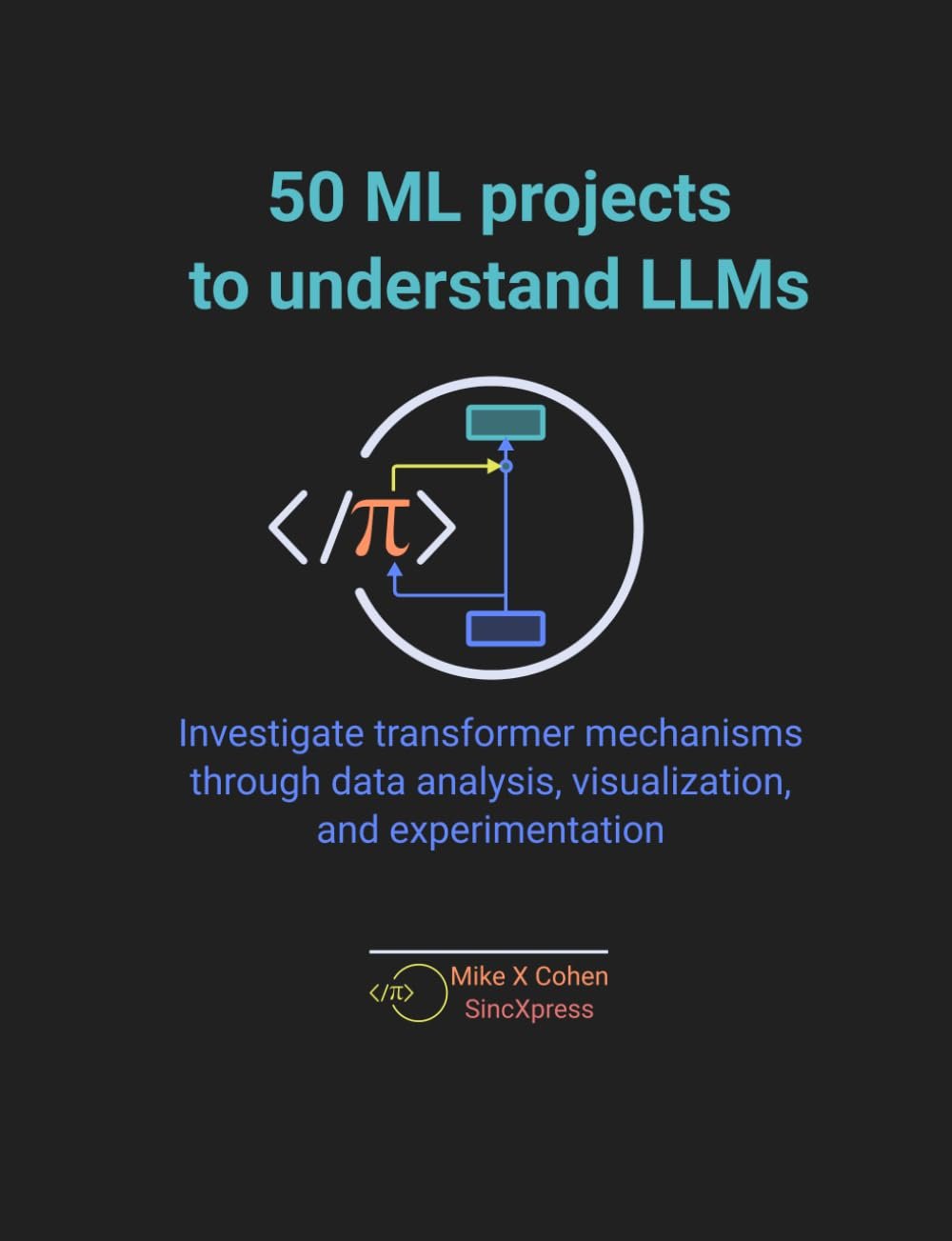
50 ML Projects to Understand LLMs and Transformer Mechanisms
By
–
50 ML projects to understand LLMs — Investigate transformer mechanisms through data analysis, visualization, and experimentation: http://
amzn.to/4aPfP7q
—————
#AI #GenAI #MachineLearning #DataScientist #DataScience -
Mathematical Methods in Data Science: Theory and Python Applications
By
–
Mathematical Methods in Data Science — Bridging Theory and Applications with Python: http://
amzn.to/4b7ZYQ4
——————
#ML #MachineLearning #DataScientist #DataScience #Mathematics #Algorithms -
Hands-On Mathematical Optimization with Python: Key Ingredients and Modeling Choices
By
–
Hands-On Mathematical Optimization with Python: https://
amzn.to/4b3VADe “…presents the key ingredients of an optimization problem and the choices one needs to make when modeling a real-life problem mathematically. Topics covered range from linear and network optimization to