Kimi K2.7 Code and MiniMax M3 are now available on Poe. Two cutting-edge open-weight models designed for serious coding and agentic tasks. Kimi K2.7 Code is Moonshot AI's most powerful coding model to date, with multi-step tool calling more
@poe_platform
-
Claude Fable 5, Anthropic’s most powerful model on Poe
By
–
Claude Fable 5 is now available on Poe. The most powerful model from Anthropic to date, designed for long and complex tasks: large-scale code migrations, deep research, and agentic sessions that last hours or days. Cutting-edge.
-
Claude Opus 4.8 Now Available on Poe with Enhanced Enterprise Capabilities
By
–
Claude Opus 4.8 is now available on Poe. Anthropic’s latest flagship model is built for enterprise-grade knowledge work, codebase-scale migrations, multi-agent coordination, and long-running autonomous tasks, with sharper judgment and improved honesty. Try it today at:
-
Gemini-3.5-Flash model now available on Poe platform
By
–
Gemini-3.5-Flash is now available on Poe. Google’s latest Flash model is built for fast, efficient responses, with strong performance on coding, complex workflows, and agentic tasks. Try it today at: https://
poe.com/Gemini-3.5-Fla
sh
… -
Grok 4.3 Now Available on Poe as Economical Daily Driver
By
–
Grok 4.3 is now available on Poe. It’s a great daily driver, not just a model that wins random benchmarks, but one that holds up for real-life use. It’s also economical enough to use every day, with strong performance for the price. After sharing a lot of feedback with the @xai
-
GPT-5.5 Now Available on Poe API Platform
By
–
Try them on all platforms and in the Poe API, available at: https://
poe.com/GPT-5.5 and https://
poe.com/GPT-5.5-Pro -

GPT-5.5 and GPT-5.5 Pro Launch on Poe Platform
By
–
GPT-5.5 and GPT-5.5 Pro are live on Poe. We’ve been testing it in early access across complex coding, debugging, and reasoning workflows. On selected internal evals, we saw encouraging improvements: – 12% higher task completion rate
– 16% fewer retries on complex prompts
– 19% -
Opus 4.7 Shows Major Improvements on Coding Tasks
By
–
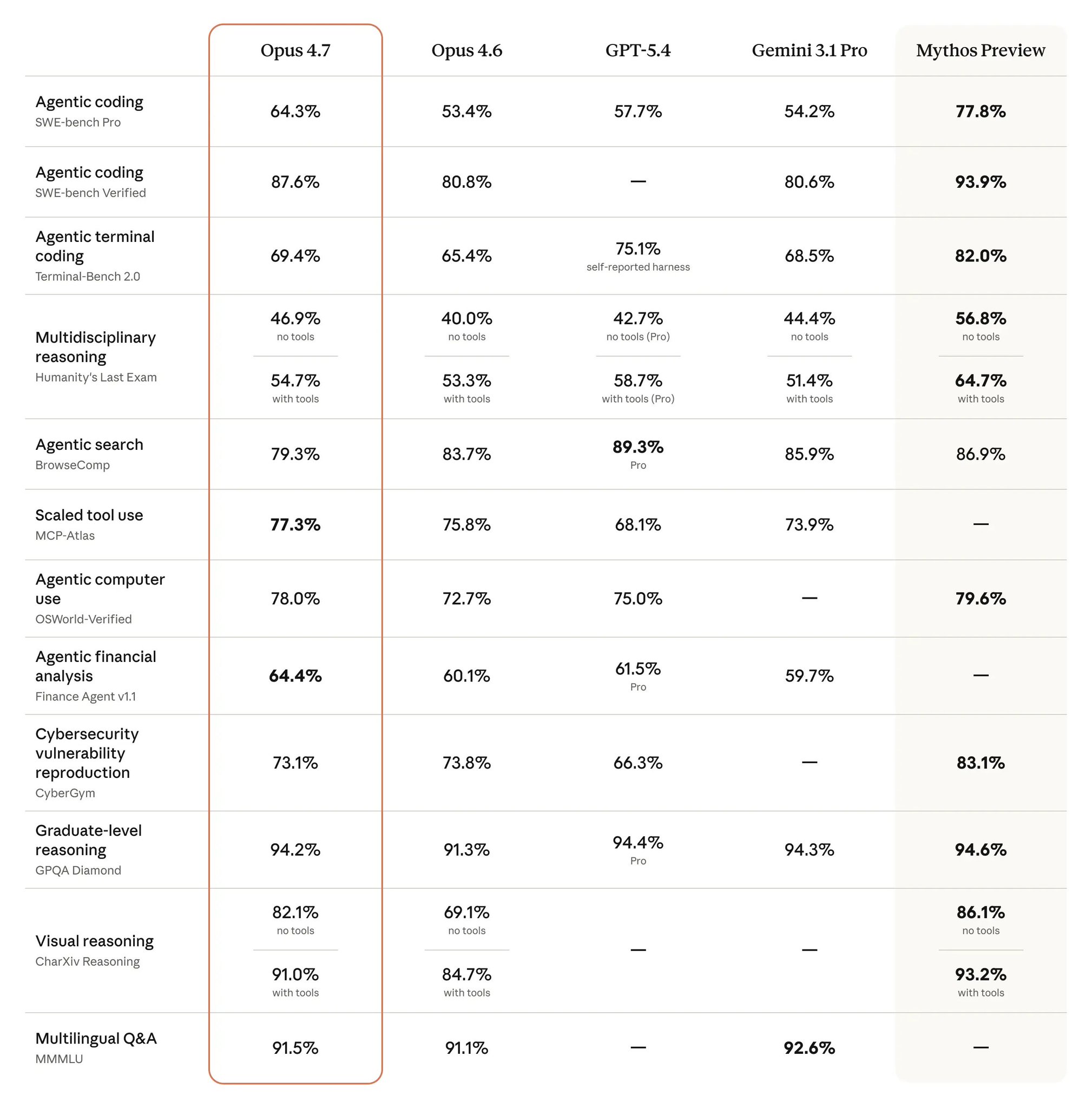
Tip 3: There is a big jump on coding tasks like – SWE-Bench Pro 64.3% – SWE-Bench Verified 87.6%
– TerminalBench 69.4% Altogether, it’s a strong signal that coding performance has improved meaningfully in Opus 4.7 compared to Opus 4.6. -
Opus 4.7 Improves Support for Low-Resource Languages
By
–
Tip 2: Opus 4.7 shows improvement on languages including those with less training data like Yoruba, Igbo and Chichewa. For folks who speak these and other languages this model will be meaningfully better.
-
Opus 4.7 New Tokenizer Uses 1x to 1.5x More Tokens
By
–
Tip 1: Opus 4.7 uses a new tokenizer behind the scenes. In our testing, it can use between 1x and 1.5x more tokens when compared to Opus 4.6, so it’s worth planning accordingly.