For what have you been using Krill? local = codex, or claude code
CODE
-
Coding Agents Automate Cross-Platform Workflows with Intelligence
By
–
Agents that can code will equally be able to use tools exceedingly well. This allows you to start to automate tasks across a workflow that requires both a component of non-deterministic intelligence but also deterministic system interaction.
— Aaron Levie (@levie) 31 mars 2026
An example would be using something… https://t.co/ziNaeIUR8TAgents that can code will equally be able to use tools exceedingly well. This allows you to start to automate tasks across a workflow that requires both a component of non-deterministic intelligence but also deterministic system interaction. An example would be using something like Codex to automate a workflow connecting data from Box to multiple other systems. The coding agent can interact with systems like an engineer via CLI/MCP/APIs, or write code on the fly when new problems are encountered in a workflow. This will also be one of the reasons you’ll see more technical and engineering roles start to help automate work in non-engineering domains. Marketing, finance, supply chain, pharma research, and other areas where there’s a large amount of data and systems to talk to all have these properties. Box (@Box) Codex just turned an upcoming meeting into a fully automated cross-platform workflow. Box. Gmail. Slack. It researches across all three, synthesizes the context, and delivers a pre-meeting brief without anyone lifting a finger. This is what personal productivity looks like when agentic automation does the work for you. See it in action.👇 — https://nitter.net/Box/status/2039056257282449696#m
→ View original post on X — @romainhuet, 2026-03-31 19:39 UTC
-
LLMs as CPUs: Statistical Processing and Agent Operating Systems
By
–
LLM = CPU (data: tokens not bytes, dynamics: statistical and vague not deterministic and precise)
Agent = operating system kernel -
AI Agent Leaks Claude Code, Recoded in Python
By
–
un agent IA a permis de faire leaker le code de claude code, un humain a recodé en python…
-
Hackathon Stories from Replit and Alif Collaboration
By
–
Hackathon stories from Replit x Alif. pic.twitter.com/uRF0aPQXTE
— Replit ⠕ (@Replit) 31 mars 2026Hackathon stories from Replit x Alif.
-
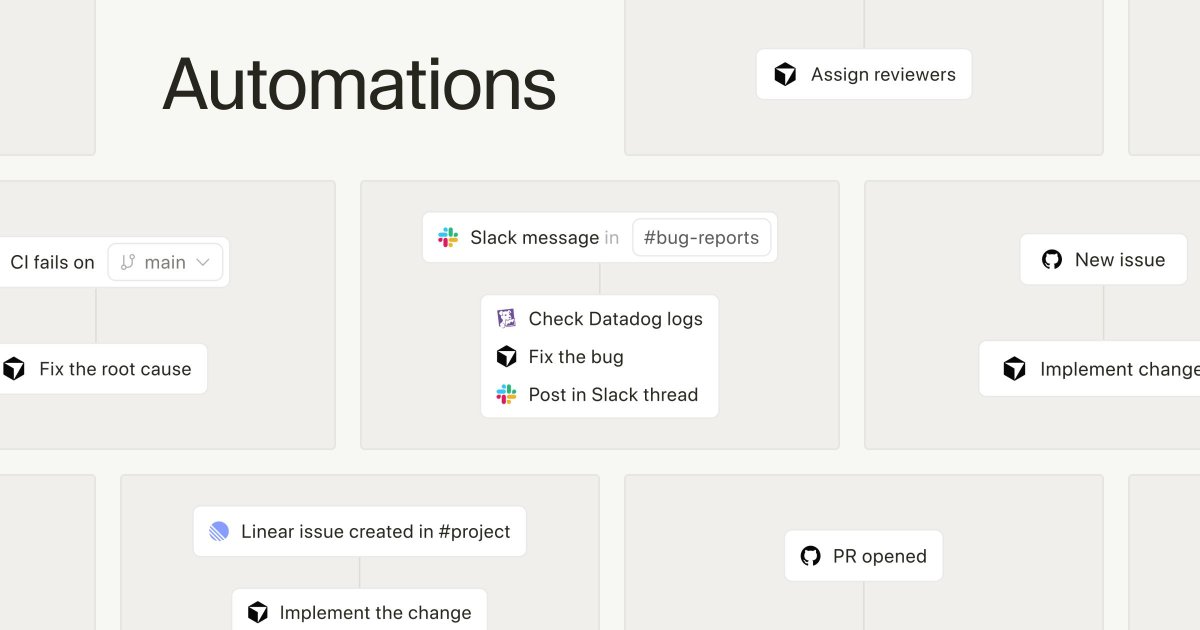
Cursor: Build AI Agents That Run Automatically
By
–
Build agents that run automatically · Cursor buff.ly/0wrnb02
#AI #MachineLearning #DeepLearning #LLMs #DataScience [Translated from EN to English]→ View original post on X — @miketamir, 2026-03-31 18:47 UTC
-
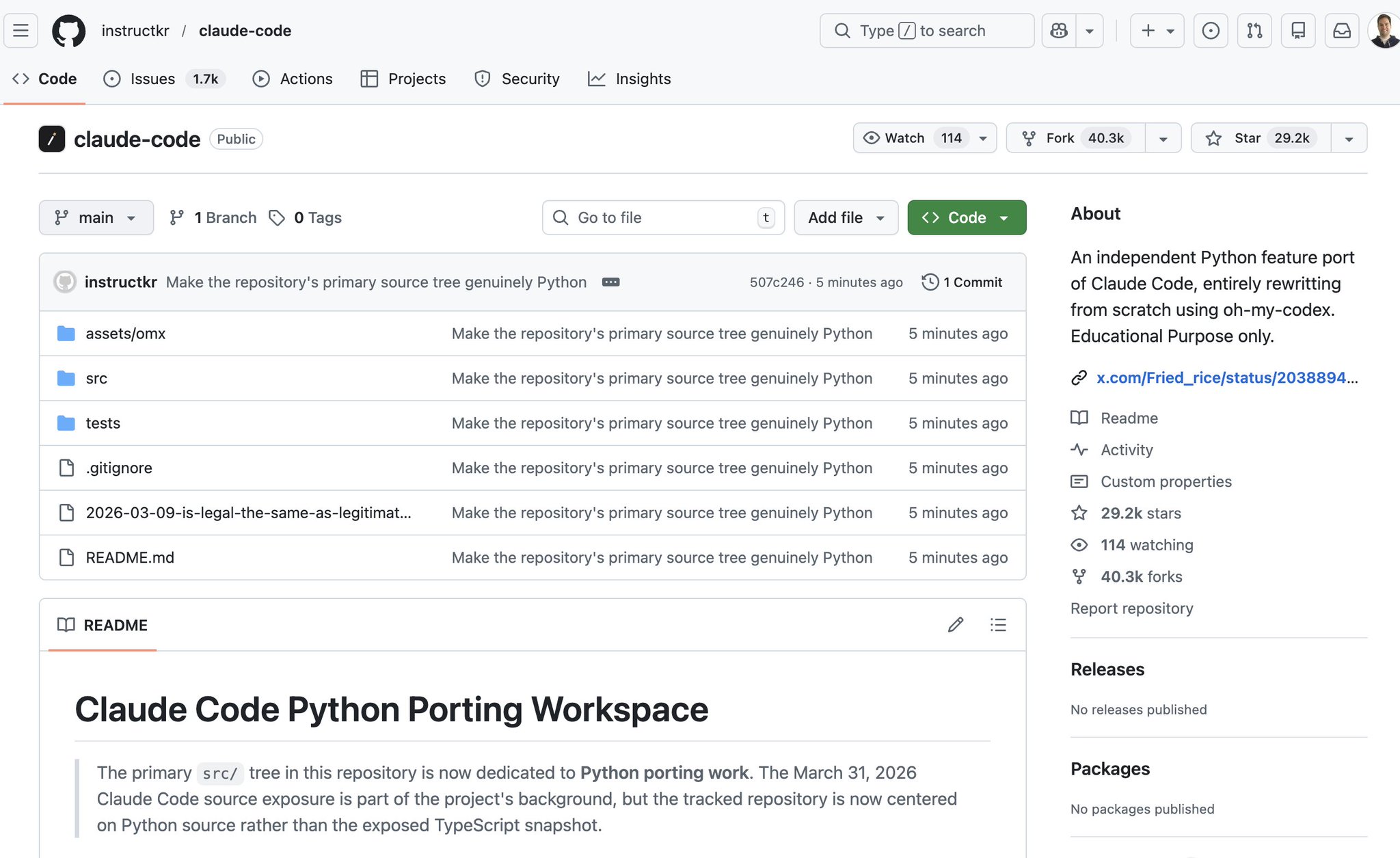
Anthropic Claude Code Leak Bypassed Via Python Rewrite
By
–
This is either brilliant or scary: Anthropic accidentally leaked the TS source code of Claude Code (which is closed source). Repos sharing the source are taken down with DMCA. BUT this repo rewrote the code using Python, and so it violates no copyright & cannot be taken down!
-
Code Leaks Lead to Python Alternative Development
By
–
just wait it leaks then they make a python instead
-

LangChain Partners with MongoDB for AI Stack Integration
By
–
Announcing our partnership with @MongoDB
: The AI Stack that runs on the database you already trust Atlas Vector Search as a drop-in retriever. MongoDB Checkpointer for durable agent state in LangSmith Deployment. Text-to-MQL for natural-language queries over operational data. -
LeWorldModel: Stable JEPA Architecture for Offline Robotics World Models
By
–
Paper review: LeWorldModel: Stable End-to-End Joint-Embedding Predictive Architecture from Pixelshttps://t.co/2dD7hPIURL
— John Carmack (@ID_AA_Carmack) 31 mars 2026
Nice clean github: https://t.co/YZ4e1eUACi
This is the application of the LeJEPA results to world models, trained offline on experience from three different… https://t.co/rJojWTCP6bPaper review: LeWorldModel: Stable End-to-End Joint-Embedding Predictive Architecture from Pixels arxiv.org/pdf/2603.19312 Nice clean github: github.com/lucas-maes/le-wm This is the application of the LeJEPA results to world models, trained offline on experience from three different robotics style tests with one to two million steps in each dataset. Re-states the benefits of the SigReg loss relative to prior world model approaches. Uses ImageNet standard 224×224 RGB pixel input images with an unmodified ViT-Tiny vision transformer from HuggingFace to generate latents. One extra post-projection step is needed to give SigReg the necessary freedom to perturb the latents into independent gaussians, since ViT ends with a layernorm’d layer. Also tested with ResNet-18, which still performed well, but slightly worse. Uses a 192 dimensional latent. Performance slightly dropped when doubling the latent size to 384; it would be nice to know if it was stable there, or if it continued worsening with excessive latents. There is a relationship between batch size and SIGReg, the larger latent may have improved performance if the batch size was increased. The predictor is implemented as a ViT-S backbone – Why a vision transformer when the latent is flat? Uses a history of 3 sets of latents for two of the benchmarks and 1 for the other. Performance was markedly better with the “small” ViT model than the “tiny”, but the larger “base” model degraded notably, which is interesting. Dropout of 0.1 on the predictor significantly improved performance. 0.2 was still better than 0.0, but 0.5 was worse. Trained with a batch of 128 x 4 trajectories. I wish their training loss graphs were more zoomed in with grid lines. Performs planning at test time instead of building a policy by training in imagination like Dreamer / Diamond. Rolls out 300 initially random sets of actions up to a planning horizon H of 5 (at frame-skip 5). Iterates up to 30 times using the Cross Entropy Method (CEM). The main paper body mentions using Model Predictive Control (MPC) strategy, where only the first K planned actions are executed before replanning, but appendix D says they execute all 5 planned actions. After training, they probe the latent space to demonstrate that it does capture and represent physically meaningful quantities. They also implement a decoder from the latent space back to pixels – not used by the algorithms, but helpful to see what things the latent space is actually representing. They tested incorporating the reconstruction loss into training, but it hurt performance somewhat. They wound up with a 0.1 lambda for SigReg, as opposed to 0.05 in the LeJEPA paper. 1024 sigreg projections, but observe the number has negligible impact I like the JEPA framework, but so far my attempts to use it on Atari games with value functions have not matched my other efforts. Lucas Maes (@lucasmaes_) JEPA are finally easy to train end-to-end without any tricks! Excited to introduce LeWorldModel: a stable, end-to-end JEPA that learns world models directly from pixels, no heuristics. 15M params, 1 GPU, and full planning <1 second. 📑: le-wm.github.io — https://nitter.net/lucasmaes_/status/2036080584569618741#m
→ View original post on X — @id_aa_carmack, 2026-03-31 18:24 UTC