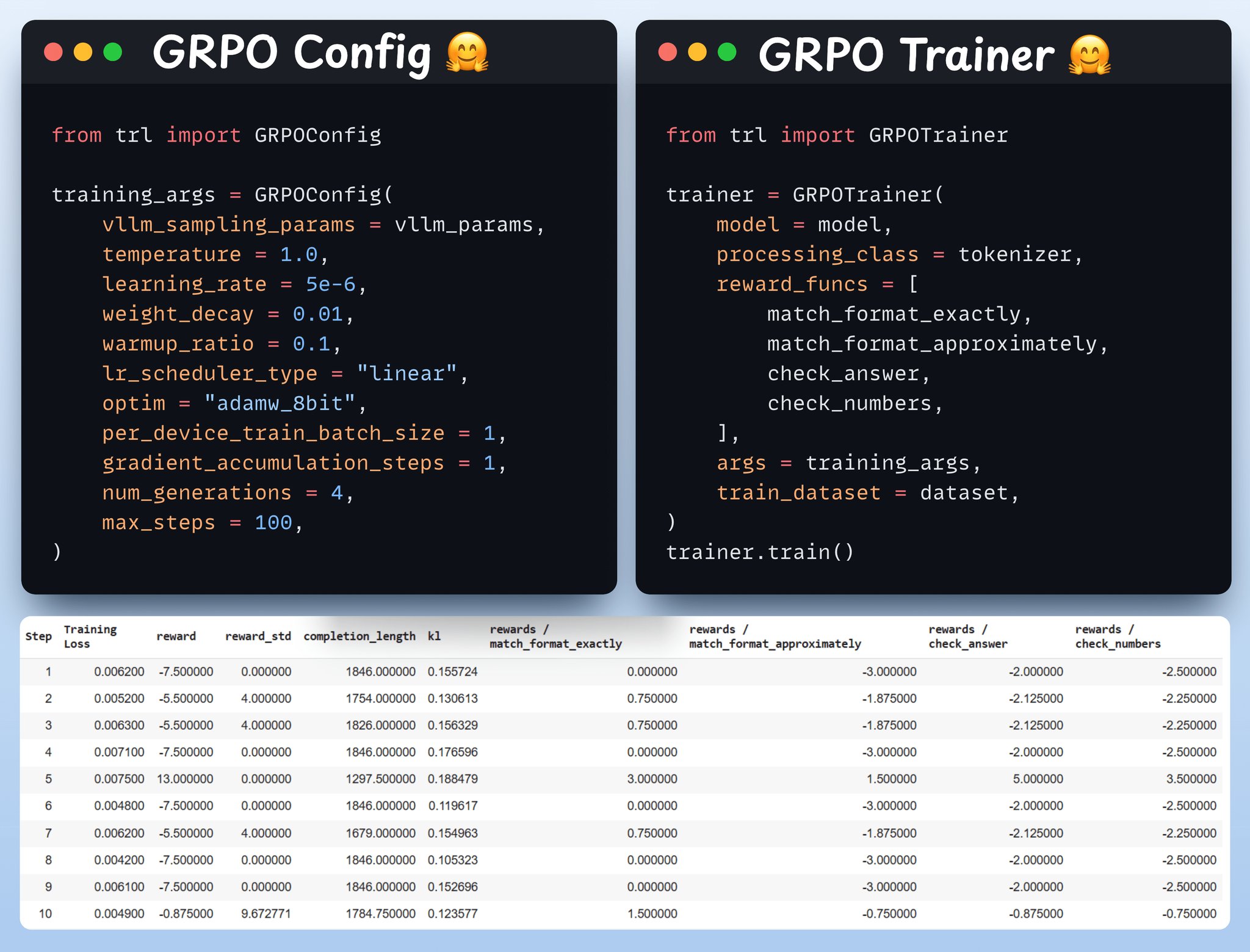
Use GRPO and start training Now that we have the dataset and reward functions ready, it's time to apply GRPO. HuggingFace TRL provides everything we described in the GRPO diagram, out of the box, in the form of the GRPOConfig and GRPOTrainer. Check this out
CODE
-
Formatting Open R1 Math Dataset for Reasoning Training
By
–
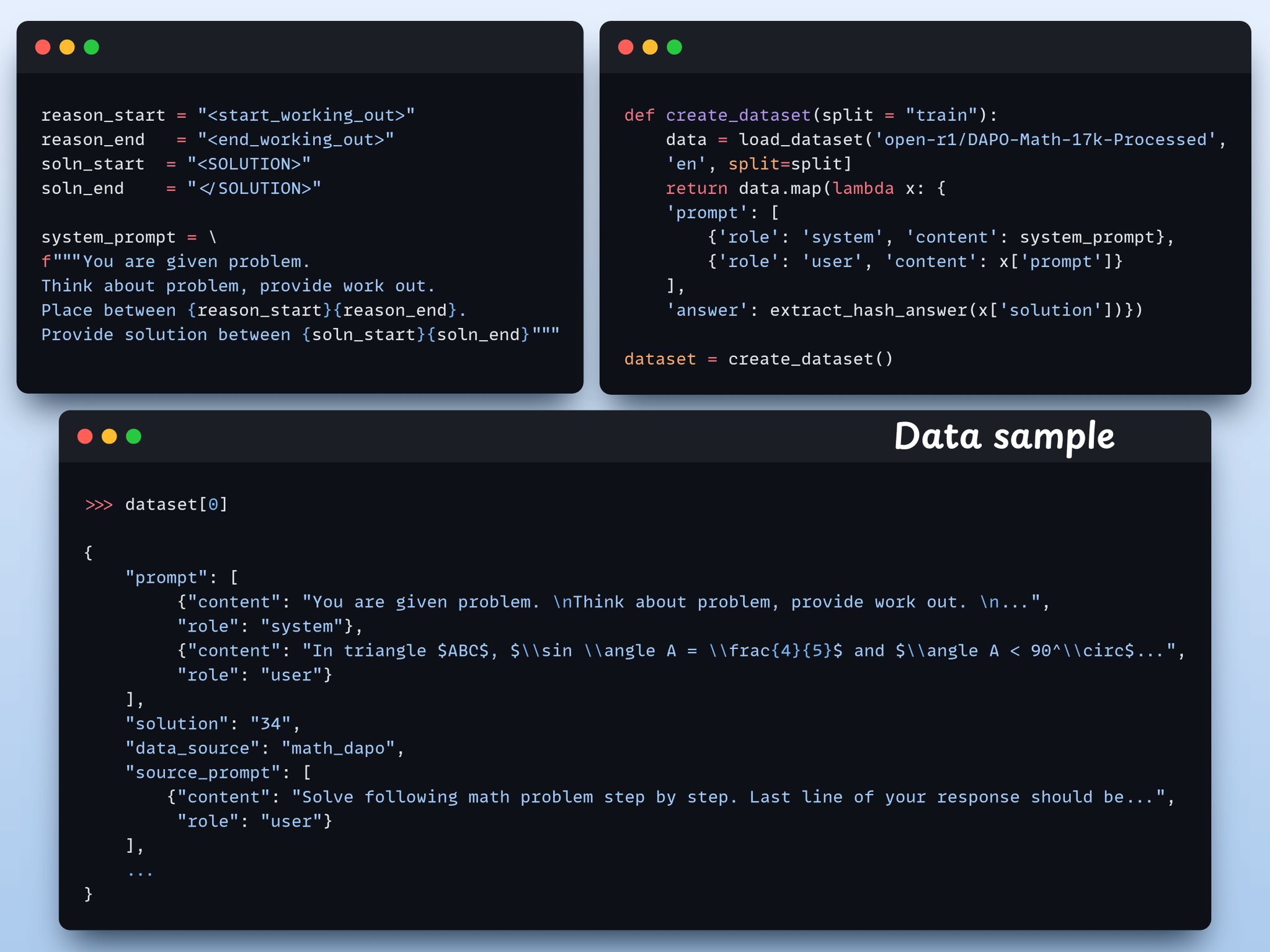
Create the dataset We load Open R1 Math dataset (a math problem dataset) and format it for reasoning. Each sample includes:
– A system prompt enforcing structured reasoning
– A question from the dataset
– The answer in the required format Check this code -
Configuring LoRA for Fine-Tuning with Unsloth PEFT
By
–
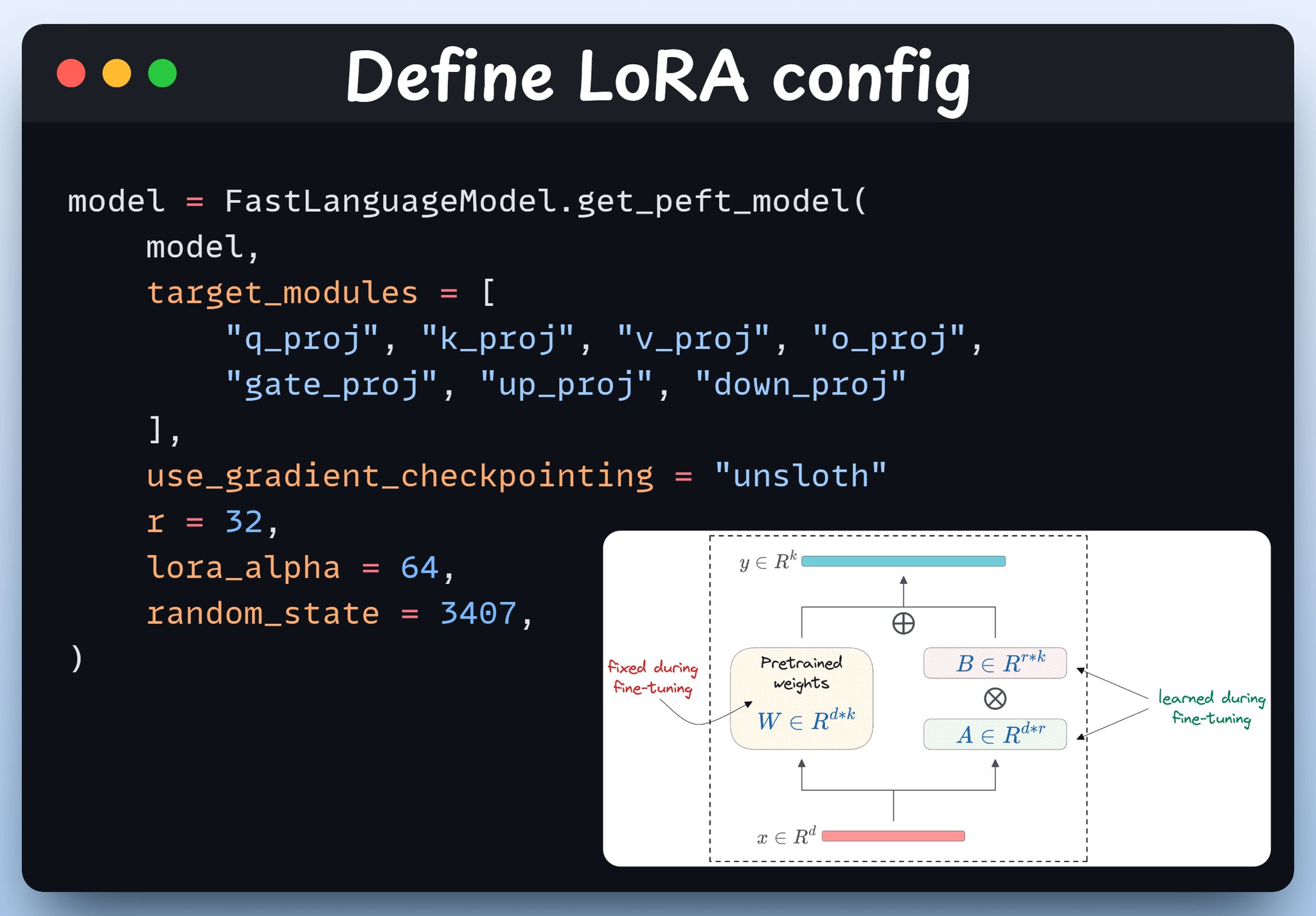
Define LoRA config We'll use LoRA to avoid fine-tuning the entire model weights. In this code, we use Unsloth's PEFT by specifying: – The model
– LoRA low-rank (r)
– Modules for fine-tuning, etc. Check this -
GRPO: Reinforcement Learning Method for Fine-Tuning LLMs Explained
By
–
What is GRPO?
— Akshay 🚀 (@akshay_pachaar) 2 mai 2026
Group Relative Policy Optimization is a reinforcement learning method that fine-tunes LLMs for math and reasoning tasks using deterministic reward functions, eliminating the need for labeled data.
Here's a brief overview of GRPO before we jump into code: pic.twitter.com/EX8hI5eEAIWhat is GRPO? Group Relative Policy Optimization is a reinforcement learning method that fine-tunes LLMs for math and reasoning tasks using deterministic reward functions, eliminating the need for labeled data. Here's a brief overview of GRPO before we jump into code:
-
Building a Reasoning Model Without Manual Labels Using Verifiable Outputs
By
–
When outputs are verifiable, labels become optional.
— Akshay 🚀 (@akshay_pachaar) 2 mai 2026
Maths, code, and logic can be automatically checked and validated.
Let's use this fact to build a reasoning model without manual labelling.
We'll use:
– @UnslothAI for parameter-efficient finetuning.
– @HuggingFace TRL to… pic.twitter.com/0FVo2aKfSUWhen outputs are verifiable, labels become optional. Maths, code, and logic can be automatically checked and validated. Let's use this fact to build a reasoning model without manual labelling. We'll use: – @UnslothAI for parameter-efficient finetuning.
– @HuggingFace TRL to -

Agentic Coding Tools Like Claude Code Reshape Developer Economics
By
–
For many AI looked bubbly six months ago, but the more and more articles and journalist argue that agentic coding tools like Claude Code have changed the economics: developers are adopting them fast, productivity gains are becoming measurable, and companies like Anthropic are
-

API Cost Math Behind AI Agents Using DeepSeek Tokens
By
–


Let's look at the API math behind AI agents. Someone just ran 831,962,136 tokens through DeepSeek for only $10.57. When building tools like OpenCode, output tokens dictate your burn rate because the agent must constantly re-read your codebase. If we migrate those 831.9M
-
Anthropic Accidentally Leaks Claude Code’s Entire Codebase
By
–
Anthropic accidentally leaked Claude Code's entire codebase and I break down everything found inside here:
-
Claude Code Three-Layer Memory System Explained
By
–
Claude Code doesn't dump everything into your context window. It uses a three-layer memory system that keeps it coherent across sessions lasting days.
— Louis-François Bouchard 🎥🤖 (@Whats_AI) 2 mai 2026
Layer 1 is a lightweight index, always in context. Layer 2 is topic files, loaded only when needed. Layer 3 is full session… pic.twitter.com/3udnaP1x9MClaude Code doesn't dump everything into your context window. It uses a three-layer memory system that keeps it coherent across sessions lasting days. Layer 1 is a lightweight index, always in context. Layer 2 is topic files, loaded only when needed. Layer 3 is full session
