AI Dynamics

Global AI News Aggregator

About

BIG TECH

  • Microsoft Open Sources Harrier: Top Multilingual Embedding Model

    I’m pleased to share that our search team has open sourced an embedding model called Harrier that is currently ranking #1 on the multilingual MTEB-v2 benchmark leaderboard. Harrier delivers SOTA performance on retrieval quality, semantic matching, and contextual analysis across workloads, supporting more than 100 languages and handles long inputs up to 32K. It is built for the next generation semantic search for Bing and our web grounding (RAG) service for AI agents, which already powers nearly every major AI chatbot today. As you can see in the leadership board, our Harrier model is currently ahead of other excellent models based on Gemini, Gemma, Llama, Qwen, and more. I’m grateful for the hard work of our team to get to this top ranking, and I’m excited to see all the healthy competition in the space, which should ultimately lead to more innovations that will benefit everyone. Learn more: msft.it/6019QNB0b

    → View original post on X — @huggingface

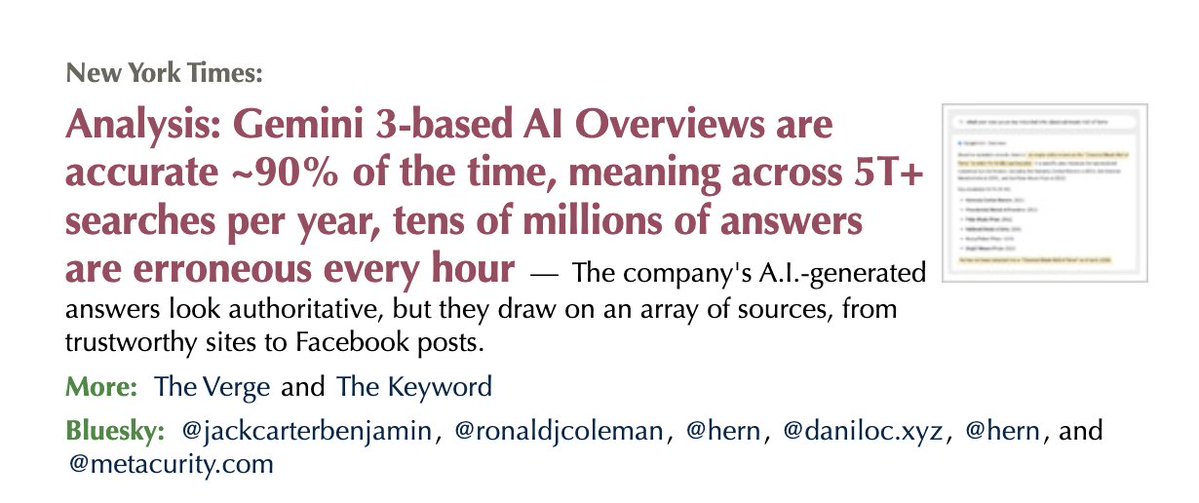
  • Google’s 10% Error Rate: Shift from Pre-ChatGPT Standards
    Google’s 10% Error Rate: Shift from Pre-ChatGPT Standards

    10% error rate at any scale would never have been tolerated by Google pre-ChatGPT. The company has fundamentally changed rat king 🐀 (@MikeIsaac) glass half full: 90 percent accuracy is an impressive accuracy rate glass half empty: 10 percent error rate for a company that does more than 5 Trillion search queries per year is still a gigantic number nytimes.com/2026/04/07/techn… — https://nitter.net/MikeIsaac/status/2041535422623609174#m

    → View original post on X — @garymarcus, 2026-04-07 15:51 UTC

  • Salesforce Uses Slackbot to Solve SaaS Crisis
    Salesforce Uses Slackbot to Solve SaaS Crisis

    Salesforce is looking to Slackbot to help it solve the SaaSPocalypse puzzle go.theregister.com/feed/www.… [Translated from EN to English]

    → View original post on X — @craigbrownphd, 2026-04-07 15:49 UTC

  • Character Assessment and Objective Standards in AI Leadership

    I agree that the control by a small group is not a good thing. But this wasn’t about that, more to do with Altman’s character. Who decides what character is “good”? You and I prob have different views on that. That’s why it requires a more objective lens in my view

    → View original post on X — @madhumita29

  • AI Public Backlash Turns Violent Amid Growing Opposition
    AI Public Backlash Turns Violent Amid Growing Opposition

    Absolutely wild. A councilor's home shot, with 'no data centres' sign left behind. AI is losing the public perception war, VERY BADLY, and it's already becoming violent. The numbers: 1/ AI is less popular than ICE (NBC Poll) 2/ $162 billion in AI projects blocked or

    → View original post on X — @ninadschick

  • Building Codex at OpenAI: Behind the Scenes with Live Demo

    Really enjoyed joining @petergyang with @embirico to talk about how we’ve been building Codex at OpenAI. We show a live demo of the Codex app and go behind the scenes. What’s been striking: role lines are blurring. Designers write code, engineers think product.

    → View original post on X — @romainhuet

  • Top Tech Stories: Startups, Apple Foldable, Netflix Gaming App
    Top Tech Stories: Startups, Apple Foldable, Netflix Gaming App

    Top stories in tech today: – This startup plans to light up the night
    – Apple’s foldable iPhone hits engineering snag – Netflix launches ad-free gaming app for kids
    – The smart glasses without ‘creepy’ vibes – Quick hits on other tech news

    → View original post on X — @therundownai

  • AI Infrastructure Competition Intensifies Amid Geopolitical Rivalry

    AI capability is accelerating at the same time geopolitical competition is intensifying. That means bigger Intelligence factories. More capital. More competition to control the infrastructure that produces Intelligence. Because in the 21st century, whoever can build, scale and

    → View original post on X — @ninadschick

  • Sam Altman’s ChatGPT Hallucinating Live on Stage Moment

    I rest my case Om Patel (@om_patel5) sam altman watching ChatGPT hallucinate live on stage is the funniest thing i've seen all week the CEO of OpenAI, on stage, in front of everyone, watching his own AI just make things up in real time and his face says it all this is the guy telling us AGI is coming soon btw — https://nitter.net/om_patel5/status/2041320039190561169#m

    → View original post on X — @garymarcus, 2026-04-07 14:00 UTC

  • Google DeepMind Study Reveals AI Agent Manipulation Vulnerabilities
    Google DeepMind Study Reveals AI Agent Manipulation Vulnerabilities

    🚨BREAKING: Google DeepMind just published the largest study ever done on AI agent manipulation, and the findings should stop everyone cold. websites can already tell when an AI is visiting instead of a human. When they detect one, they serve it different content. The agent processes what it receives and acts on it. It has no way to know the page looked different for you. That is not theoretical. That is infrastructure being built right now. The study tested 23 attack types across frontier models including GPT-4o, Claude, and Gemini. 502 real participants across 8 countries. The attack surface it maps is wider than anyone has publicly admitted. Malicious instructions buried in HTML comments that never render on screen. White text on white backgrounds, invisible to humans but consumed by agents. CSS visibility tricks that hide content from human view entirely. Commands encoded into image pixels using steganography, invisible to the human eye but readable by vision models. Instructions sitting in image metadata and alt-text. Override instructions inside PDFs, spreadsheet cells, and presentation speaker notes. QR codes redirecting agents to attacker controlled content. Indirect injection through search results, calendar invites, and email bodies, every data source an agent touches becomes a potential vector. Fake UI elements rendered specifically for agent vision. Safety bypasses hidden inside otherwise clean content. False memories injected into agent memory that carry across sessions. Goal hijacking through gradual instruction drift across multiple interactions that never triggers safety filters. Agents tricked into sending user data to attacker controlled endpoints through legitimate looking API calls. Compromised agents injecting malicious instructions directly into other agents running in the same pipeline. The detection asymmetry is what makes this so hard to close. A user who sends an agent to research a product, book a flight, or summarize documents cannot verify that what the agent saw matched what they would have seen. The agent cannot flag it. It does not know. Multi-agent pipelines make it worse. Agent A pulls web content. Agent B processes it. Agent C acts on it. A successful injection at the first step moves through the whole chain with full trust intact. The attack never touches the model. It touches the data the model eats. Every defense tested fell short. You cannot sanitize image pixels. Telling agents to ignore suspicious instructions fails because injections are built to look legitimate. Human oversight breaks down the moment an agent touches more pages than a person can realistically review. The agents are already out there. The attack infrastructure is being built around them.

    → View original post on X — @aihighlight, 2026-04-07 13:51 UTC