AI Dynamics

Global AI News Aggregator

About

AI

  • The AI Scientist Published in Nature: Fully Automated Research Milestone

    I’m incredibly proud of The AI Scientist team for this milestone publication in @Nature. We started this project to explore if foundation models could execute the entire research lifecycle. Seeing this work validated at this level is a special moment. I truly believe AI will forever change the landscape of how scientific discoveries and scientific progress are made. Sakana AI (@SakanaAILabs) The AI Scientist: Towards Fully Automated AI Research, Now Published in Nature Nature: nature.com/articles/s41586-0… Blog: sakana.ai/ai-scientist-natur… When we first introduced The AI Scientist, we shared an ambitious vision of an agent powered by foundation models capable of executing the entire machine learning research lifecycle. From inventing ideas and writing code to executing experiments and drafting the manuscript, the system demonstrated that end-to-end automation of the scientific process is possible. Soon after, we shared a historic update: the improved AI Scientist-v2 produced the first fully AI-generated paper to pass a rigorous human peer-review process. Today, we are happy to announce that “The AI Scientist: Towards Fully Automated AI Research,” our paper describing all of this work, along with fresh new insights, has been published in @Nature! This Nature publication consolidates these milestones and details the underlying foundation model orchestration. It also introduces our Automated Reviewer, which matches human review judgments and actually exceeds standard inter-human agreement. Crucially, by using this reviewer to grade papers generated by different foundation models, we discovered a clear scaling law of science. As the underlying foundation models improve, the quality of the generated scientific papers increases correspondingly. This implies that as compute costs decrease and model capabilities continue to exponentially increase, future versions of The AI Scientist will be substantially more capable. Building upon our previous open-source releases (github.com/SakanaAI/AI-Scien…), this open-access Nature publication comprehensively details our system's architecture, outlines several new scaling results, and discusses the promise and challenges of AI-generated science. This substantial milestone is the result of a close and fruitful collaboration between researchers at Sakana AI, the University of British Columbia (UBC) and the Vector Institute, and the University of Oxford. Congrats to the team! @_chris_lu_ @cong_ml @RobertTLange @_yutaroyamada @shengranhu @j_foerst @hardmaru @jeffclune — https://nitter.net/SakanaAILabs/status/2036840833690071450#m

    → View original post on X — @_yutaroyamada, 2026-03-25 16:24 UTC
  • Tech Jobs Continue Growing Despite Ongoing Layoffs
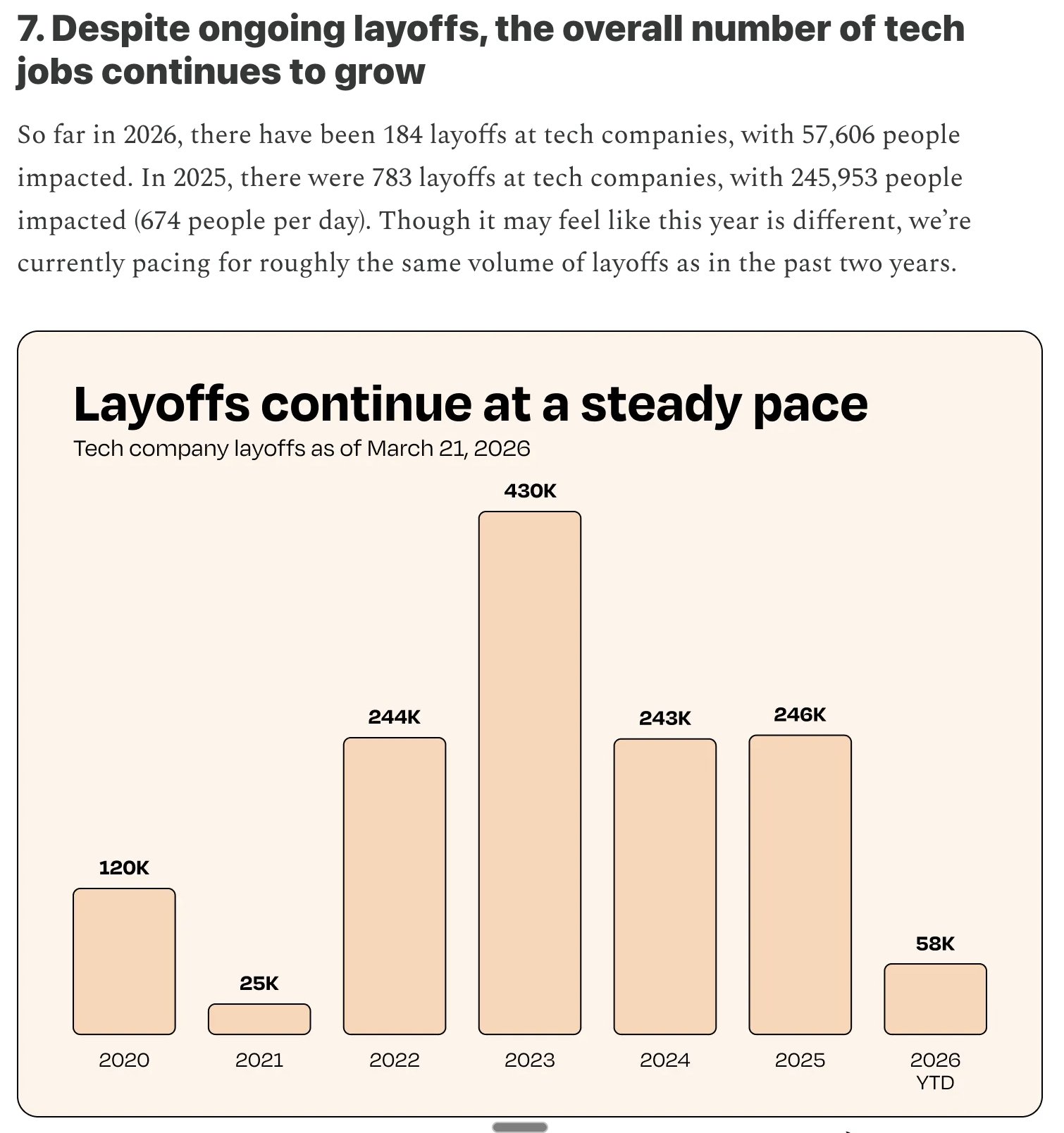
    Tech Jobs Continue Growing Despite Ongoing Layoffs

    See the end of the post https://
    lennysnewsletter.com/i/191595250/7-
    despite-ongoing-layoffs-the-overall-number-of-tech-jobs-continues-to-grow
    …

    → View original post on X — @lennysan

  • Innovative Foot-Tilt Controlled Cart Assistant Technology from China

    Foot-Tilt Controlled Cart Assistant from China
    by @RealXavier011 #Innovation #EmergingTech #Technology #Tech

    → View original post on X — @ronald_vanloon

  • LLMs Overfitting to RAG Context: A Systemic Training Bias

    (I cycle through all LLMs over time and all of them seem to do this so it's not any particular implementation but something deeper, e.g. maybe during training, a lot of the information in the context window is relevant to the task, so the LLMs develop a bias to use what is given, then at test time overfit to anything that happens to RAG its way there via a memory feature (?))

    → View original post on X — @karpathy, 2026-03-25 16:22 UTC

  • Huawei Showcases 115 Industrial AI Solutions at MWC2026
    Huawei Showcases 115 Industrial AI Solutions at MWC2026

    At #MWC2026, Huawei and its customers released 115 industrial intelligence showcases, demonstrating how AI and digital infrastructure are being applied in real operational environments. My latest article explores key insights from the Industrial Digital and Intelligent

    → View original post on X — @ingliguori

  • The AI Scientist Published in Nature: Fully Automated Research

    The AI Scientist: Towards Fully Automated AI Research, Now Published in Nature Nature: nature.com/articles/s41586-0… Blog: sakana.ai/ai-scientist-natur… When we first introduced The AI Scientist, we shared an ambitious vision of an agent powered by foundation models capable of executing the entire machine learning research lifecycle. From inventing ideas and writing code to executing experiments and drafting the manuscript, the system demonstrated that end-to-end automation of the scientific process is possible. Soon after, we shared a historic update: the improved AI Scientist-v2 produced the first fully AI-generated paper to pass a rigorous human peer-review process. Today, we are happy to announce that “The AI Scientist: Towards Fully Automated AI Research,” our paper describing all of this work, along with fresh new insights, has been published in @Nature! This Nature publication consolidates these milestones and details the underlying foundation model orchestration. It also introduces our Automated Reviewer, which matches human review judgments and actually exceeds standard inter-human agreement. Crucially, by using this reviewer to grade papers generated by different foundation models, we discovered a clear scaling law of science. As the underlying foundation models improve, the quality of the generated scientific papers increases correspondingly. This implies that as compute costs decrease and model capabilities continue to exponentially increase, future versions of The AI Scientist will be substantially more capable. Building upon our previous open-source releases (github.com/SakanaAI/AI-Scien…), this open-access Nature publication comprehensively details our system's architecture, outlines several new scaling results, and discusses the promise and challenges of AI-generated science. This substantial milestone is the result of a close and fruitful collaboration between researchers at Sakana AI, the University of British Columbia (UBC) and the Vector Institute, and the University of Oxford. Congrats to the team! @_chris_lu_ @cong_ml @RobertTLange @_yutaroyamada @shengranhu @j_foerst @hardmaru @jeffclune

    → View original post on X — @sakanaailabs, 2026-03-25 16:21 UTC

  • ChatGPT Memory Improvements Rollout for Plus and Pro Users

    Not yet, I just got home yesterday and still need to finish it up and send the emails

    → Voir le post original sur X — @theahmadosman

  • Apple’s Deep Integration with Google’s Gemini Model Revealed
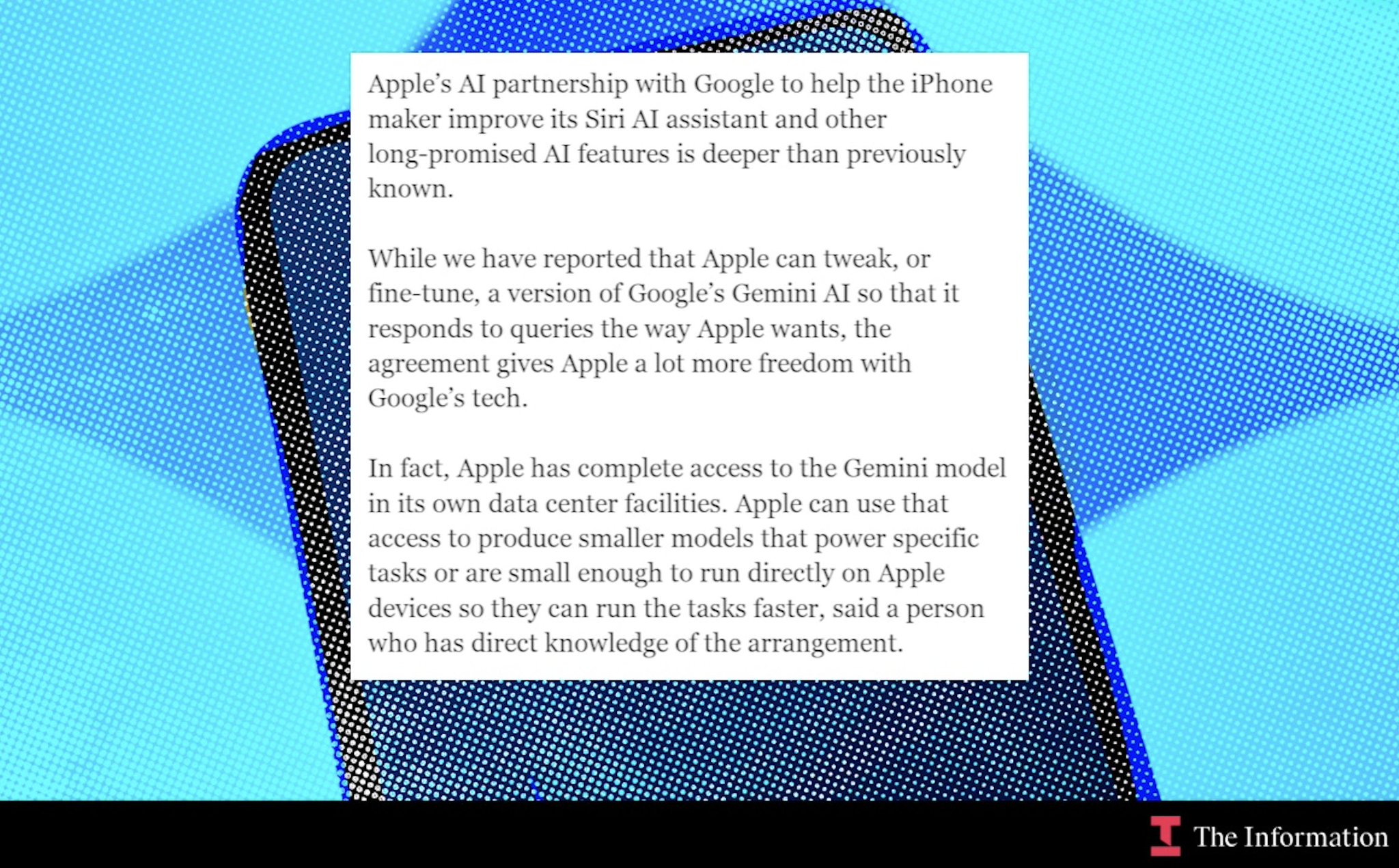
    Apple’s Deep Integration with Google’s Gemini Model Revealed

    Apple's deal with Google goes way deeper than anyone thought. Apple doesn't just get to fine-tune Gemini, they have full access to the model inside their own data centers. That means they can distill (and are doing so) Gemini's knowledge into smaller models purpose-built for

    → View original post on X — @kimmonismus

  • Cloud CLI Auth Patterns and Command Discovery Suggestions

    great list, maybe also return related commands/suggested next commands on output to nudge discovery auth is a big hole for cloud agents using clis, better design patterns there

    → View original post on X — @swyx

  • Google launches Lyria 3 Pro with 3-minute tracks

    Google launched Lyria 3 Pro, and upgraded music model, capable of generating up to 3 minute tracks. “The model now understands the architecture of music. This makes it possible to prompt for intros, verses, choruses and bridges + generate songs with more complex transitions.”

    → View original post on X — @testingcatalog