I made a way better AI than anyone else has to watch the AI community:
AI
-
Context Layer: The Core of Enterprise AI Stack Architecture
By
–
One of the core things we’re going to have to contend with in AI is that even the most advanced models in the word can’t have all the relevant knowledge needed to be useful, because everyone has different use-cases and ways they’ve designed their workflows. Perhaps most importantly, as you get into the enterprise, everyone has entirely different access levels to corporate knowledge and information. Continual learning at the model layer, even at a single enterprise level, is near impossible because every user knows and has access to something different than another user. This isn’t like coding where by and large most developers can access all the relevant stuff to their job. On a single banking team, bankers have entirely different sets of documents they’re ever allowed to see. Sanitizing this is hard and having the model keep secrets is impossible. This is why the context layer is going to always be the core part of the AI stack for applied use cases to turn general models turn into useful agents. Can’t fight the physics on this one. Harrison Chase (@hwchase17) x.com/i/article/204046441296… — https://nitter.net/hwchase17/status/2040467997022884194#m
→ View original post on X — @langchain, 2026-04-05 04:40 UTC
-
Karpathy’s LLM Knowledge Base System and the Future of Memory Infrastructure
By
–
Karpathy posted a long thread about his most frequent use cases with LLMs recently. Not writing code, but building knowledge bases. The approach is quite hardcore: he dumps papers, articles, code repositories and other materials into a folder, then lets an LLM "compile" them into a Markdown wiki. The wiki includes summaries, backlinks, concept categorization, and articles linked to each other. The frontend uses Obsidian for viewing, and Q&A also has the LLM retrieve against the wiki. In his own words, most token consumption now isn't in manipulating code, but in manipulating knowledge. This shift is quite interesting. The entire system can also maintain itself. He wrote some LLM "health check" scripts that periodically scan the wiki for contradictory data, missing information, and potential connections, letting the LLM patch itself. The results from each Q&A can also be archived back into the wiki, making it thicker with each use. Actually, Karpathy clarified something that's happening right now: the greatest value of LLMs might not be helping you generate content, but helping you manage knowledge. But the last sentence of his post is the most worth pondering: "I think there is room here for an incredible new product instead of a hacky collection of scripts." He himself knows this system is hacked together from scripts. Obsidian + command line + manual processes—it works, but it's just a demo. And there are several problems he probably felt:
The wiki is local Markdown files, tied to the computer—it breaks when you switch machines. Retrieval relies on the LLM's own maintained indexes and summaries; he said around 400K words it still holds up, but beyond that? He even said "I thought I had to reach for fancy RAG," just that the scale hasn't reached that point yet. A more fundamental problem is that the wiki stores knowledge, but not memory. What does that mean? Knowledge is "domain X has these concepts, and their relationships are like this." Memory is "I just read a paper last week that refutes this viewpoint, and my judgment on this direction changed." One is static, one walks with you. Karpathy's system can help you store things and search things, but it doesn't know you've changed.
This is actually the difference between a knowledge base and a memory system. The gap isn't a better script—it's an entire architecture. The model can't just "store" and "search"; it needs to sense which information is relevant to who you are now, needs to evolve itself as you use it, needs to maintain coherence across projects and timelines. Karpathy proved with a hand-rolled solution that this direction is right. But he also proved firsthand that you can't go far with just file systems and prompts. Memory needs to be infrastructure, not a collection of scripts. [Translated from EN to English]→ View original post on X — @elliotchen100, 2026-04-05 04:31 UTC
-

The Tournament for Intelligence by Montreal AI President
By
–
The Tournament for Intelligence Vincent Boucher, President of @Montreal_AI and @Quebec_AI
: https://
linkedin.com/pulse/tourname
nt-intelligence-vincent-boucher-xizue/
… #AIAgents #Jobs -

Intelligence Tournament: AI Agents and Future Jobs
By
–
The Tournament for Intelligence Vincent Boucher, President of @Montreal_AI and @Quebec_AI : https://
linkedin.com/pulse/tourname
nt-intelligence-vincent-boucher-xizue/
… #AIAgents #Jobs -
GDP-B: Better Welfare Measure for 21st Century Economics
By
–
Yep. Traditional GDP was never designed to be a proxy for welfare, but it worked tolerably well in the 20th century. For the 21st century, I think GDP-B will do a better job:
-
README-Driven Development with Claude Code for Tool Building
By
–
I built this one using README-driven-development: I hand crafted a detailed README describing exactly how the tool should work… then dumped that into Claude Code and told it to build it gisthost.github.io/?d4b1a398…
-
GDP-B: Measuring Digital Economy Value and Free Goods
By
–
Yep. Here's an attempt to address that issue: GDP-B: Accounting for the Value of New and Free Goods in the Digital Economy
The welfare contributions of the digital economy, characterized by the proliferation of new and free goods, are not well-measured in our current national -
Droidup Robotics Unveils Moya Next-Generation Lifelike Humanoid Robot
By
–
Droidup #Robotics Unveils Moya, a Next-Gen Lifelike Humanoid
— Ronald van Loon (@Ronald_vanLoon) 5 avril 2026
by @CyberRobooo
#AI #Robots #MachineLearning #ArtificialIntelligence #ML pic.twitter.com/3IMfRwtVtQDroidup #Robotics Unveils Moya, a Next-Gen Lifelike Humanoid
by @CyberRobooo #AI #Robots #MachineLearning #ArtificialIntelligence #ML -
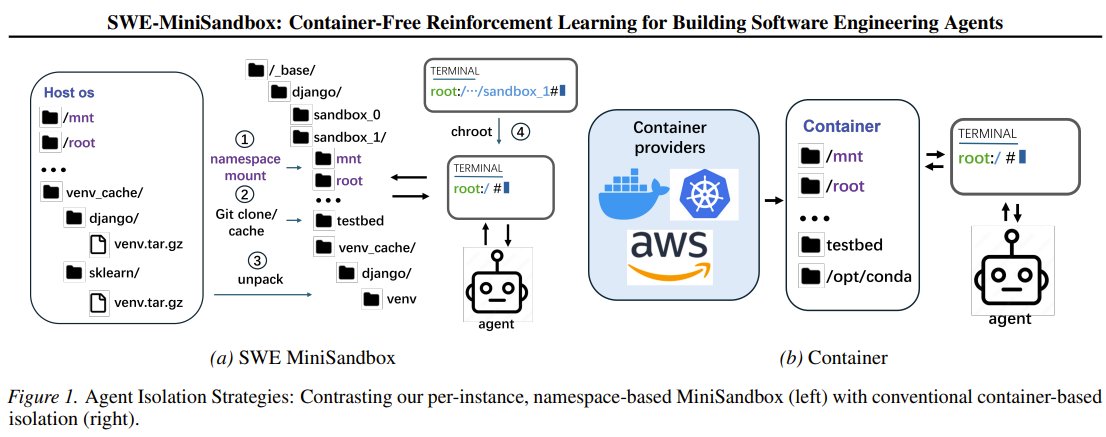
SWE-MiniSandbox: Container-Free RL for Software Engineering Agents
By
–
What if you could train AI software engineers faster, without the heavy overhead of containers? Researchers from Peking University, Ant Groupe, and The University of Hong Kong present SWE-MiniSandbox. This novel, container-free method uses kernel-level isolation and lightweight pre-caching, eliminating bulky container images for reinforcement learning. It achieves comparable performance to container-based pipelines while reducing disk usage by 95% and environment setup time by 75%, making scalable RL training far more accessible for software engineering agents. SWE-MiniSandbox: Container-Free Reinforcement Learning for Building Software Engineering Agents Paper: arxiv.org/abs/2602.11210 Code: github.com/lblankl/SWE-MiniS… Docs: lblankl.github.io/SWE-MiniSa… Our report: mp.weixin.qq.com/s/NlQLprZmM… 📬 #PapersAccepted by Jiqizhixin
→ View original post on X — @jiqizhixin, 2026-04-05 04:00 UTC