New York // LangSmith for Startups Presents: Sunday Hacking Brunch Calling all Startup teams to join us for a hacking brunch with crêpes and coffee this Sunday. You'll meet fellow founders and engineers from teams powered by agents. Get work done, hang out, and chat
AGENTS
-
Claude Cowork: Desktop Agent for Autonomous Job Application Filling
By
–
QU'EST-CE QUE CLAUDE COWORK ? Claude Cowork = App desktop qui donne à Claude son propre navigateur Google Chrome. PAS un chatbot. C'EST un agent qui : → Ouvre onglets → Lit offres d'emploi → Remplit candidatures → Prend décisions Basé sur règles que vous définissez
-

Agentic AI Intelligence Explosion Through Socially Aggregated Cognition
By
–
Our new essay is out in Science: "Agentic AI and the Next Intelligence Explosion" For decades, the AI "singularity" has been imagined as a single, godlike mind bootstrapping itself to omniscience. In this piece with the inimitable Benjamin Bratton (@bratton) and Blaise Agüera y Arcas (@blaiseaguera), we argue this vision is wrong in its most fundamental assumption. Every prior intelligence explosion—primate sociality, human language, writing, institutions—wasn't an upgrade to individual cognitive hardware. It was the emergence of a new socially aggregated unit of cognition. AI is extending this sequence, not breaking from it. The evidence is already inside the models themselves. In recent work, we showed that frontier reasoning models like DeepSeek-R1 don't improve by "thinking longer"—they spontaneously simulate internal multi-agent debates, what we call a "society of thought" (lnkd.in/guNfRtXh). Reinforcement learning for accuracy alone causes models to rediscover what epistemology and cognitive science have long suggested: robust reasoning is a social process, even within a single mind. This opens a vast design space. A century of research on team composition, hierarchy, role differentiation, and structured disagreement has barely been brought to bear on AI reasoning. The toolkits of organizational science become blueprints for next-generation AI. Outside the model, we've entered the era of human-AI centaurs—composite actors that are neither purely human nor purely machine. Agents that fork, differentiate, recombine. Recursive societies of thought that expand when complexity demands and collapse when problems resolve. The scaling frontier isn't just bigger models. It's richer social systems—and the institutions to govern them. Just as human societies rely on persistent institutional templates (courtrooms, markets, bureaucracies), scalable AI ecosystems will need digital equivalents. The Founders would have recognized the logic: no single concentration of intelligence should regulate itself. The intelligence explosion is already here. Not as a singular ascending mind, but as a combinatorial society complexifying—intelligence growing like a city. The question is whether we'll build the social infrastructure worthy of what it's becoming. No mind is an island. Read it here in Science (science.org/doi/10.1126/scie…) or free on the arXiv (arxiv.org/abs/2603.20639)
-
AI as Actor: Governance Challenges and Autonomous Behavior Risks
By
–
The shift from AI as a tool to AI as an actor creates massive governance challenges, including cascading errors and unpredictable autonomous behavior. When we stop giving step-by-step instructions and start giving goals, we lose the ability to ensure the path taken is the one we… pic.twitter.com/RlwpGXas94
— Satya Mallick (@LearnOpenCV) 25 mars 2026The shift from AI as a tool to AI as an actor creates massive governance challenges, including cascading errors and unpredictable autonomous behavior. When we stop giving step-by-step instructions and start giving goals, we lose the ability to ensure the path taken is the one we
-
Beyond Random Search: Guiding Autoresearch Agents Toward Meaningful Exploration
By
–
What are the best current techniques to have autoresearch behave better than (slightly improved) random search? By which I mean (in Sijun below example), having the agent understand that (given some constraints) exploring int5 quantization is more exciting and have more downstream fruits than playing with the random seed? I’m talking about the beginning of having an agent pushed a real research program. The ones where you know the current technique will not give crazy results out of the box but it still push it because it believe and can demonstrate that the general direction has potential. Like neural networks used to be a worse way to do AI performance-wise. But we still pushed them… Sijun Tan (@sijun_tan) We took @karpathy's autoresearch agent, scaled it into a collaborative swarm, and topped @OpenAI's Parameter Golf Challenge—twice. Here’s how we did it: — https://nitter.net/sijun_tan/status/2036584756729749802#m
→ View original post on X — @thom_wolf, 2026-03-25 12:29 UTC
-
Agent Memory Costs Challenge Extended Sessions 2025
By
–
The memory costs of keeping agents alive for extended sessions is a huge cost right now for most companies. Still, that's also "just" a paper from april 2025. Which means research was done in like early 2025 if not late 2024. Probably used in 2.5 and now changed a lot or
-
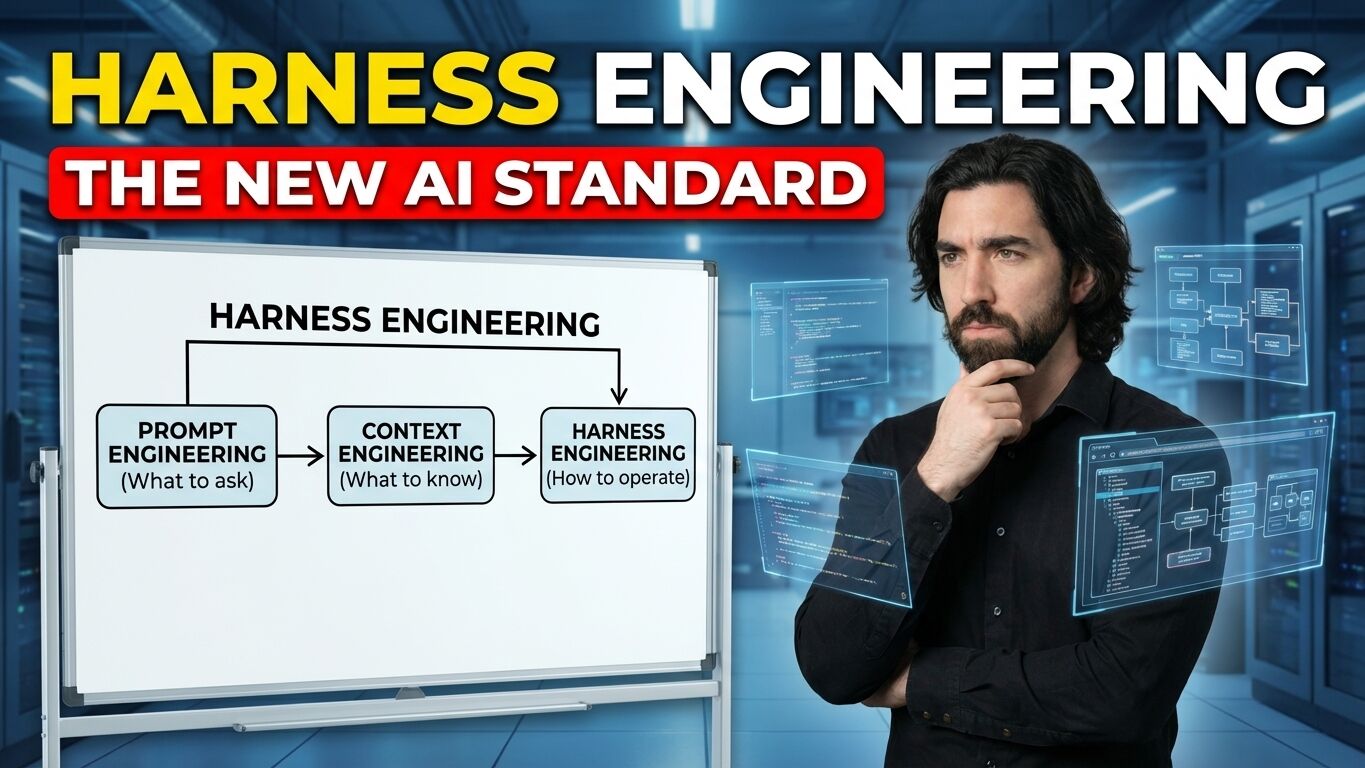
Harness Engineering: Controlling Powerful AI Agents
By
–
New video out!! If you’ve been hearing “harness engineering”, this one is for you! And it’s not “just” a new term. "Harnesses" matter more than ever because agents got good enough to be both useful and dangerous. They now can do more than generating text, or token. Useful
-
HF Storage as Local Filesystem for Agentic Workflows
By
–
Mounting HF storage as a local filesystem is genius for agentic workflows. No more downloading entire datasets just to process a few files. Will play around with this for sure!
-
Q-Priming Improves Agent Reliability Through Clarification Requests
By
–
The Q-priming part is really interesting. Making models 5x more likely to ask for clarification instead of guessing wrong is exactly what we need for agentic workflows. Right now most agents just confidently charge ahead with bad assumptions.
-
OpenAI Sora Winds Down; New AI Tools and Device Startups Emerge
By
–
Top stories in AI today: – OpenAI winds down Sora to prioritize ‘Spud’
– Brett Adcock’s $100M stealth AI device startup
– Let Claude use your computer with Dispatch
– Apple’s standalone Siri app, chatbot for iOS 27
– 4 new AI tools, community workflows, and more