AI Dynamics

Global AI News Aggregator

About

AGENTS

  • KiloClaw AI personal logistics assistant

    KiloClaw puede actuar como un asistente personal para la logística familiar. Pregúntale cómo es tu agenda y obtendrá información de tu calendario, correos electrónicos y chats familiares para darte un itinerario diario perfecto.
    → View original post on X — @s0n_ia_

  • How to set up the open-source KiloClaw AI agent tool

    KiloClaw sets up in less than 60 seconds. http://
    1.Ve to the Kilo panel
    2.Click on “Claw” and select your AI model
    3.Connect your Telegram, Discord, or Slack bot token
    4.Start chatting! It's completely open source and customizable.

    → View original post on X — @s0n_ia_

  • Human DDoS: New Cybersecurity Risk from Autonomous AI Systems

    AI agents are changing cyber defense, but they may also create a new denial-of-service layer: humans 🤯 New blog 👉The Few Humans Left: Risk of Denial Service Attacks on Humans trent.ai/blog/humans-ddos-ai… As autonomous systems scale, the few humans left in the loop inherit only: ☑️ambiguity ☑️edge cases ☑️final judgment calls That means the real bottleneck shifts from infrastructure to cognition. The system doesn’t need to be breached to fail. It just needs to overwhelm human decision-making. Eno Thereska, CEO & Co-Founder of Trent AI, calls this “human DDoS.” A key idea from our RSAC 2026 Cyber Startup Expo panel on machine-speed cyber battle. #AISecurity #CyberSecurity #AgenticAI #RSAC

    → View original post on X — @lawrennd, 2026-04-01 15:01 UTC

  • Anthropic releases Claudini for automated adversarial research against LLMs
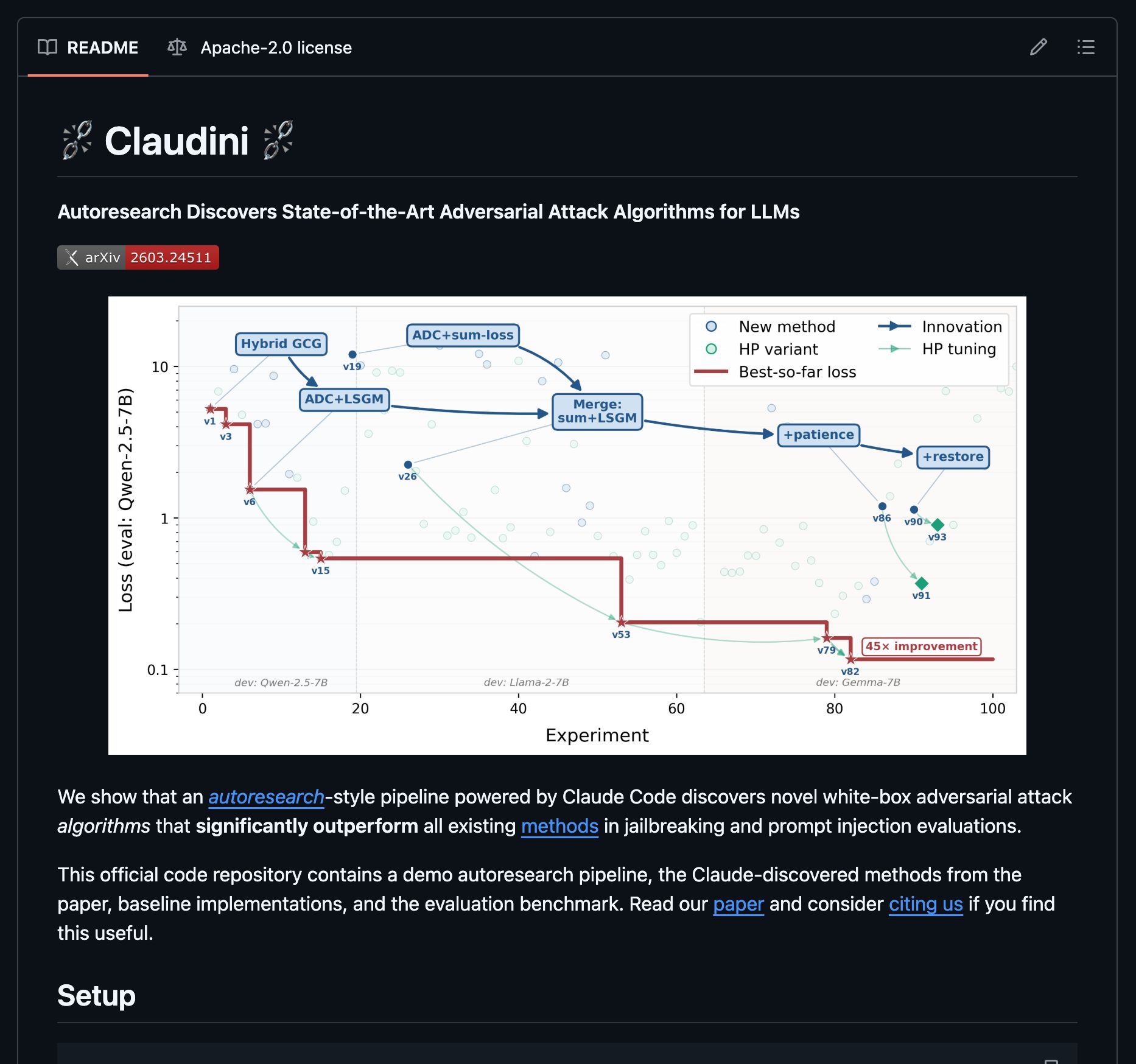
    Anthropic releases Claudini for automated adversarial research against LLMs

    56 loops of Claude Code just killed every hand-crafted AI attack method. Anthropic just open-sourced a repo called Claudini. It uses Claude Code in an autoresearch loop to automatically discover new adversarial attacks against LLMs. After 56 iterations, it found an

    → View original post on X — @alphasignalai

  • SaaS Evolution: Linear Pioneers Agent-Native Software Era

    SaaS isn’t dead, it just needs to become agent-native. Linear (
    @linear
    ) is a great example of how: They pivoted the product to be used by both humans and agents, and that has made them one of the premier software tools in the agent-native era. I had Linear’s cofounder and CEO

    → View original post on X — @danshipper

  • Self-Organizing LLM Agents Outperform Predefined Role Hierarchies
    Self-Organizing LLM Agents Outperform Predefined Role Hierarchies

    NEW papers on self-organizing LLM Agents. Assign an agent a role, and it'll follow instructions. Let agents figure out roles themselves, and they'll outperform your design. New research tested this across 25,000 tasks with up to 256 agents. The work shows that self-organizing LLM agents spontaneously develop specialized roles without any predefined hierarchy. A sequential coordination protocol outperformed centralized approaches by 14%, agents generated over 5,000 unique roles organically, and open-source models reached 95% of closed-source quality at significantly lower cost. Most multi-agent frameworks today start by defining roles: planner, coder, reviewer, critic. This paper provides large-scale evidence that the opposite approach works better. Give agents a mission, a protocol, and a capable model. The agents will figure out the rest. Paper: arxiv.org/abs/2603.28990 Learn to build effective AI agents in our academy: academy.dair.ai/

    → View original post on X — @dair_ai, 2026-04-01 14:35 UTC

  • MemFactory: Unified Framework for Trainable Agent Memory Systems
    MemFactory: Unified Framework for Trainable Agent Memory Systems

    // Unified Inference and Training Framework for Agent Memory // Most memory-augmented agents are built with duct tape—one system for storage, another for retrieval, a third for training. New research introduces a unified framework that treats agent memory as a first-class, trainable component. MemFactory provides modular, plug-and-play memory components with native GRPO integration for fine-tuning memory management policies through RL. It supports Memory-R1, RMM, and MemAgent paradigms in one framework, with up to 14.8% relative gains over baselines. Why does it matter? As agents move from single-turn tools to persistent assistants, memory becomes the bottleneck. MemFactory gives researchers standardized infrastructure to build, train, and evaluate memory-driven agents without reinventing plumbing for every new approach. Paper: arxiv.org/abs/2603.29493 Learn to build effective AI agents in our academy: academy.dair.ai/

    → View original post on X — @dair_ai, 2026-04-01 14:28 UTC

  • Code-as-Policy Framework for Robot Perception and Control

    Very excited about the prospect of Code-as-Policy (CaP) for Robotics! Esp with recent rapid advances in agentic coding. CaP has potential to quickly combine VLA models with GOFE primitives into interpretable code, observe experiments, and iterate. Initial results are promising: Max Fu (@letian_fu) Robotics: coding agents’ next frontier. So how good are they? We introduce CaP-X: an open-source framework and benchmark for coding agents, where they write code for robot perception and control, execute it on sim and real robots, observe the outcomes, and iteratively improve code reliability. From @NVIDIA @Berkeley_AI @CMU_Robotics @StanfordAILab capgym.github.io 🧵 — https://nitter.net/letian_fu/status/2039342130565357956#m

    → View original post on X — @ken_goldberg, 2026-04-01 14:25 UTC

  • Every Runs on Notion Agents for Workflow Automation
    Every Runs on Notion Agents for Workflow Automation

    we run all of @every on @NotionHQ one of the big reasons we love notion is notion agents. they run 24/7 in the background to help us: – prioritize work
    – plan out our strategy
    – organize knowledge
    – make sure everyone is on the same page on Friday we're doing a Custom

    → View original post on X — @danshipper

  • CaP-X: Open-Source Framework for Coding Agents in Robotics

    Robotics: coding agents’ next frontier. So how good are they? We introduce CaP-X: an open-source framework and benchmark for coding agents, where they write code for robot perception and control, execute it on sim and real robots, observe the outcomes, and iteratively improve code reliability. From @NVIDIA @Berkeley_AI @CMU_Robotics @StanfordAILab capgym.github.io 🧵

    → View original post on X — @berkeley_ai, 2026-04-01 14:00 UTC