Really excited for the release of 𝜏³-bench, which brings interactive agent evals ever closer to real-world use cases across two dimensions: 1. 𝜏-knowledge evaluates agents that need to operate over noisy knowledge bases to figure out the correct policies/tools to use while serving a user 2. 𝜏-voice tests voice agents in interactive customer service style settings. If you are developing embedding or voice models for AI agents, 𝜏³ is a great testbed for you to see how your models would perform in a realistic downstream use case. Blog: sierra.ai/blog/bench-advanci… Tweets from @BenShi34 and @keshav_57: nitter.net/benshi34/status/203436… nitter.net/keshav_57/status/20346…
AGENTS
-
LeWorldModel: Teaching AI to Simulate and Understand World
By
–
LeWorldModel: Teaching AI to Simulate and Understand the World
— Satya Mallick (@LearnOpenCV) 3 avril 2026
In this episode of Artificial Intelligence: Papers and Concepts, we explore LeWorldModel, a new approach to building AI systems that can model and simulate real-world environments. Instead of reacting to inputs… pic.twitter.com/Jlf3hbSIfvLeWorldModel: Teaching AI to Simulate and Understand the World In this episode of Artificial Intelligence: Papers and Concepts, we explore LeWorldModel, a new approach to building AI systems that can model and simulate real-world environments. Instead of reacting to inputs step-by-step, world models aim to learn underlying dynamics—allowing AI to predict outcomes, plan actions, and reason about future scenarios. We break down why traditional models struggle with long-term reasoning and planning, how world models enable a deeper understanding of cause and effect, and what this means for applications like robotics, gaming, and autonomous systems. If you’re interested in world models, reinforcement learning, or the future of AI systems that can think ahead and simulate reality, this episode explains why LeWorldModel represents an important step toward more general and intelligent AI. Resources: Paper Link: arxiv.org/pdf/2603.19312v1 Interested in Computer Vision and AI consulting and product development services? Email us at contact@bigvision.ai or visit us at bigvision.ai
→ View original post on X — @learnopencv, 2026-04-03 14:30 UTC
-
AI Coding Agents Reach Inflection Point in November 2025
By
–
My biggest takeaways from @simonw
: 1. November 2025 was an inflection point for AI coding. GPT 5.1 and Claude Opus 4.5 crossed a threshold where coding agents went from “mostly works” to “almost always does what you want it to do.” Software engineers who tinkered over the -
Agent AI Takes Action and Executes Results Independently
By
–
Most AI gives you ideas and tells you what to do, but you’re still stuck doing the work and hoping it actually works. Agent AI flips that by taking action itself, handling the execution, and being responsible for getting real results. pic.twitter.com/oPiCY94Ay4
— Satya Mallick (@LearnOpenCV) 3 avril 2026Most AI gives you ideas and tells you what to do, but you’re still stuck doing the work and hoping it actually works. Agent AI flips that by taking action itself, handling the execution, and being responsible for getting real results.
→ View original post on X — @learnopencv, 2026-04-03 13:32 UTC
-
OpenAI Shifts Focus to Automated Researchers and Agent Systems
By
–
Holy: OpenAI says it’s reallocating compute and talent toward its next generation of models, echoing the internal shift that preceded GPT-3.
— Chubby♨️ (@kimmonismus) 3 avril 2026
The focus now is on “automated researchers” and agent-based systems that can execute complex tasks end-to-end.
It’s a signal that the lab… pic.twitter.com/4jMc4eJgTRHoly: OpenAI says it’s reallocating compute and talent toward its next generation of models, echoing the internal shift that preceded GPT-3. The focus now is on “automated researchers” and agent-based systems that can execute complex tasks end-to-end. It’s a signal that the lab
-

8 RAG Architectures for AI Engineers: Complete Guide
By
–
8 RAG architectures for AI Engineers: (explained with usage) 1) Naive RAG – Retrieves documents purely based on vector similarity between the query embedding and stored embeddings. – Works best for simple, fact-based queries where direct semantic matching suffices. 2) Multimodal RAG – Handles multiple data types (text, images, audio, etc.) by embedding and retrieving across modalities. – Ideal for cross-modal retrieval tasks like answering a text query with both text and image context. 3) HyDE (Hypothetical Document Embeddings) – Queries are not semantically similar to documents. – This technique generates a hypothetical answer document from the query before retrieval. – Uses this generated document’s embedding to find more relevant real documents. 4) Corrective RAG – Validates retrieved results by comparing them against trusted sources (e.g., web search). – Ensures up-to-date and accurate information, filtering or correcting retrieved content before passing to the LLM. 5) Graph RAG – Converts retrieved content into a knowledge graph to capture relationships and entities. – Enhances reasoning by providing structured context alongside raw text to the LLM. 6) Hybrid RAG – Combines dense vector retrieval with graph-based retrieval in a single pipeline. – Useful when the task requires both unstructured text and structured relational data for richer answers. 7) Adaptive RAG – Dynamically decides if a query requires a simple direct retrieval or a multi-step reasoning chain. – Breaks complex queries into smaller sub-queries for better coverage and accuracy. 8) Agentic RAG – Uses AI agents with planning, reasoning (ReAct, CoT), and memory to orchestrate retrieval from multiple sources. – Best suited for complex workflows that require tool use, external APIs, or combining multiple RAG techniques. 👉 Over to you: Which RAG architecture do you use the most? _____ Share this with your network if you found this insightful ♻️ Find me → @akshay_pachaar ✔️ For more insights and tutorials on LLMs, AI Agents, and Machine Learning!
→ View original post on X — @akshay_pachaar, 2026-04-03 12:54 UTC
-

HACRL: AI Agents Learn Together Without Losing Autonomy
By
–
What if diverse AI agents could mutually learn and improve without sacrificing their autonomy? Researchers from Beihang University, Bytedance China, Tsinghua University, and Peking University have just unveiled Heterogeneous Agent Collaborative Reinforcement Learning (HACRL)! This innovative framework allows different types of AI agents to share verified learning experiences during training, creating a bidirectional flow of knowledge to enhance performance for everyone. Unlike other multi-agent systems, it requires no coordinated deployment and fosters true peer-to-peer growth, not one-way teaching. Their HACPO algorithm consistently boosts all participating agents, outperforming GSPO by 3.3% on diverse reasoning benchmarks while dramatically cutting training data costs in half. Heterogeneous Agent Collaborative Reinforcement Learning Paper: arxiv.org/abs/2603.02604 Github Page: zzx-peter.github.io/hacrl/ Huggingface: huggingface.co/papers/2603.0… Our report: mp.weixin.qq.com/s/ggzim_4Pc… 📬 #PapersAccepted by Jiqizhixin
→ View original post on X — @jiqizhixin, 2026-04-03 12:43 UTC
-

Free Access to Claude Code Workshop and LLM Knowledge Bases Session
By
–
Wow! There is so much interest in this. Months ago, I spoke on this idea in a live workshop. Access it for FREE for the next couple of days: academy.dair.ai/dashboard/co… I am also hosting a live session on building LLM Knowledge Bases for your agents: academy.dair.ai/dashboard/ev…
-
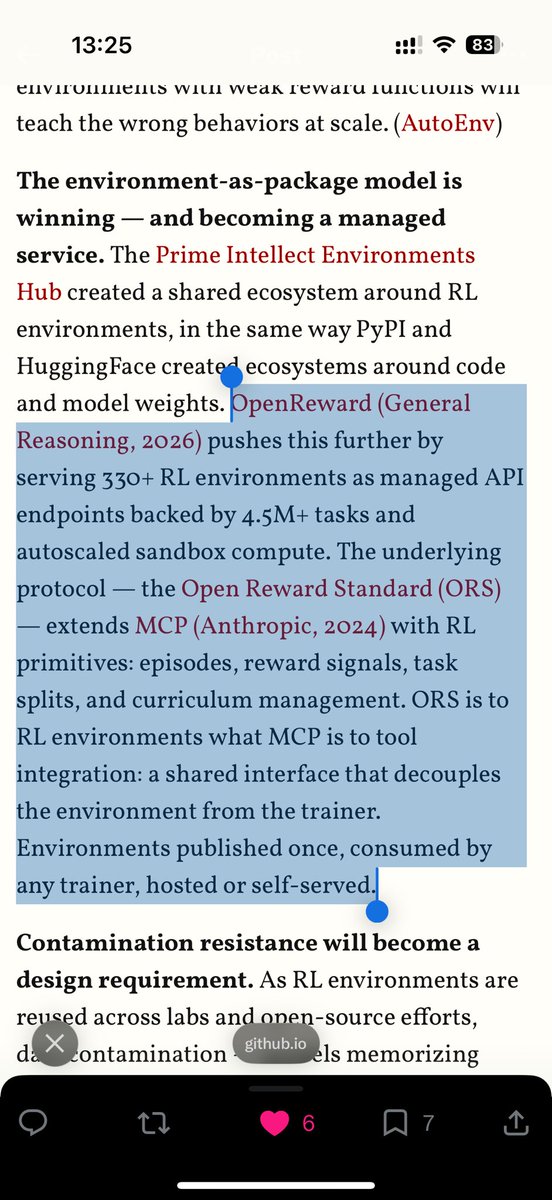
Ross Taylor shares article on RL environments for LLM agents
By
–
✌️ Ross Taylor (@rosstaylor90) Really enjoyed this article by @HanchungLee leehanchung.github.io/blogs/… — https://nitter.net/rosstaylor90/status/2040038533390365152#m
→ View original post on X — @nathanbenaich, 2026-04-03 12:27 UTC
-
LLM-Powered Knowledge Base Automation at Towards AI
By
–
I do something similar with Cowork and skills at Towards AI, having the LLM maintain the knowledge base itself instead of me editing it manually changed everything. The "compile" framing is perfect.