we just opened up 5 new roles @every
: – GTM engineer
– Head of Finance Vertical, Consulting
– Head of Learning and Development
– Head of Product Marketing
– Head of Social if you want to help discover and define how the world works with agents over the next 10 years—join us:
AGENTS
-

Five New Roles Open: Agents and GTM Leadership Positions
By
–
-

Chatbot Personas: Engineering Choice with Dangerous Consequences
By
–
We take it for granted that the current form of artificial intelligence is a chat bot, which talks to you like a character, displaying a persona. That is not accidental. It is part of the whole history of Gen AI leading up to ChatGPT and its peers, Claude and Gemini. Researchers are finding out the deep downside of this particular engineering choice. A program with a persona will follow that persona to its logical conclusion, including generating output that seeks to cheat at a task, or sending blackmail threats. All of this comes out of the history of today’s LLMs, the quest to design better an better chat bots. The engineers succeeded, and we’re going to face the consequences. ===> Your chatbot is playing a character – why Anthropic says that's dangerous Researchers found that part of what makes chatbots so compelling also makes them vulnerable to bad behavior. Here's why. zdnet.com/article/anthropic-… @AnthropicAI
→ View original post on X — @tiernanraytech, 2026-04-06 16:42 UTC
-
ASI-Evolve: AI System Achieving Self-Improving Automated Research
By
–
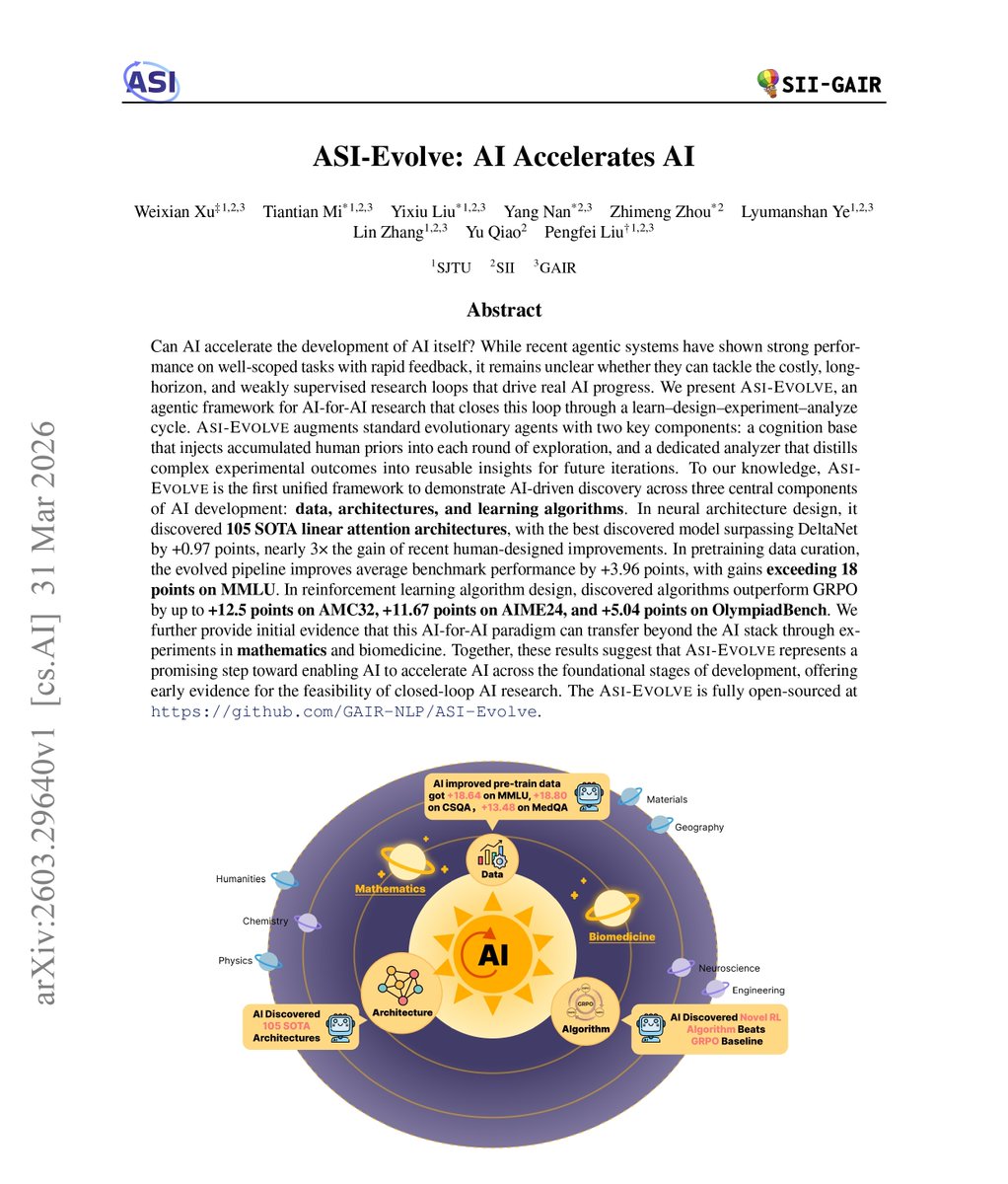
wow, insane AI news We may have just crossed the line where AI research becomes automated and self improving. This paper introduces ASI-Evolve, a system where AI doesn’t just use tools… it becomes the researcher. Instead of humans designing better models, AI now runs a full scientific loop on itself: learns from past research designs new ideas runs experiments analyzes results improves itself… again and again It already produced real results: Discovered 100+ new neural architectures Beat human designed improvements by ~3x Improved training data pipelines significantly Invented new RL algorithms outperforming existing ones AI/acc
→ View original post on X — @deeplearn007, 2026-04-06 16:25 UTC
-
Building Open-Source Frontier Agents Through Crowdsourced Dataset Sharing
By
–
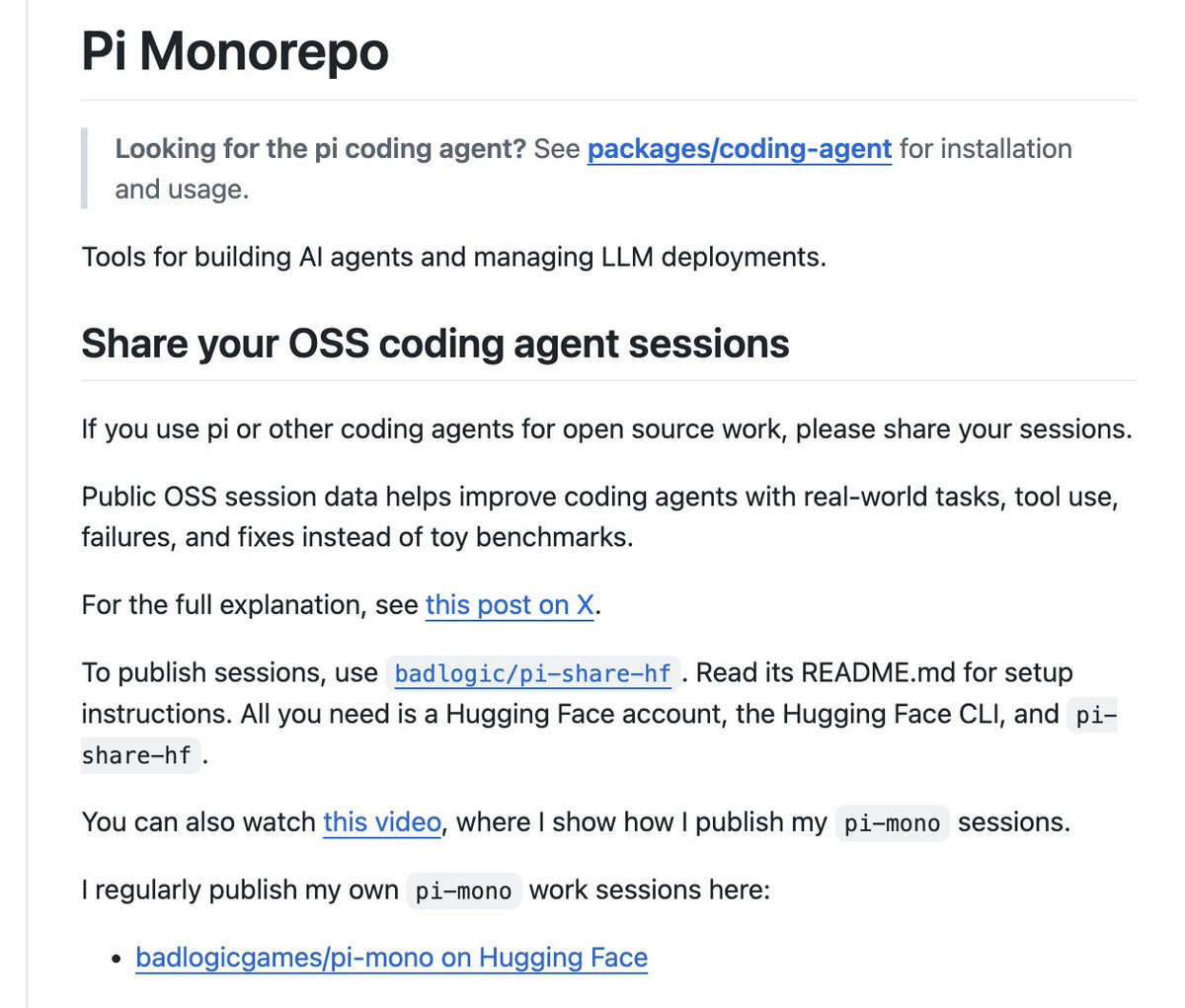
We keep saying we want open-source frontier agents. Fine. Then let’s build the dataset. @badlogicgames, creator of Pi, just shared some of his agent traces used to build Pi on @huggingface. I’m now sharing some of mine too, exporting them from @hermes, @opencode, and Claude via @tracesdotcom, and I’ll keep going. Why this matters: one of the biggest bottlenecks for open-source agent models is the data. And all of us are generating that data every day through our conversations with agents. If enough builders share even a slice of their traces publicly, we can create the largest crowdsourced open dataset for agents. Time to put your tokens where your mouth is and give a chance for open source to win!
→ View original post on X — @clementdelangue, 2026-04-06 16:22 UTC
-
Meta Harnesses: Automated Framework Optimization for AI Tasks
By
–
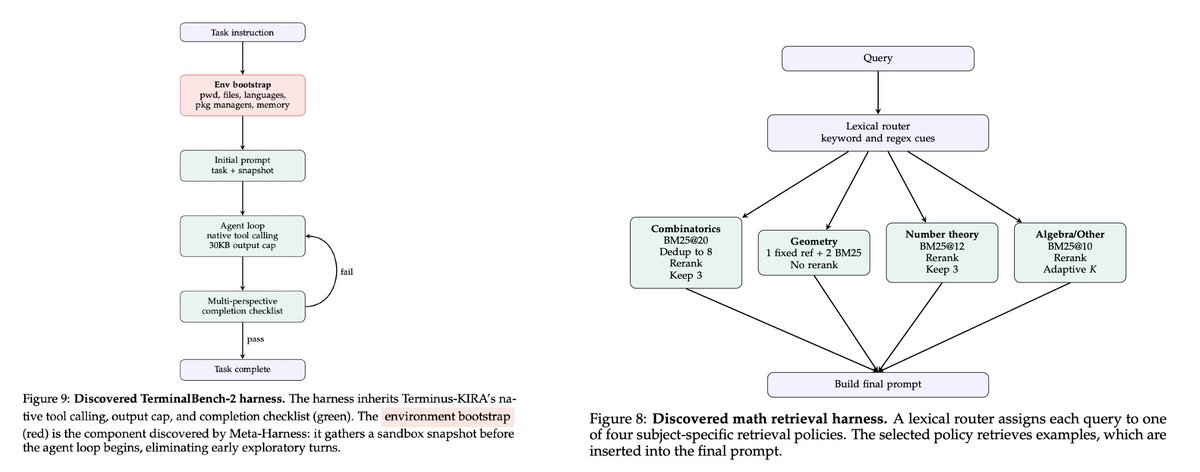
Meta Harnesses is Autoresearch on steroids. Something I've been exploring recently is to get long running agents to hill climb on a verifiable task to continuously improve without my intervention. Karpathy's Autoresearch did this pretty well on specific tasks, but this weekend I tried Meta Harnesses which moves one level of abstraction up. What does Meta Harness do? Autoresearch can be used in harness like Claude Code / Codex to generate experiments to try, evaluate results, and continue looping. Meta Harness generates a harness itself that optimizes on a task or a set of task. Here, we define a harness as "a single-file Python program that modifies task-specific prompting, retrieval, memory, and orchestration logic". The idea is that LLMs are very powerful today, but to harness [pun intended] their power, you need to give it the right prompts and context. Meta Harnesses automates coming up with the right prompts and the right way to retrieve context to solve a problem. Where did this idea come from? This is from a paper from Stanford and the author of DSPy written last week. The paper shows fantastic performance on 3 tasks: text classification, math reasoning (IMO level problems) and coding (Terminal Bench 2.0), far outperforming traditional harnesses. The discovered harnesses are interesting: math for example, splits up the logic into different categories (Combinatorics, Geometry, Number Theory, Algebra) and prompts and looks at the context differently. The coding harness, amongst other things, pre-processes the tools available in the environment to save exploratory turns. When should you use and not use it? Meta Harnesses seem pretty useful for tackling a specific but wide set of problems where the result is verifiable. In contrast, when I tried it on a specific task like Chess, it arbitrarily divides the problem into separate tasks – opening, mid game, end game, and creates different approaches for each. This "works" but isn't really clean because we believe there should be one approach that does all three. It does far better on things like examinations (JEE, Gaokao) where it splits problems into categories and tackles each category with different strategies. This paper covers a pretty light version of what a harness means. In the future, we can split up tasks into harnesses that have access to specific kinds of data, specific toolchains and various models to get even better results. Overall, pretty cool applied AI approach to hillclimb a verifiable task in a specific domain with variety within the problem space.
→ View original post on X — @askalphaxiv, 2026-04-06 16:22 UTC
-

OSGym: Scalable Infrastructure for Computer Use AI Agents
By
–
How do you train AI agents that can use computers like humans? Introducing OSGym: Scalable OS Infrastructure for Computer Use Agents. It’s large-scale training made possible by extensive infra optimization: • 1024 OS sandboxes running in parallel • $0.23 / sandbox / day (90% cost down) • 1420 trajectories per minute • 37× faster disk provisioning • 88% less physical disk usage • RAM-bound orchestration (10× scalable than CPU-bound) 🧵
→ View original post on X — @mit_csail, 2026-04-06 16:22 UTC
-

Autonomy and Scale: Vincent Boucher on AGI Alpha and AI Agents
By
–
"Autonomy & Scale" Vincent Boucher, President of @Montreal_AI and @Quebec_AI: linkedin.com/pulse/autonomy-… #AGIALPHA #AIAgents #Jobs
→ View original post on X — @montreal_ai, 2026-04-06 16:07 UTC
-

Architect: Rapid Transformation of Use Cases into Intelligent Systems
By
–
Architect facilitates the transformation from a use case prompt to an intelligent system with a working UI in minutes. If you are looking to automate your own client-related tasks, you can explore the platform here: architect.new/ [Translated from EN to English]
→ View original post on X — @kimmonismus, 2026-04-06 16:04 UTC
-
Automating Operational Overhead for Solo Consultant Success
By
–
7/ For solopreneurs, the bottleneck is usually operational overhead. This system handles the repetitive administrative tasks so I can focus on the actual consulting work. The connected agentic workflows ensure nothing falls through the cracks.
→ View original post on X — @kimmonismus, 2026-04-06 16:04 UTC
-
Agentic Layer: Logic, Workflows, and Intake Data Qualification
By
–
5/ Next was the Agentic Layer. This is where the actual logic lives. Architect configured the agentic workflows to handle the thinking parts: qualifying the intake data and triggering the welcome communications based on the project type.
→ View original post on X — @kimmonismus, 2026-04-06 16:04 UTC