
When should AI agents actually reach for external tools? Researchers from Edinburgh, CUHK, UIUC, Northwestern & Princeton present Theory of Agent (ToA) at ICML 2026. Their answer: only when epistemically necessary — meaning the agent cannot complete the task reliably using its
AGENTS
-
Chat tools hit ceiling when context window full; become CI pipeline
By
–
That's a good way to frame it. Chat tools hit a ceiling when the task outgrows what one context window can hold. Once the plan lives in executable code with parallel agents, resumability, and convergence loops, it's closer to a CI pipeline than a conversation.
-
Adversarial verification loop prevents organized wandering
By
–
Both, actually. The adversarial verification loop is what prevents organized wandering. Agents don't just fan out and report back. Other agents actively try to refute findings. The system keeps iterating until answers converge, not until agents run out of things to do. So scope
-
Claude Code execution plan and JS script diffing for guardrails
By
–
That's a sharp point. Claude Code already does this partially. The first time a workflow triggers, it shows the execution plan and asks for confirmation. But diffing the actual JS script across runs is a different level of control. Especially for teams trying to set guardrails
-
Workflow runtime saves progress, agents return cached results
By
–
Both. The workflow runtime saves progress as it goes, so a failed agent doesn't kill the run. Completed agents return cached results on resume. And the convergence loop means other agents can independently cover what a failed one missed. It's less "retry the exact call" and
-
Dynamic Workflows solve context bloat by moving results to JS
By
–
Exactly. That's the architectural insight most people gloss over. In a normal subagent setup, every result flows back into Claude's context window. More agents = more context bloat = earlier compaction = degraded quality. Dynamic Workflows solve that by moving results into JS
-
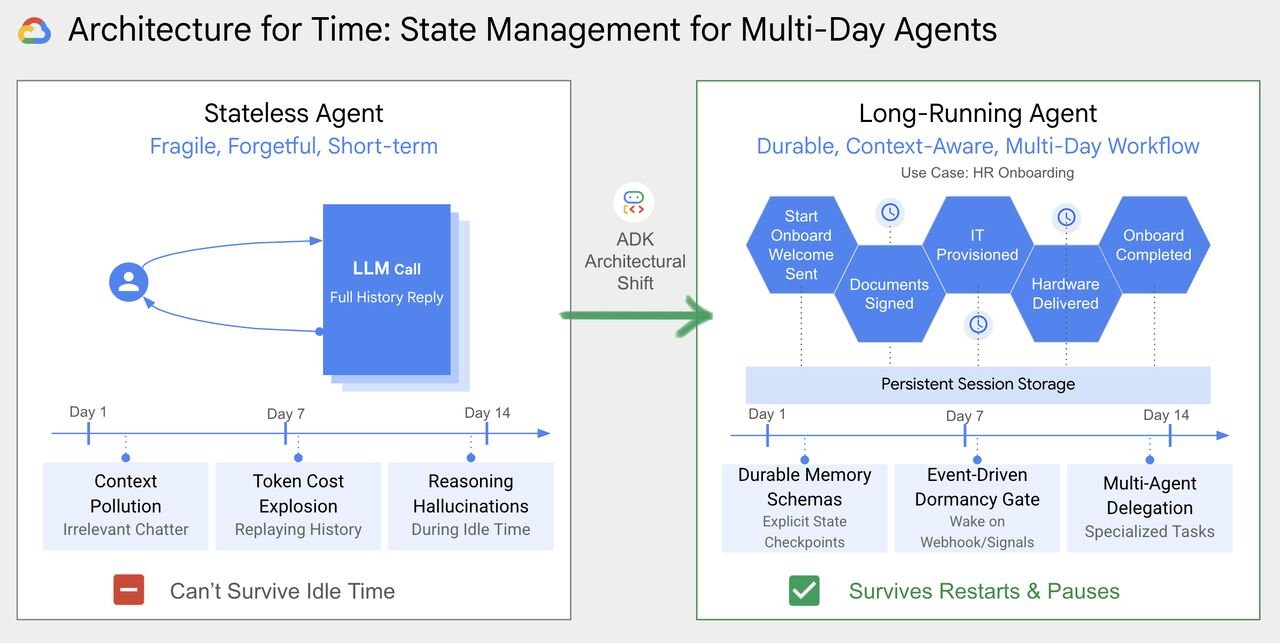
Build Persistent AI Agents with Google ADK and CLI
By
–
Build long-running AI agents that pause for days, survive restarts, and resume without losing context using Google Agent Development Kit and Agents CLI. Step-by-step tutorial with 100% Opensource code.
-
Using AI Agents for Code Orchestration and Workflows
By
–
this! codex can create and interact with threads across projects and tasks – all you need to do is ask
— Vaibhav (VB) Srivastav (@reach_vb) 29 mai 2026
I’ve used this recently orchestrate multiple worktrees and implement a feature with different PoVs using subagents
and ofcourse to archive, unarchive and find relevant threads… https://t.co/LmIKytkCz6this! codex can create and interact with threads across projects and tasks – all you need to do is ask I’ve used this recently orchestrate multiple worktrees and implement a feature with different PoVs using subagents and ofcourse to archive, unarchive and find relevant threads
-

AI Agent Skills for Video Search and Summarization
By
–
Hours of video, now searchable by your agent. We just released a new set of agent skills and modular architecture for the Metropolis Blueprint for Search and Summarization, eliminating the need for manual configuration of multiple microservices. Load the skills into a
-
Dell AI Factory with NVIDIA Redefines Enterprise AI
By
–
Our CEO Jensen Huang and @Dell Chairman & CEO Michael Dell kicked things off at #DellTechWorld in Las Vegas with a look at how the Dell AI Factory with NVIDIA is redefining how companies build, run, and scale AI.
— NVIDIA (@nvidia) 29 mai 2026
We saw NemoClaw powering agentic AI on-prem, robots demonstrating… pic.twitter.com/V6IDEiTaCAOur CEO Jensen Huang and @Dell Chairman & CEO Michael Dell kicked things off at #DellTechWorld in Las Vegas with a look at how the Dell AI Factory with NVIDIA is redefining how companies build, run, and scale AI. We saw NemoClaw powering agentic AI on-prem, robots demonstrating