
COPILOT : Microsoft is working on its own super app along with a new always-on agent called Scout according to Sources. This UI looks familiar

By
–
COPILOT : Microsoft is working on its own super app along with a new always-on agent called Scout according to Sources. This UI looks familiar
By
–
我们新设计了 EverOS 的界面, 现在主要想突出两个点。
— 艾略特 (@elliotchen100) 30 mai 2026
第一,它是面向 AI Agent 的“长程记忆操作系统”。
传统 LLM 应用更多依赖短期上下文,而 EverOS 试图把 agent… pic.twitter.com/mwLmJLrFXj
We have redesigned the EverOS interface, and we now wish to highlight two main points. First, it is a "long memory operating system" designed for AI agents. Traditional LLM applications rely more on context to

By
–
When should AI agents actually reach for external tools? Researchers from Edinburgh, CUHK, UIUC, Northwestern & Princeton present Theory of Agent (ToA) at ICML 2026. Their answer: only when epistemically necessary — meaning the agent cannot complete the task reliably using its
By
–
That's a good way to frame it. Chat tools hit a ceiling when the task outgrows what one context window can hold. Once the plan lives in executable code with parallel agents, resumability, and convergence loops, it's closer to a CI pipeline than a conversation.
By
–
Both, actually. The adversarial verification loop is what prevents organized wandering. Agents don't just fan out and report back. Other agents actively try to refute findings. The system keeps iterating until answers converge, not until agents run out of things to do. So scope
By
–
That's a sharp point. Claude Code already does this partially. The first time a workflow triggers, it shows the execution plan and asks for confirmation. But diffing the actual JS script across runs is a different level of control. Especially for teams trying to set guardrails
By
–
Both. The workflow runtime saves progress as it goes, so a failed agent doesn't kill the run. Completed agents return cached results on resume. And the convergence loop means other agents can independently cover what a failed one missed. It's less "retry the exact call" and
By
–
Exactly. That's the architectural insight most people gloss over. In a normal subagent setup, every result flows back into Claude's context window. More agents = more context bloat = earlier compaction = degraded quality. Dynamic Workflows solve that by moving results into JS
By
–
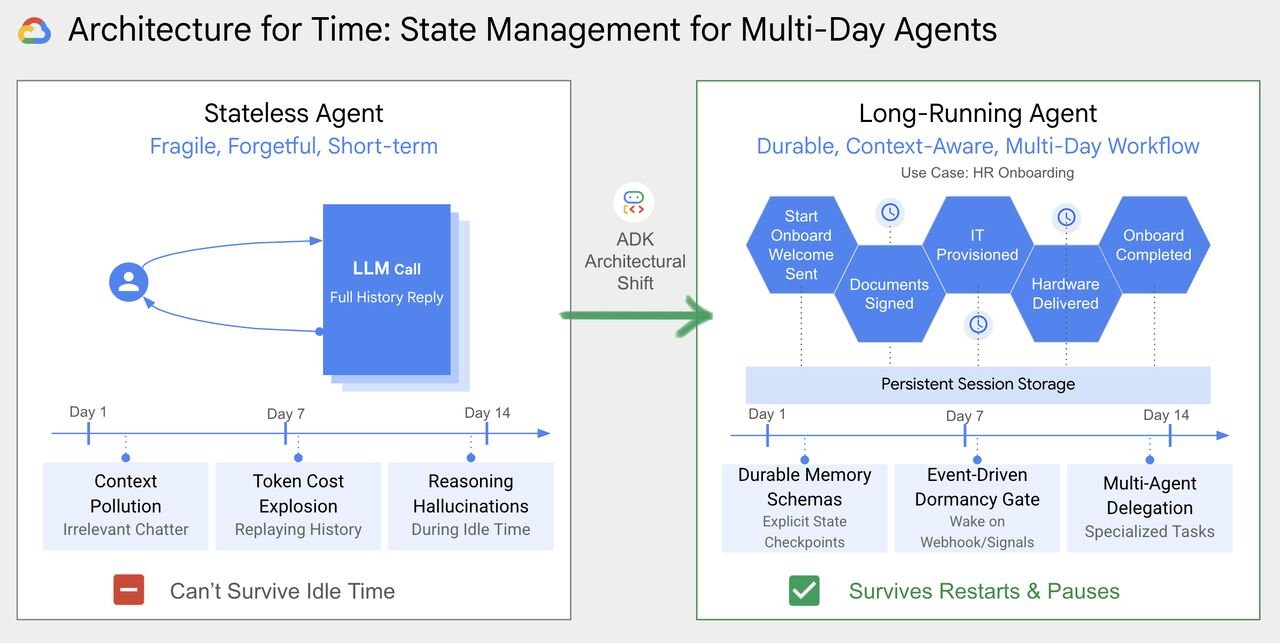
Build long-running AI agents that pause for days, survive restarts, and resume without losing context using Google Agent Development Kit and Agents CLI. Step-by-step tutorial with 100% Opensource code.
By
–
this! codex can create and interact with threads across projects and tasks – all you need to do is ask
— Vaibhav (VB) Srivastav (@reach_vb) 29 mai 2026
I’ve used this recently orchestrate multiple worktrees and implement a feature with different PoVs using subagents
and ofcourse to archive, unarchive and find relevant threads… https://t.co/LmIKytkCz6
this! codex can create and interact with threads across projects and tasks – all you need to do is ask I’ve used this recently orchestrate multiple worktrees and implement a feature with different PoVs using subagents and ofcourse to archive, unarchive and find relevant threads