Tests passing while complexity explodes from 29 to 285 is the perfect illustration of why benchmarks are misleading right now. The field keeps measuring "can AI write code" when the real question is "can it maintain software." Very different things.
@whats_ai
-
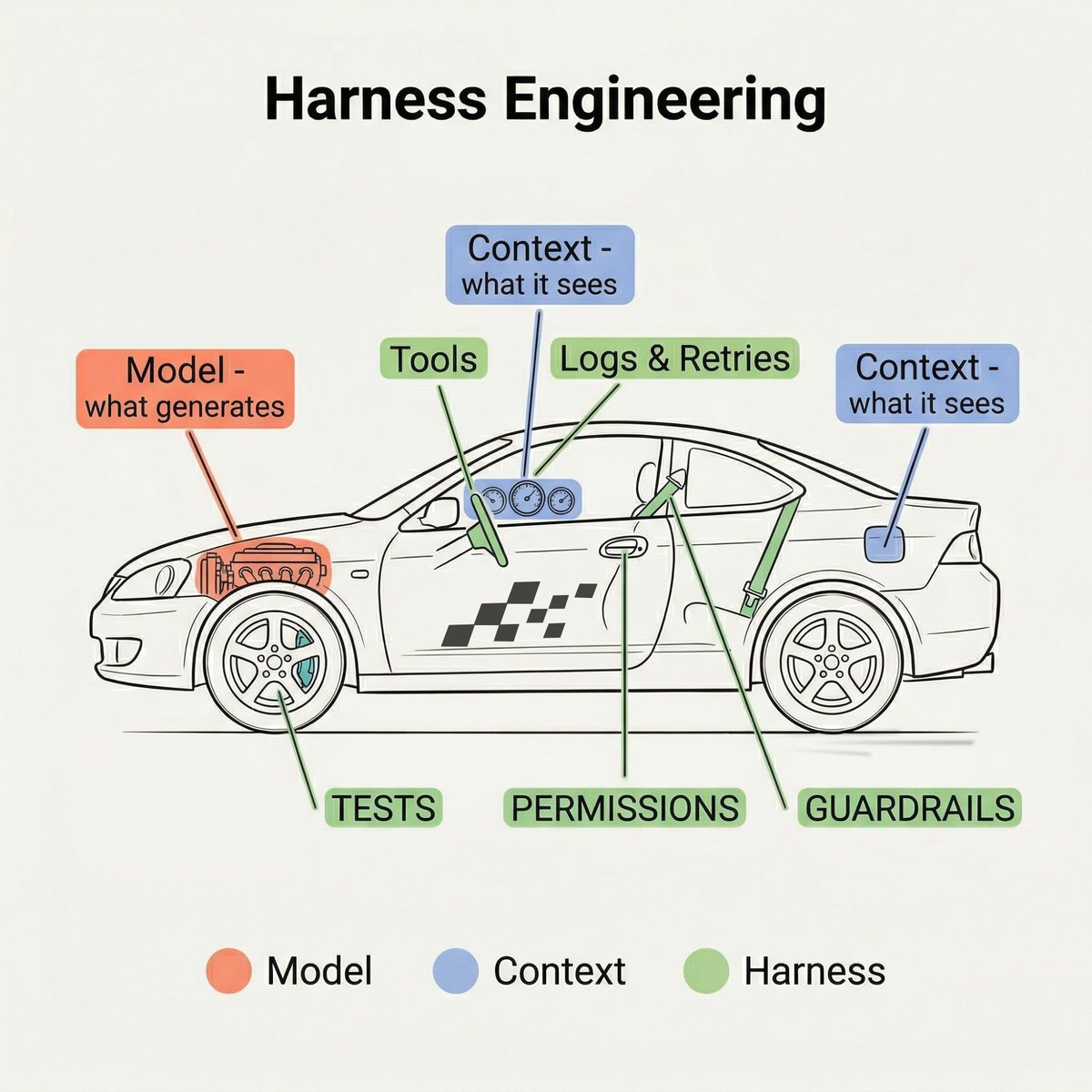
Harness Engineering: Building Better AI Agent Systems
By
–
I let Claude Code loop for 45 minutes while I was at the gym. Came back. It told me the feature was done. It wasn't. It hadn't even run the tests. Not because the model is dumb. Because I wrapped it in nothing but a loop and a dream. That's harness engineering in one sentence. And no, it's not prompt engineering with a fancier name. The model is the engine. Context is the fuel. The harness is the rest of the car. Steering. Brakes. Lane boundaries. Warning lights. Tools, permissions, tests, retries, guardrails. Engine + fuel but not strong parts in it = dangerous car. So I stopped tuning the engine and started building the car around it. In every skill file (Claude Code, Claude Co-work), I added one last step. After each interaction, the agent reflects on what I liked, what I edited, what failed. Then it updates its own skill to be better next time. Token usage dropped (a lot). Output quality went up. Compounding improvement with zero extra effort from me. LangChain did something similar at a bigger scale. Changed only the harness on a coding agent. Same model. Went from outside the top 30 to top 5 on a benchmark. Same engine, completely different results, just because the car around it was better. Next time your agent breaks, don't blame the model. Fix the car. P.S. Do your agents learn from their mistakes, or do they keep making the same ones?
-
Anthropic Expands Into Voice Technology With Full Stack Integration
By
–
Anthropic moving into voice is something. Owning the full stack from reasoning to voice makes sense if you want to control the experience end-to-end.
-
Claude Code Training: Bridging Installation and Productive Mastery
By
–
The demand for proper Claude Code training is real. We're building similar practical content at Towards AI Academy, the gap between "I installed it" and "I'm actually productive with it" is huge.
-
Research Workflow Standardization for AI Teams
By
–
Same here! We use skills and md setup with the same docs we give to juniors. The research workflow standardization has been a game changer for us at Towards AI.
-
AI Hallucinations in Medical Contexts: Reliability Concerns
By
–
Hallucinations in medical contexts is a bit alarming TBH. Jagged intelligence at its finest, brilliant at some things and completely unreliable at others.
-
AI Providers Blur Line Between Personal Use and Product Monetization
By
–
Interesting move. The line between "personal use" and "powering a product" is getting blurry fast for all the AI providers.
-
Exploring New Open Source AI Models
By
–
Excited to play around with this one! Always nice to see new open models.
-
AI Exhaustion: The Cognitive Load of Running Multiple Agents Daily
By
–
The AI exhaustion point is so real. I run multiple agents daily and the cognitive load of reviewing and directing is genuinely harder than just doing it yourself sometimes. Especially when the task is simple but long to do, at least it used to not require mental efforts. Now I
-
Fine-tuning vs Retrieval: Fixing Hallucinations About Company Docs
By
–
If your model is hallucinating about your company docs, fine-tuning is usually not the fix.
— Louis-François Bouchard 🎥🤖 (@Whats_AI) 4 avril 2026
That’s the trap.
A lot of teams see wrong answers about internal files and assume they need to retrain the model. But fine-tuning changes behavior, not factual recall of constantly… pic.twitter.com/LBVCwJbm3YIf your model is hallucinating about your company docs, fine-tuning is usually not the fix. That’s the trap. A lot of teams see wrong answers about internal files and assume they need to retrain the model. But fine-tuning changes behavior, not factual recall of constantly changing company knowledge. It can help with tone, structure, or broad domain patterns. It is not the best tool for making a model reliably remember your latest return policy, pricing sheet, or product catalog. For that, you usually want retrieval. In other words: fine-tuning teaches patterns, retrieval supplies facts. So if the issue is accuracy on specific documents, give the model better access to the right context instead of trying to bake those facts into its parameters. It is cheaper, easier to update, and much more controllable. Mixing those two up is one of the fastest ways to waste time and budget in AI. Have you seen teams make this mistake already?