
But I think the biggest news is just how *fast* the turnaround is. At ~75 days median, that's 2.5 months from submission to notification. The big conferences (NeurIPS, ICML, ICLR) are closer to 4 months. And much faster than JMLR, which takes > 200 days to first reviews. 5/n
@thegautamkamath
-
TMLR publishes 188 papers with 62% acceptance rate
By
–
TMLR numbers:
– 651 submissions
– 188 accepted papers
– currently ~100 submissions/month
– 189 action editors
– 1846 reviewers
– acceptance rate: 62% (46% if you count desk rejections and withdrawls)
– median time to decision: 76 days (#NeurIPS2022: 118 days, JMLR: >200 days) 2/n -
TMLR releases first year operations report highlights
By
–
TMLR (
@TmlrOrg
) just put out a report on their first (almost) year of operations. Here's a with some of the highlights. https://
docs.google.com/document/d/1tJ
Tw-LUJqENC5yxwmcTqlj4_Va1fWFqv7Lxt3eKMcqE/
… 1/n -
Machine Unlearning Failures: Adaptivity and Request Ordering Limitations
By
–
And https://
arxiv.org/abs/2106.04378 by Gupta @crispy_jung @sethvneel @Aaroth Sharifi-Malvajerdi @ChrisWaites which shows that adaptivity and ordering of MU requests can fail to cause a point to be unlearned, even if the requests are fulfilled honestly. 9/n -
Camouflage Poisoning Attack on Machine Learning Models
By
–
For more details, please check out the paper and the code! And definitely remember the names of the first authors, Waterloo undergrads Jimmy Di (applied to grad schools this year) and Jack Douglas. https://
arxiv.org/abs/2212.10717 https://
github.com/Jimmy-di/camou
flage-poisoning
… 10/10 -
Adversarial Attacks on Machine Learning Model Updates Research
By
–
We were inspired by previous papers in the "attacking MU" space. See https://
arxiv.org/abs/2109.08266 by Marchant @bipr @ScottAlfeld
, which poisons MU to make it take longer. 8/n -
Defending Against Data Poisoning Through Strategic Point Addition
By
–
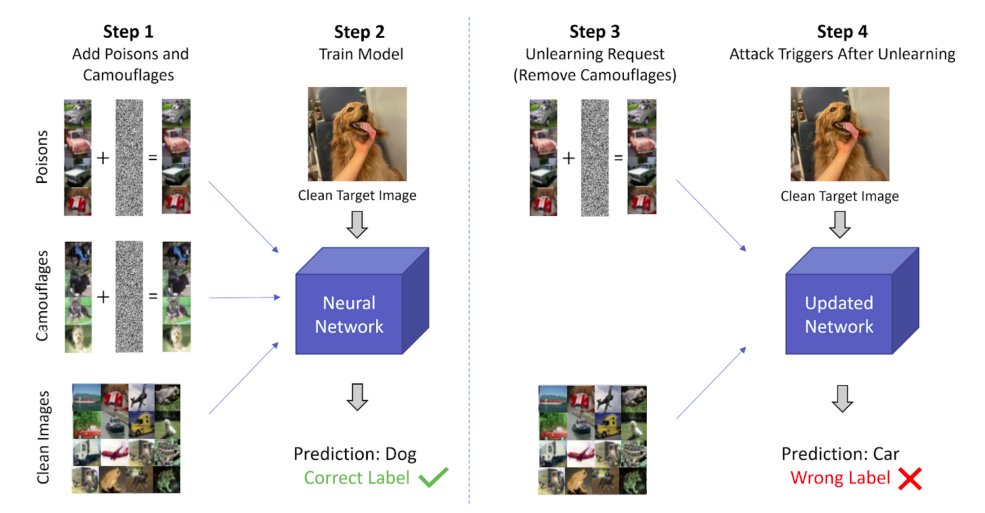
From a technical perspective, we raise an interesting new question. Usually, one mitigates data poisoning attacks by *removing* training points. But camouflage essentially asks: can you negate data poisoning attacks by *adding* points! Interesting beyond MU. 7/n
-
Dataset Poisoning Attack via Malicious Machine Unlearning
By
–
Here's how it works. The adversary first poisons the dataset, and the victim trains a model on it. Everything behaves as normal. But the adversary later requests some of their points to be unlearned. Only after the unlearning, then the model behaves in some malicious way. 4/n
-
Targeted Poisoning Attacks in Machine Learning Models
By
–
In this work we focus on targeted poisoning attacks (the goal is to misclassify a specific point in the test set) & used this attack (
https://
arxiv.org/abs/2009.02276) ft @jonasgeiping @wronnyhuang @tomgoldsteincs
. But ours is a proof of concept, neither is intrinsic to the framework. 5/n -
Camouflage Data Poisoning Attacks in ML Unlearning Systems
By
–
But when you add something new to an ML pipeline, there's new ways for adversaries to wreak havoc. We introduce a new type of data poisoning attack exploiting the dynamic nature of unlearn requests: a "camouflage" attack, which lies dormant until triggered by the adversary. 3/n