We're hiring data science postdocs! Work on interdisciplinary projects in causal inference, ML, econometrics, and more. Recent PhDs with coding expertise and cross-disciplinary experience are encouraged to apply: https://
datascience.stanford.edu/programs/data-
science-fellows
…
@stanfordhai
-

Stanford Hiring Data Science Postdocs in Causal Inference
By
–
-
Stanford HAI Researchers Predict AI Trends for 2026
By
–
What’s next in AI in 2026? Stanford HAI's leading researchers just dropped their predictions: @landay https://t.co/0eRDUypDCZ pic.twitter.com/laz63RarMR
— Stanford HAI (@StanfordHAI) 19 décembre 2025What’s next in AI in 2026? Stanford HAI's leading researchers just dropped their predictions: @landay https://
hai.stanford.edu/news/stanford-
ai-experts-predict-what-will-happen-in-2026
… -
AI Models 280x Cheaper, Adoption Soars to 78% in 2025
By
–
Top story of 2025: AI models are 280x cheaper, adoption hit 78%, China caught up, and incidents spiked 56% to record highs. See the full picture in the #AIIndex2025: https://
hai.stanford.edu/news/ai-index-
2025-state-of-ai-in-10-charts
… -
Stanford RegLab Expert Joins California Innovation Council
By
–
Big congratulations to @StanfordHAI Senior Fellow Dan Ho for joining the newly launched California Innovation Council! Prof. Ho will serve on the "Modernizing Government Service Delivery" working group, bringing his expertise from @Stanford
's RegLab to help transform how state -
APAC AI Regulation Focuses on Deployment Over Development
By
–
ICYMI: @StanfordHAI
's @russellwald discussed AI regulation in Asia Pacific at an event hosted by @asiasocietysf in partnership with @Google
. Key insight: APAC focuses on regulating AI deployment over development, prioritizing how the technology is used. -
AI Index 2025 Launch Delivers Comprehensive Global AI Trends Data
By
–
One of our most-watched events: The AI Index 2025 launch delivered comprehensive, unbiased global data on AI trends across eight dimensions, providing essential insights for evidence-based policy and research. Watch now:
-
AI reveals stark urban inequality in disaster recovery patterns
By
–
Stanford researchers used AI to analyze Google Street View images across 16 states, revealing a troubling pattern: 37% of damaged buildings in poor areas became empty lots for years, while 82% in wealthy areas were rebuilt bigger and better.
-
Chinese AI Models Eclipse Global Competitors Policy Implications
By
–
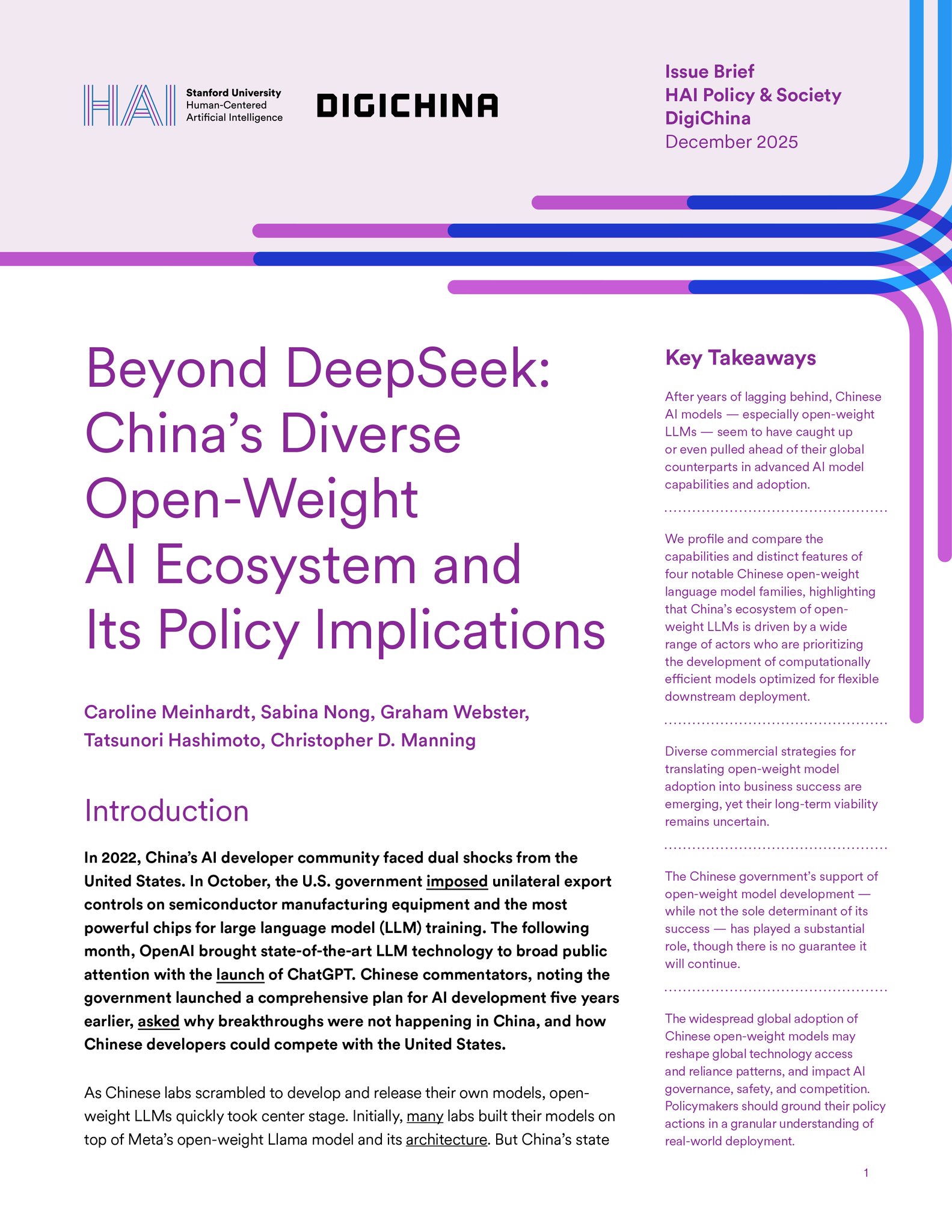
New issue brief: Have Chinese AI models pulled ahead of their global counterparts? Our latest brief analyzes China’s diverse open-weight model ecosystem and examines the policy implications of their widespread global diffusion. https://
hai.stanford.edu/policy/beyond-
deepseek-chinas-diverse-open-weight-ai-ecosystem-and-its-policy-implications
… -
Can We Trust AI Therapists? 2025’s Top AI Stories
By
–
This year, @StanfordHAI scholars addressed what people wanted to know: Can we trust AI therapists? Is workplace automation serving workers? Our most-read stories reveal a society grappling with AI's real-world impact on mental health, privacy, and power: https://
hai.stanford.edu/news/most-read
-the-stanford-hai-stories-that-defined-ai-in-2025
… -
Stanford HAI Experts Predict 2026 Focus on AI Rigor and Utility
By
–
AI predictions in 2026: @StanfordHAI experts envision 2026 as a year defined by rigor, transparency, and a long-overdue focus on actual utility over speculative promise. Read more: