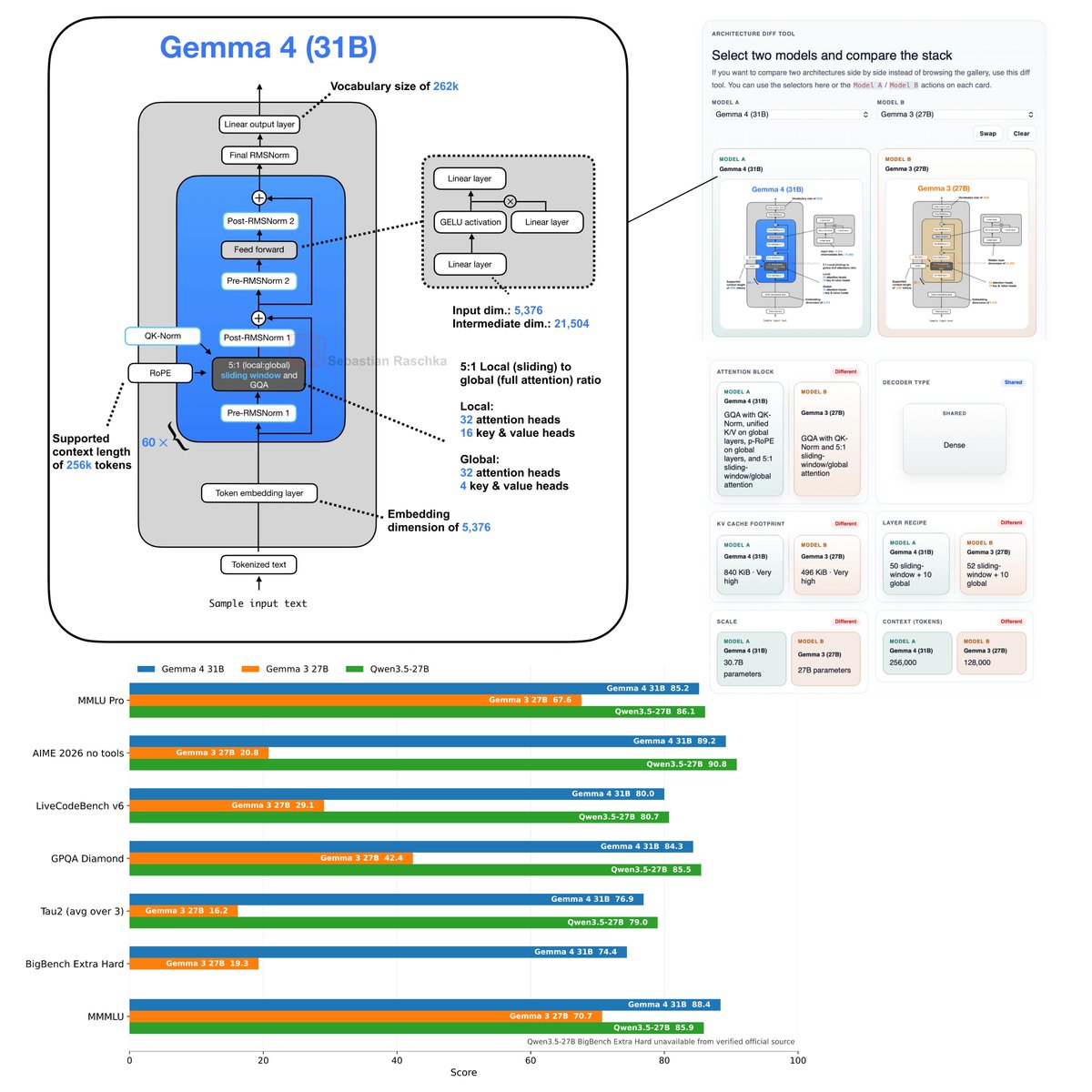
Flagship open-weight release days are always exciting. Was just reading through the Gemma 4 reports, configs, and code, and here are my takeaways: Architecture-wise, besides multi-model support, Gemma 4 (31B) looks pretty much unchanged compared to Gemma 3 (27B). Gemma 4 maintains a relatively unique Pre- and Post-norm setup and remains relatively classic, with a 5:1 hybrid attention mechanism combining a sliding-window (local) layer and a full-attention (global) layer. The attention mechanism itself is also classic Grouped Query Attention (GQA). But let’s not be fooled by the lack of architectural changes. Looking at the benchmarks, Gemma 4 is a huge leap from Gemma 3. This is likely due to the training set and recipe. Interestingly, on the AI Arena Leaderboard, Gemma 4 (31B) ranks similarly to the much larger Qwen3.5-397B-A17B model. But as I discussed in my model evaluation article, arena scores are a bit problematic as they can be gamed and are biased towards human (style) preference. If we look at some other common benchmarks, which I plotted below, we can see that it’s indeed a very clear leap over Gemma 3 and ranks on par with Qwen3.5 27B. Note that there is also a Mixture-of-Experts (MoE) Gemma 4 variant that is slightly smaller (27B with 4 billion parameters active. The benchmarks are only slightly worse compared to Gemma 4 (31B). I omitted the MoE architecture in the figure below because the figure is already very crowded, but you can find it in my LLM Architecture Gallery. Anyways, overall, it's a nice and strong model release and a strong contender for local usage. Also, one aspect that should not be underrated is that (it seems) the model is now released with a standard Apache 2.0 open-source license, which has much friendlier usage terms than the custom Gemma 3 license.
@rasbt
-
Book Independence and Relationship to LLM from Scratch Guide
By
–
Thanks for getting a copy! And that's a good question, there's practically not much overlap. So, this book can be read on its own, and it also works well as a follow-up to Build a Large Language Model (from Scratch). The latter focuses on LLM architecture and pre-training from
-
Ollama Gets MLX Support in Recent Update
By
–
Haha, but what's not April's fools is that ollama finally got MLX support the other day
-
Claude Code’s Popularity: Model Quality vs Coding Harness
By
–
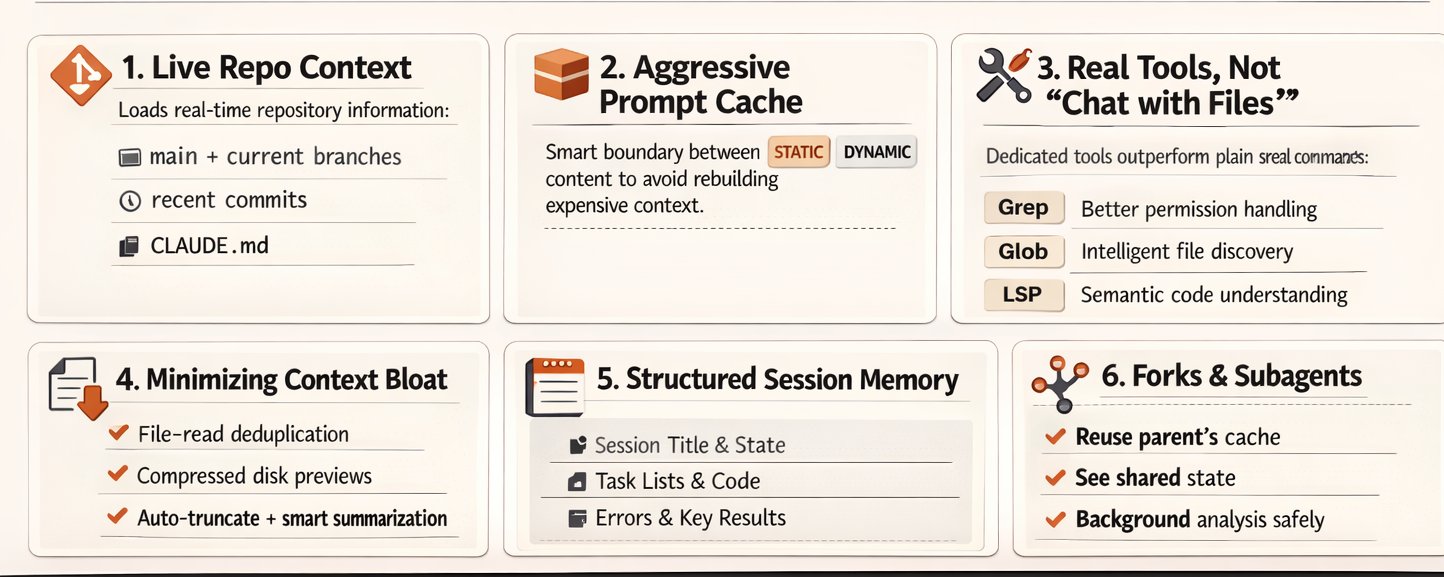
Haha that is also a fair point. The model is really good. But I am not sure if it is that much better than say GLM-5 or GPT 5.4 etc. The reason why Claude Code seems so good and popular is the coding harness?
-
Python Port of Interesting Project with TypeScript Versions
By
–
Looks like this is a Python port. I saw some of the Typescript versions earlier on GitHub as well. Anyways, super interesting. I tried to summarize some of the tidbits
-
Links to Reasoning from Scratch project and book
By
–
Ah yes, here are the links: GitHub: github.com/rasbt/reasoning-f… Manning: mng.bz/Nwr7 Amazon: amzn.to/4aAKiFY
-
Fine-tuning strategies and future plans for expanding capabilities
By
–
Thanks! The fine-tuning section is more general in the first one, and the second one is focused on math because it makes it easier from a security perspective. But I plan to add bonus materials over time, and function calling would be an interesting one.
-

Build A Reasoning Model book chapters now available in early access
By
–
It’s done. All chapters of Build A Reasoning Model (From Scratch) are now available in early access. The book is currently in production and should be out in the next months, including full-color print and syntax highlighting. There’s also a preorder up on Amazon.
-
LLMs Excel at Technical Editing Tasks Over Content Generation
By
–
Well, I guess that's because it had a lot of newspapers in it's training corpus .
Joking aside, I think LLMs work best for technical editing tbh. Things like "what sources did I forget to cite", "is my spelling of technical terms consistent" etc.