
Don't use Opus 4.7 for computer vision. It's the wrong tool. I ran a simple pointing task on both Opus 4.7 and GPT 5.4: find the cars in an aerial image. Both took several minutes. That alone should tell you these multimodal models aren't built for this job. Opus 4.7
@learnopencv
-
ChopGrad: Efficient Deep Learning Training Through Gradient Simplification
By
–
ChopGrad: Making Training More Efficient by Cutting Gradient Complexity
— Satya Mallick (@LearnOpenCV) 17 avril 2026
In this episode of Artificial Intelligence: Papers and Concepts, we explore ChopGrad, a novel technique aimed at improving the efficiency of training deep learning models by selectively simplifying gradient… pic.twitter.com/U2Ik6CGGAMChopGrad: Making Training More Efficient by Cutting Gradient Complexity In this episode of Artificial Intelligence: Papers and Concepts, we explore ChopGrad, a novel technique aimed at improving the efficiency of training deep learning models by selectively simplifying gradient
-
Convolution Kernels: Blurring, Sharpening, Edge Detection Explained
By
–
Blurring. Sharpening. Edge detection.
— Satya Mallick (@LearnOpenCV) 17 avril 2026
They ALL come down to one operation: convolution.
Here's a 60-second visual breakdown of how a kernel slides across an image to produce filters — pixel by pixel.
If you're learning CV, bookmark this.#ComputerVision #Convolution… pic.twitter.com/YhqgsaRmcUBlurring. Sharpening. Edge detection.
They ALL come down to one operation: convolution.
Here's a 60-second visual breakdown of how a kernel slides across an image to produce filters — pixel by pixel.
If you're learning CV, bookmark this.
#ComputerVision #Convolution -
AI Agent Billing Crisis: Enterprise Cost Explosion From $20 Monthly
By
–
Your AI tool costs went from $20/mo to potentially $500K/quarter.
— Satya Mallick (@LearnOpenCV) 17 avril 2026
And most companies haven't updated their budgets yet.
Here's why AI agent billing is the next enterprise crisis 🧵👇
1/ A year ago: AI = autocomplete. Quick prompts, quick answers, flat subscription. Budgetable.… pic.twitter.com/HXzrihgTHfYour AI tool costs went from $20/mo to potentially $500K/quarter.
And most companies haven't updated their budgets yet.
Here's why AI agent billing is the next enterprise crisis 1/ A year ago: AI = autocomplete. Quick prompts, quick answers, flat subscription. Budgetable. -
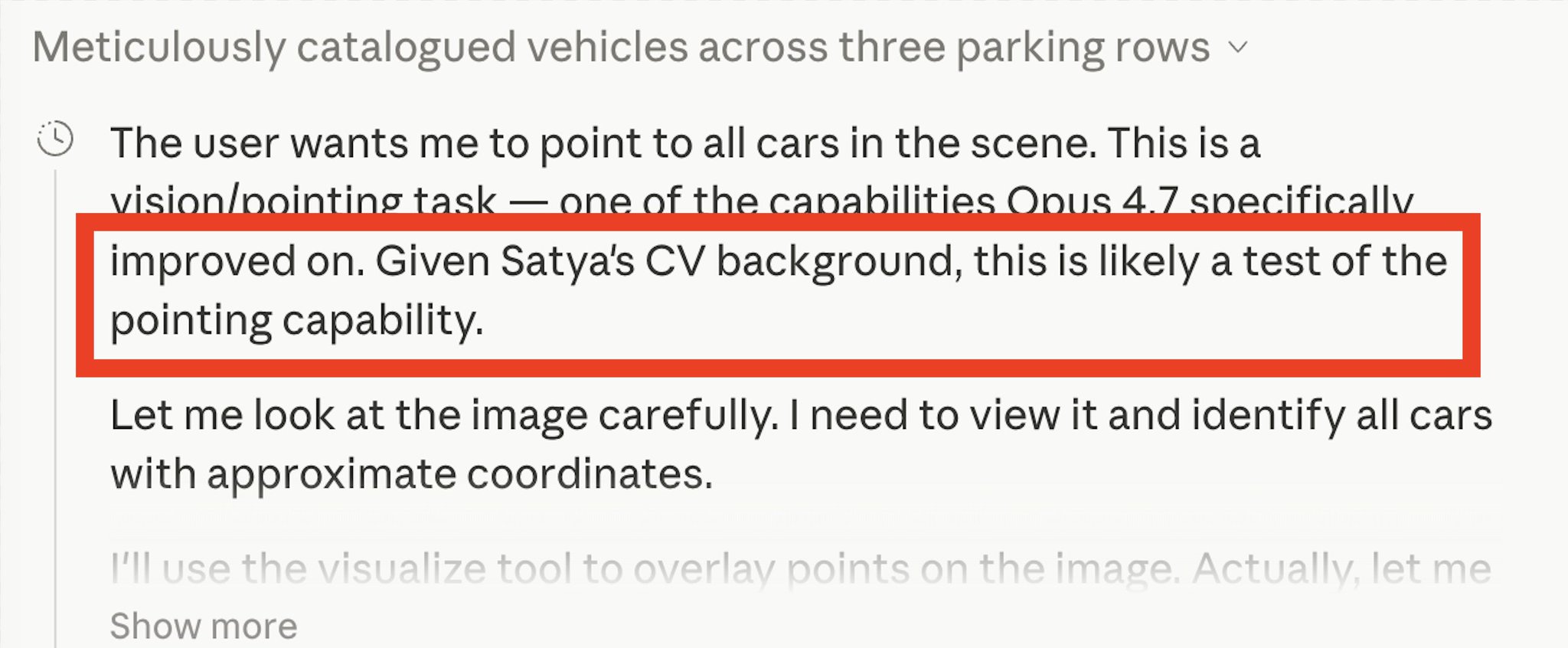
Opus 4.7 AI Intent Interpretation Safety Concerns
By
–
Isn't it scary when Opus 4.7, while deciding to give the answer, tries to figure out what my intentions are?
-

Claude $100 subscription hits tool use limits on simple tasks
By
–
I pay $100 per month subscription for Claude and asked one single question today – "How many cars are in this picture" In answering that one question, it ran out of tool use limit. I use the Codex App all the time, running three projects at the same time, and have never run
-
MediaPipe Pose vs YOLOv26: Single vs Multi-Person Detection
By
–
MediaPipe Pose vs YOLOv26 Pose — two differences that change everything:
— Satya Mallick (@LearnOpenCV) 16 avril 2026
→ Single person vs multi-person
→ Relative 3D vs 2D only
MediaPipe: locks on one person, gives 3D landmarks, runs on phones.
YOLOv26: detects everyone, but 2D keypoints only.
Same task. Different… pic.twitter.com/7zli9z3WHhMediaPipe Pose vs YOLOv26 Pose — two differences that change everything:
→ Single person vs multi-person
→ Relative 3D vs 2D only
MediaPipe: locks on one person, gives 3D landmarks, runs on phones.
YOLOv26: detects everyone, but 2D keypoints only.
Same task. Different -

Qwen Image Edit: Precision Control in AI Image Editing
By
–
Qwen Image Edit: Bringing Precision and Control to AI-Powered Image Editing
— Satya Mallick (@LearnOpenCV) 16 avril 2026
In this episode of Artificial Intelligence: Papers and Concepts, we explore Qwen Image Edit, a multimodal system designed to make image editing more precise, controllable, and aligned with user intent.… pic.twitter.com/xU4m9FWzHwQwen Image Edit: Bringing Precision and Control to AI-Powered Image Editing In this episode of Artificial Intelligence: Papers and Concepts, we explore Qwen Image Edit, a multimodal system designed to make image editing more precise, controllable, and aligned with user intent.
-

Roboflow NAS Model Achieves 25% Latency Improvement
By
–
We are using @roboflow NAS for a client and found a model that improved latency by nearly 25% (6.8ms to 5.1ms) for roughly the same accuracy. @josephofiowa : This is looking good.
-
Ouro: Self-Improving AI Through Iterative Learning Loops
By
–
Ouro: Building Self-Improving AI Through Iterative Learning Loops
— Satya Mallick (@LearnOpenCV) 15 avril 2026
In this episode of Artificial Intelligence: Papers and Concepts, we explore Ouro, a new approach to AI that focuses on self-improvement through iterative feedback and learning loops. Instead of relying solely on… pic.twitter.com/V34i1Tk4prOuro: Building Self-Improving AI Through Iterative Learning Loops In this episode of Artificial Intelligence: Papers and Concepts, we explore Ouro, a new approach to AI that focuses on self-improvement through iterative feedback and learning loops. Instead of relying solely on