ugh kids these days! back in my days we used to watch the tokens stream one at a time and wait for the output.
@karpathy
-
GPT-2 Reproduction with Increased Channel Size and Memory Optimization
By
–
We want to do a full GPT-2 repro, at channel size 1600 this is 2.1X higher C. And we'll want to ~max out batch dim to fit in memory too. So the "easy times" will be over soon.
-
GPT-2 Activation Memory and GPU Cache Analysis
By
–
Makes sense, in GPT-2 (124M) case we're currently doing B=4, T=1024, C=768 => 3M activations @ float32 => 12MB. A100 L2 cache is 40MB, and even L1, at 192KB/SM with 108 SMs => ~= 20MB (wow, that's more than I expected). The pleasures of smaller networks and caches…
-
Kernel optimization attempts yield minimal performance gains
By
–
added under kernel4 https://
github.com/karpathy/llm.c
/commit/cb791c4ef58d45d58e5af624b0ed41439ac7aeff
…
a bit surprised to only see ~1-2% out of it, which then washes out in training, as the layernorm is not a top-ranking time kernel. Also tried float4 and unrolling but that didn't improve it too much bleh -
Nostalgic Reflection on Past Project with Future Rewrite Plans
By
–
oh my god blast from the past maybe one day i shall do a re-write of this project.
i am imagining efficient, batched training + inference running the brain of all the little bots… -
GPT-2 as the Hello World of Large Language Models
By
–
GPT-2 is the "hello world" of LLMs I think (there must be a better analogy… err MOS 6502? xv6?), so that's why I started there. And it has a proper paper, weights released and available, and a lot is known about it. At this point it is an artifact of historical significance.
-
GPT-2 Weight Initialization and Fine-tuning Strategy
By
–
atm we're doing init from gpt-2 weights and finetuning. this was very useful for debugging and when the code was slower. there is no code yet to init from scratch, so no code to warmup the lr etc. should be a very short addition though.
-
PyTorch Support and llm.c Project Development Status
By
–
Part agree! I love PyTorch ofc. But also llm.c is a ~2 week old project that is worked on by ~3 people as a hobby in spare time.
-
torch.compile uses Triton kernels under the hood for optimization
By
–
So if you're using torch.compile you're already using a lot of triton under the hood, afaik PyTorch picks and chooses whether to call cuda kernels or triton for different ops / settings. Triton is really awesome, but of course you're staying in the Python / torch universe. Which
-
llm.c Matches PyTorch Performance Training GPT-2 on GPU
By
–
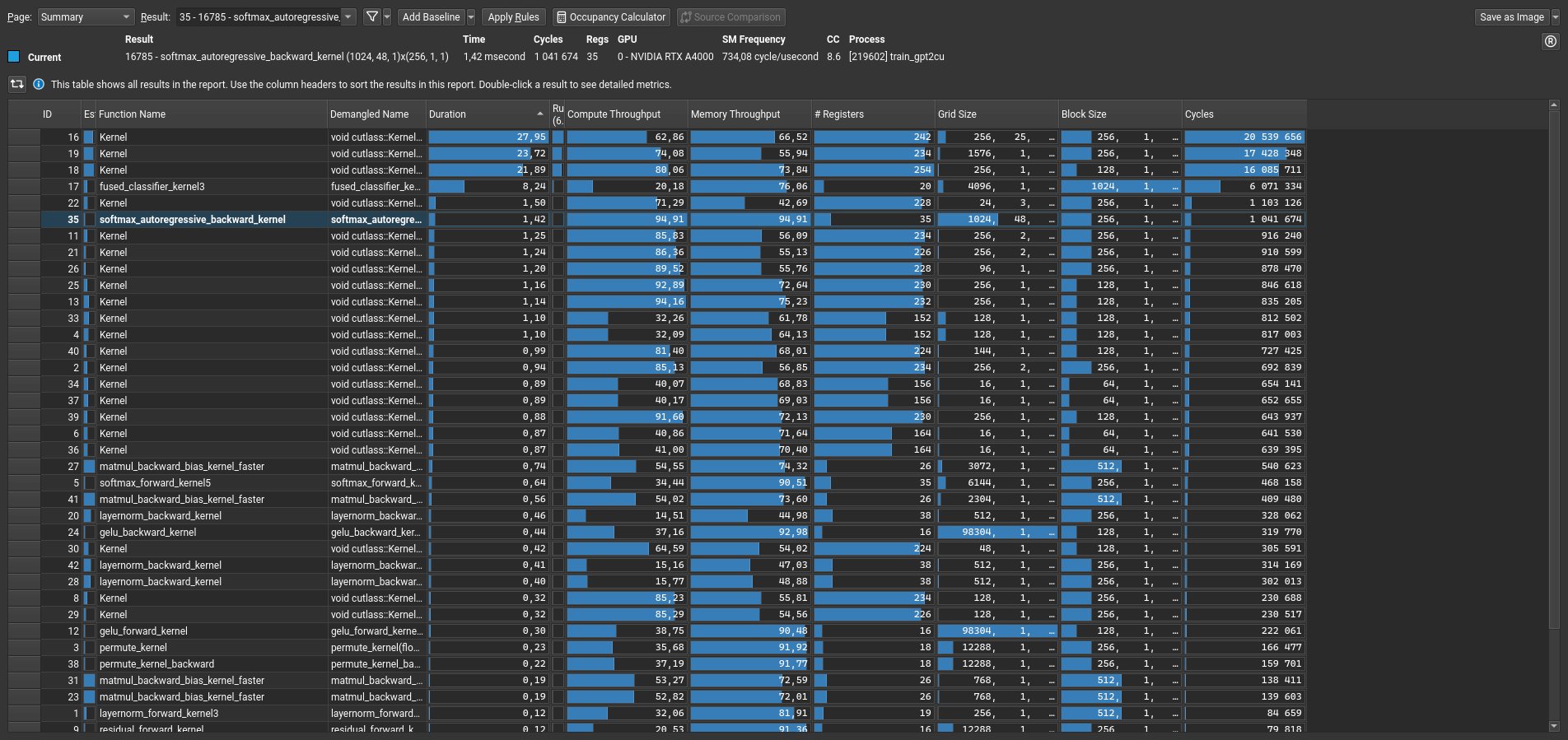
llm.c update: Our single file of 2,000 ~clean lines of C/CUDA code now trains GPT-2 (124M) on GPU at speeds ~matching PyTorch (fp32, no flash attention) https://
github.com/karpathy/llm.c
/blob/master/train_gpt2.cu
… On my A100 I'm seeing 78ms/iter for llm.c and 80ms/iter for PyTorch. Keeping in mind this is fp32,