AI Dynamics

Global AI News Aggregator

About

@jiqizhixin

  • DefensiveKV Reduces LLM Memory Usage Without Quality Loss

    What if your LLM could dramatically reduce memory usage without sacrificing quality, even in tough situations? Researchers at University of Science and Technology of China & Data Darkness Lab present DefensiveKV. They tackle the fragility of LLM Key-Value cache eviction by using a smart, two-step "defensive aggregation strategy." This approach proactively controls worst-case risks, preventing performance drops in extreme scenarios with negligible computational cost. Layer-DefensiveKV extends this with intelligent layer-wise budget allocation. Their methods slash generation quality loss by an impressive 2.3x and 4.3x respectively against the strongest baselines, across seven task domains and 18 datasets, even when cache is cut to just 20%. This breakthrough sets new performance benchmarks for efficient LLM inference! DefensiveKV: Taming the Fragility of KV Cache Eviction in LLM Inference Paper: openreview.net/forum?id=nJgS… Code: github.com/FFY0/DefensiveKV/… Our report: mp.weixin.qq.com/s/81wiPTdye… 📬 #PapersAccepted by Jiqizhixin
    → View original post on X — @jiqizhixin

  • On-Policy SFT Matches RL Generalization Without Sacrificing Efficiency

    Can we boost Supervised Fine-Tuning (SFT) to match Reinforcement Learning's (RL) generalization power, without sacrificing efficiency? Researchers from Southeast University, Microsoft Research Asia, and Shopee just dropped a game-changer! They introduce a "Distribution Discriminant Theory" to align training data with a model's own output, leading to two techniques: In-Distribution Finetuning and Hinted Decoding. This enables "On-Policy SFT" – effectively training SFT with data highly relevant to its current state, much like RL. The result? SFT that outperforms leading offline RL algorithms like DPO and SimPO in generalization, all while keeping SFT's renowned efficiency. This is a game-changer for domains where RL is too complex! Towards On-Policy SFT: Distribution Discriminant Theory and its Applications in LLM Training Paper: arxiv.org/abs/2602.12222 Code: github.com/zhangmiaosen2000/… Our report: mp.weixin.qq.com/s/vBtoBAsTe… 📬 #PapersAccepted by Jiqizhixin
    → View original post on X — @jiqizhixin

  • ByteDance Seed Achieves Zero-Shot Sim-to-Real Dexterous Hand Manipulation
    ByteDance Seed Achieves Zero-Shot Sim-to-Real Dexterous Hand Manipulation

    What if robotic hands could learn complex maneuvers purely in simulation and work perfectly in reality? ByteDance Seed just unveiled a breakthrough. Their new RL framework bridges the sim-to-real gap for dexterous hands with a fast virtual tactile simulation, current-to-torque calibration (no extra sensors!), and actuator dynamics modeling with randomization to cover real-world quirks. Result? Policies trained 100% in simulation directly enable a five-finger hand to perform precise, controllable grasp force tracking and object reorientation – a first for zero-shot sim-to-real multi-finger manipulation! Closing the Reality Gap: Zero-Shot Sim-to-Real Deployment for Dexterous Force-Based Grasping and Manipulation Paper: arxiv.org/abs/2601.02778 Project: dexmanip-seed.github.io/dexm… Our report: mp.weixin.qq.com/s/7TQC0sJfw… 📬 #PapersAccepted by Jiqizhixin
    → View original post on X — @jiqizhixin, 2026-04-07 01:35 UTC

  • Comprehensive Survey on World Models in Artificial Intelligence
    Comprehensive Survey on World Models in Artificial Intelligence

    Nice survey! This comprehensive survey tackles the fragmented field of World Models, systems that help AI predict how environments change. It unifies them into four key paradigms, from learning directly from observations to understanding objects and actions. This survey provides a unified map for understanding, comparing, and advancing World Models. It clarifies their performance across robotics, autonomous driving, game simulation, and identifies critical challenges like long-term consistency, charting the course for future AI breakthroughs. Learning to Model the World: A Survey of World Models in Artificial Intelligence Project: github.com/JiahuaDong/Awesom… Paper: techrxiv.org/doi/full/10.362… Our report: mp.weixin.qq.com/s/RYATYwUDg… 📬 #PapersAccepted by Jiqizhixin

    → View original post on X — @jiqizhixin, 2026-04-06 18:27 UTC

  • One-Step AI Image Generation Framework Achieves State-of-the-Art Results
    One-Step AI Image Generation Framework Achieves State-of-the-Art Results

    What if you could generate stunning AI images in a single step, without compromising quality? Researchers from Westlake University, Chinese Academy of Sciences, and DP Technology present a breakthrough. They've introduced a new framework that simplifies the design of 'shortcut' diffusion models. This framework clarifies how to build more efficient one-step image generators by disentangling their core components. Their model achieves a new state-of-the-art FID50k of 2.85 on ImageNet-256×256 with one-step generation, and 2.53 with two steps. Remarkably, it requires NO pre-training, distillation, or curriculum learning! On the Design of One-step Diffusion via Shortcutting Flow Paths Paper: openreview.net/forum?id=k6q8…  Code: github.com/EDAPINENUT/Explic…    Project: edapinenut.github.io/explici… Our report: mp.weixin.qq.com/s/BptmtBa_O… 📬 #PapersAccepted by Jiqizhixin

    → View original post on X — @jiqizhixin, 2026-04-06 14:23 UTC

  • SwitchCraft: Training-Free Multi-Event Video Generation Framework
    SwitchCraft: Training-Free Multi-Event Video Generation Framework

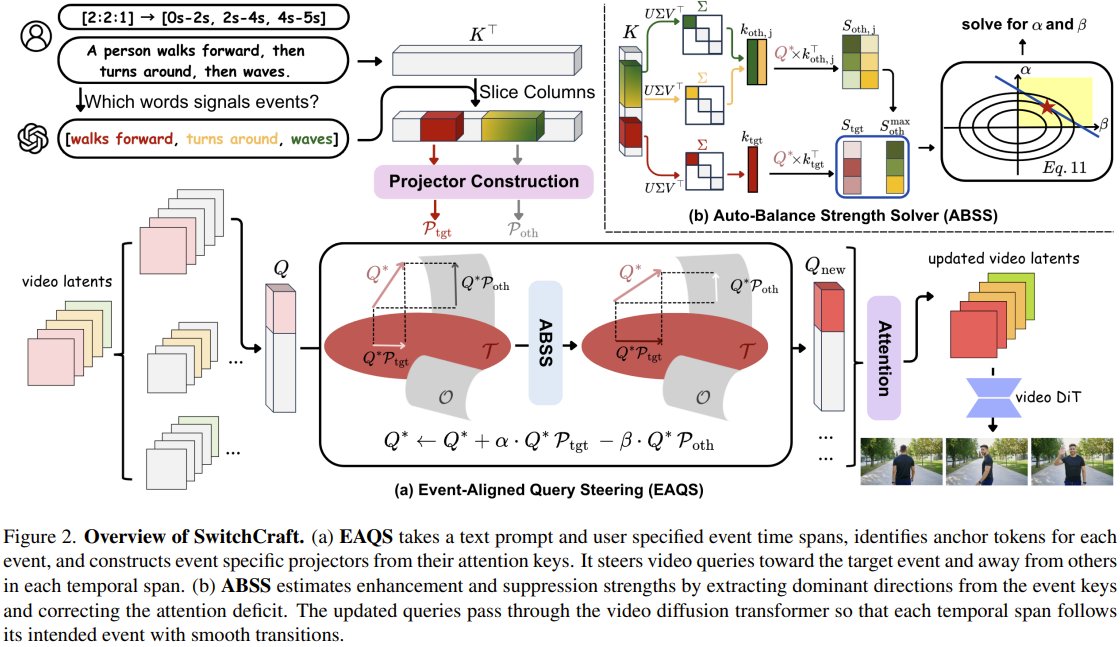
    What if AI could generate multi-event videos with perfectly distinct scenes and smooth transitions? Researchers from Westlake University, Duke Kunshan University, and The University of Queensland present SwitchCraft! This training-free framework smartly aligns each video frame's attention to individual events in your prompt. t directs focus precisely and adaptively balances this control to ensure both smooth transitions and visual quality. It dramatically improves prompt alignment, event clarity, and scene consistency, outperforming current baselines and making complex video narratives easy. SwitchCraft: Training-Free Multi-Event Generation with Attention Controls Paper: arxiv.org/abs/2602.23956 Project: switchcraft-project.github.i… Github: github.com/Westlake-AGI-Lab/… Our report: mp.weixin.qq.com/s/Z7D5imbgZ… 📬 #PapersAccepted by Jiqizhixin

    → View original post on X — @jiqizhixin, 2026-04-06 14:20 UTC

  • HiDrop: Efficient Visual Token Reduction for Multimodal LLMs
    HiDrop: Efficient Visual Token Reduction for Multimodal LLMs

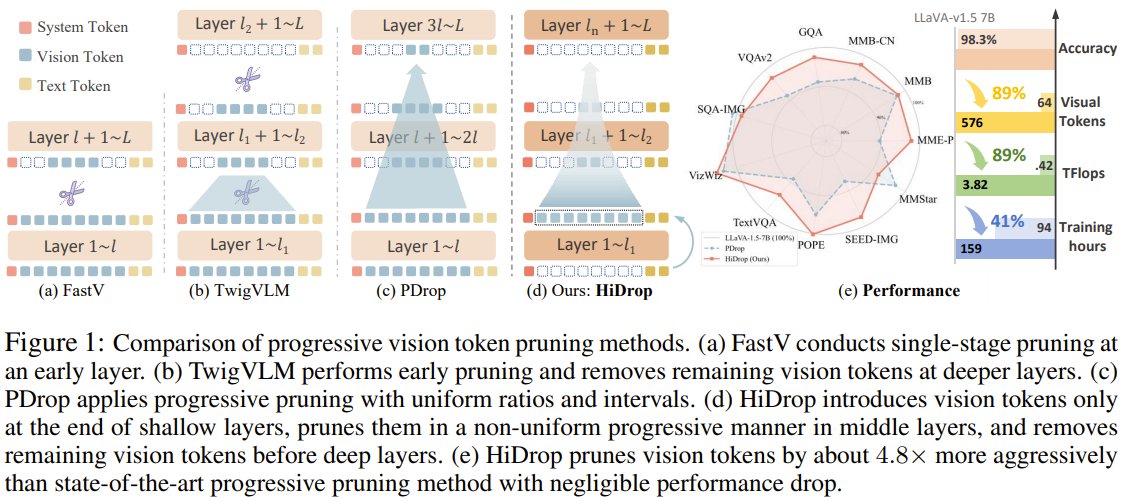
    What if MLLMs could process visual data much faster without sacrificing performance? Eastern Institute of Technology, Ningbo, with USTC, SJTU, and LMU Munich presents HiDrop just for that! This new framework intelligently reduces visual tokens by processing them only when active fusion truly begins (Late Injection) and dynamically pruning them across deeper layers (Concave Pyramid Pruning with Early Exit). It focuses computation where it matters most. HiDrop compresses ~90% of visual tokens, matches original MLLM performance, and accelerates training by 1.72x. A new state-of-the-art for efficient MLLM training & inference! HiDrop: Hierarchical Vision Token Reduction in MLLMs via Late Injection, Concave Pyramid Pruning, and Early Exit Paper: arxiv.org/pdf/2602.23699 Code: github.com/EIT-NLP/HiDrop Our report: mp.weixin.qq.com/s/QKGZ7cFi0… 📬 #PapersAccepted by Jiqizhixin

    → View original post on X — @jiqizhixin, 2026-04-06 10:16 UTC

  • IMMACULATE: Auditing LLM Providers with Verifiable Computation
    IMMACULATE: Auditing LLM Providers with Verifiable Computation

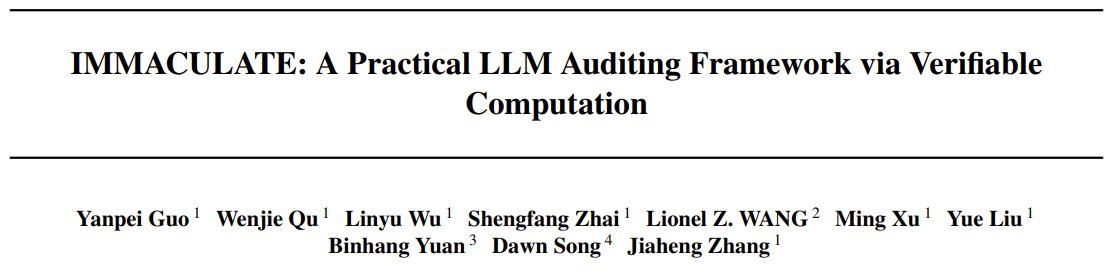
    Can you really trust your black-box LLM provider with correct inference and honest billing? Researchers from NUS, NTU, and UC Berkeley introduce IMMACULATE. This practical auditing framework uses verifiable computation to randomly check a small fraction of LLM requests. It detects economically motivated cheats like model substitution, quality degradation, and token overbilling without needing trusted hardware or internal model access. IMMACULATE reliably distinguishes honest vs. malicious LLM execution in dense and MoE models, adding less than 1% throughput overhead. IMMACULATE: A Practical LLM Auditing Framework via Verifiable Computation Paper: arxiv.org/pdf/2602.22700 Code: github.com/guo-yanpei/Immacu… Our report: mp.weixin.qq.com/s/WR9nXudXT… 📬 #PapersAccepted by Jiqizhixin

    → View original post on X — @jiqizhixin, 2026-04-06 05:13 UTC

  • SHINE: Hypernetwork Generates LoRA Adapters from Context Instantly
    SHINE: Hypernetwork Generates LoRA Adapters from Context Instantly

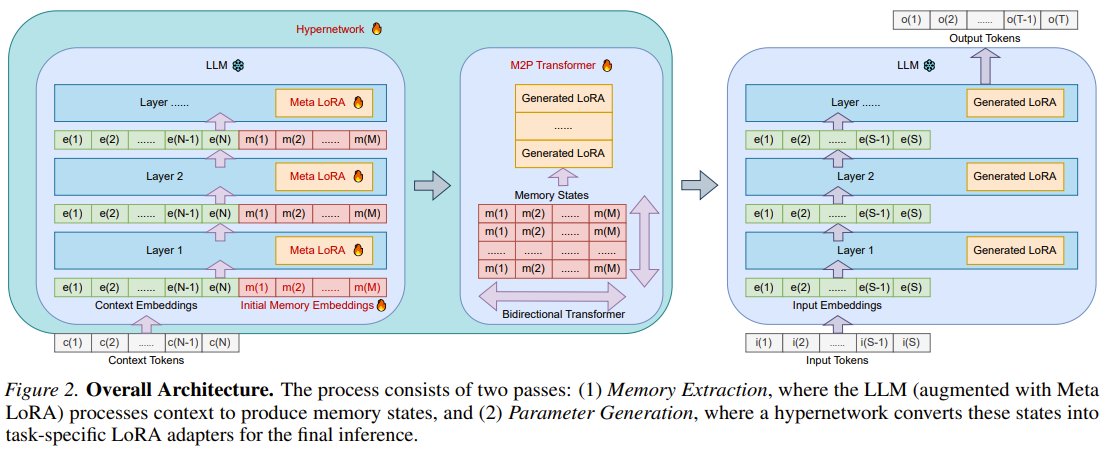
    What if LLMs could instantly absorb new context directly into their parameters? Researchers from Peking University, University of Oxford, Technion, and NVIDIA present SHINE! SHINE is an innovative hypernetwork that, in a single pass, generates high-quality LoRA adapters directly from diverse contexts. This effectively bakes temporary contextual knowledge into the LLM’s core parameters, turning it into lasting skill without any traditional fine-tuning. It smartly reuses the LLM's own frozen parameters for efficiency. This breakthrough dramatically cuts down on time, computation, and memory costs compared to supervised fine-tuning (SFT). SHINE outperforms SFT across various tasks, especially in complex question answering by embedding knowledge directly, offering outstanding performance and massive scalability potential. SHINE: A Scalable In-Context Hypernetwork for Mapping Context to LoRA in a Single Pass arXiv: arxiv.org/abs/2602.06358 GitHub: github.com/Yewei-Liu/SHINE Hugging Face: huggingface.co/collections/Y… Our report: mp.weixin.qq.com/s/sy1L2RoWu… 📬 #PapersAccepted by Jiqizhixin

    → View original post on X — @jiqizhixin, 2026-04-06 01:11 UTC

  • Alchemy: Standardized AI Research Environment from Tsinghua University
    Alchemy: Standardized AI Research Environment from Tsinghua University

    What's holding back the true scale of automated AI research? Tsinghua University's AI team, led by Asst. Prof. Jia Li, with key contributions from Lehui Li and Liyi Cai, introduces Alchemy, a standardized research environment. It's a 'pre-built AI furnace' that unifies all complex engineering tasks—from data processing to resource scheduling. AI scientists simply provide their algorithm (.py) and hyperparameters (.yaml) to run full experiments. This frees AI scientists from engineering burdens, drastically boosting the scale and efficiency of automated AI research across domains like recommender systems, time series, and graph learning, enabling high-concurrency experiments and continuous integration for new tasks. Code: github.com/TsinghuaISE/Alche… Our report: mp.weixin.qq.com/s/FyhCjhZ4l… 📬 #PapersAccepted by Jiqizhixin

    → View original post on X — @jiqizhixin, 2026-04-05 18:08 UTC