AI Dynamics

Global AI News Aggregator

About

@jeande_d

  • Robotic Steering: Mechanistic Interpretability for VLA Finetuning

    🎉Despite massive pretraining, VLAs need to adapt to specific physical contexts. We introduce Robotic Steering, a novel finetuning method using mechanistic interpretability to surpass standard FT: 🎁 22× fewer parameters 🎁 +53% on unseen tasks 🎁 Interpretable Thread below👇

    → View original post on X — @jeande_d, 2025-12-26 16:57 UTC

  • Text-Graph Complementarity in NLP: R²-CoD Analysis Framework
    Text-Graph Complementarity in NLP: R²-CoD Analysis Framework

    💡Text + graphs have powered NLP tasks for a long time. But key questions remain: How do their representations relate to each other during learning? How does that relationship impact task performance? Under what conditions is integrating text and graph more beneficial? In our paper, "R²-CoD: Understanding Text-Graph Complementarity in Relational Reasoning via Knowledge Co-Distillation", we take an analysis-driven perspective and uncover a spectrum of behaviors from complementarity → partial alignment → full alignment. 📜arxiv.org/abs/2508.01475 🧵[1/8]

    → View original post on X — @jeande_d, 2025-12-23 15:58 UTC

  • AI 2025 Breakthroughs: RL, Reasoning Models, and Future Paradigms

    Things move very very fast in AI. 2025 was a year of RL with verifiable rewards(RLVR), LLM ghosts/jagged intelligence, Cursor-like LLM apps, claude code/codex, vibe-coding, NanoBanana showing early glimpse of LLM promptable graphical interfaces(PGI, i just coined this lol), LLM reasoning models crushing olympiad competitions (maths, physics, code). Most altering releases tend to come early in a year, jan-feb, and then scaling-up and small fixes begin. Eagerly looking forward to new paradigm shifts. What will next NanoBanana look like, just bigger or new capabilities no one thought before? There are several stages of training now, RL(VR) being the most recent. What will be the RL successor? And continual learning, will it be fixed in 2026, or this is a problem we will live with for long? There are also world models, agents that actually work reliably in the wild for hours. Andrej Karpathy (@karpathy) x.com/i/article/200211463822… — https://nitter.net/karpathy/status/2002118205729562949#m

    → View original post on X — @jeande_d, 2025-12-20 10:46 UTC

  • SWE-Playground: Synthetic Data Generation for Versatile Coding Agents
    SWE-Playground: Synthetic Data Generation for Versatile Coding Agents

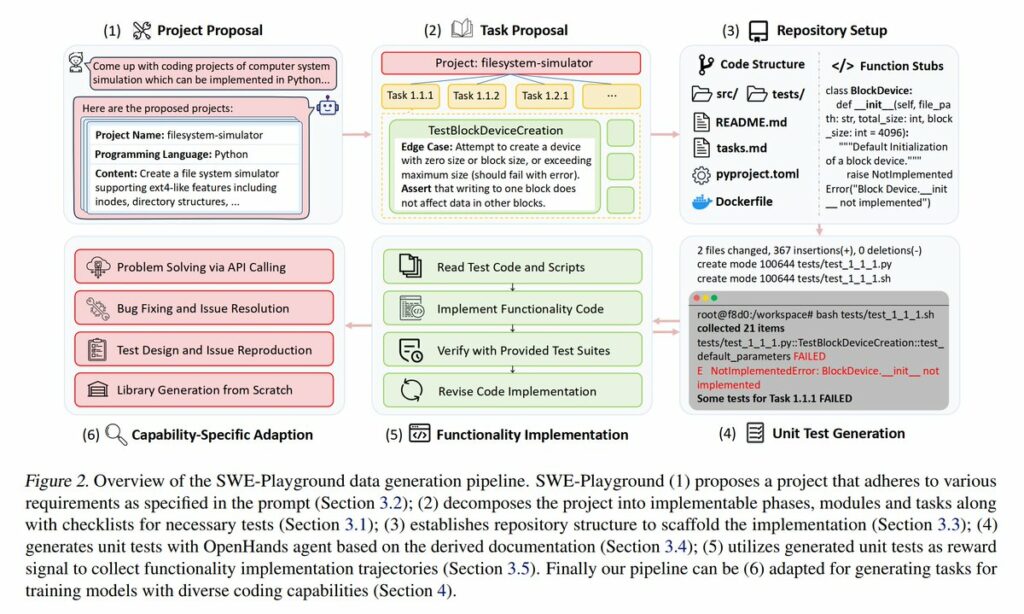
    There are many good training methods for improving agents on SWE-bench: SWE-Gym, SWE-Smith, R2E-Gym. But what about broader software engineering tasks? In SWE-Playground, we introduce a new, more diverse synthetic data generation strategy to train divers software agents. Yiqi Zhu (@StephenZhu0218) Introducing SWE-Playground: A fully automated pipeline that generates synthetic environments to train versatile coding agents. 🤖✨ Training software engineering agents often relies on existing resources like GitHub issues and focuses on solving SWE-bench style issue resolution tasks. While this has driven incredible progress, real-world engineering involves a wider spectrum of tasks —from designing new libraries to writing reproduction scripts. 🌐 Rather than mining existing repositories, SWE-Playground synthetically generates projects, tasks, and verifiable unit tests from scratch. This approach offers two exciting opportunities: 1️⃣ Flexibility: We can generate tasks without being constrained by the availability or structure of existing open-source data. 2️⃣ Versatility: We extend training beyond Issue Resolution to include Issue Reproduction and Library Generation from Scratch. The results? 🚀 Our agents achieve strong performance across SWE-bench Verified, SWT-Bench, and Commit-0, demonstrating high data efficiency compared to baselines trained on larger datasets. Huge thanks to my amazing collaborators @apurvasgandhi and @gneubig for their incredible efforts on bringing this work to life! 👇 🧵 A deep dive into how we build versatile agents synthetically. Paper: arxiv.org/pdf/2512.12216 Project Page: neulab.github.io/SWE-Playgro… Code: github.com/neulab/SWE-Playgr… Data & Models: huggingface.co/collections/S… — https://nitter.net/StephenZhu0218/status/2000754124019683469#m

    → View original post on X — @jeande_d, 2025-12-16 15:52 UTC

  • RL Impact on Base Model Performance: Pre-training and Mid-training Interplay
    RL Impact on Base Model Performance: Pre-training and Mid-training Interplay

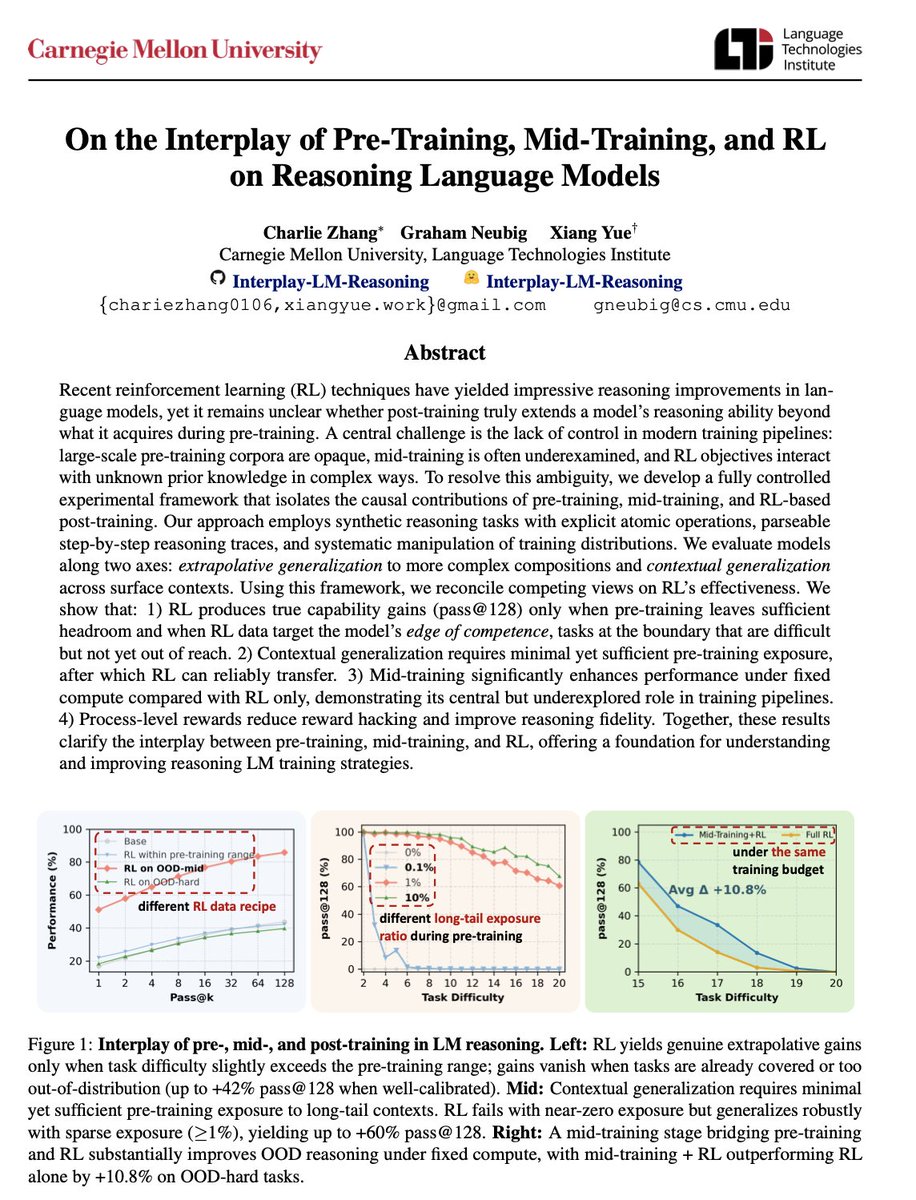
    There are competing views on whether RL can genuinely improve base model's performance (e.g., pass@128). The answer is both yes and no, largely depending on the interplay between pre-training, mid-training, and RL. We trained a few hundreds of GPT-2 scale LMs on synthetic GSM-like reasoning data from scratch. Here are what we found: 🧵

    → View original post on X — @jeande_d, 2025-12-09 20:20 UTC

  • Claude’s Post-Training Quality and Conversational Consistency Praised

    Every time you are chatting with claude(Opus 4.5 esp. but seems to apply to all models), you quickly realize how clever claude post-training is. The attention to details, data quality. It's rare that claude will break in the middle of conversations. I think this is beyond system

    → View original post on X — @jeande_d

  • Claude’s Post-Training Excellence and Alignment in AI Models

    Every time you are chatting with claude(Opus 4.5 esp. but seems to apply to all models), you quickly realize how clever claude post-training is. The attention to details, data quality. It's rare that claude will break in the middle of conversations. I think this is beyond system prompt and training dynamics/physics, and more about aura-like things: behaviors, personalities, when to push back/when to defer, and countless subtle edge cases. It's no surprise alignment people there follow closely the training. There was an invited talk at CMU this past spring on alignment and I asked why claude vibes and post-training feel different, the answer was high-level as you'd expect, but same: training, post-training, alignment, and evals teams are closed-loop. Sam Bowman (@sleepinyourhat) From everything we know so far, Opus 4.5 seems to be the best-aligned model out there in a bunch of ways. I follow the training process closely as part of my work on alignment evaluations. Here's my guess about the two things that are most responsible for making 4.5 special. 🧵 — https://nitter.net/sleepinyourhat/status/1997006353647522098#m

    → View original post on X — @jeande_d, 2025-12-06 09:56 UTC

  • Post-training bottlenecks solved through refined methods and data

    "The lesson is post-training bottlenecks are solved by refining methods and data" Zhibin Gou (@zebgou) If Gemini-3 proved continual scaling pretraining, DeepSeek-V3.2-Speciale proves scaling RL with large context. We spent a year pushing DeepSeek-V3 to its limits. The lesson is post-training bottlenecks are solved by refining methods and data, not just waiting for a better base. — https://nitter.net/zebgou/status/1995462720078934213#m

    → View original post on X — @jeande_d, 2025-12-01 17:08 UTC

  • Can Language Models Effectively Self-Refine Their Responses?
    Can Language Models Effectively Self-Refine Their Responses?

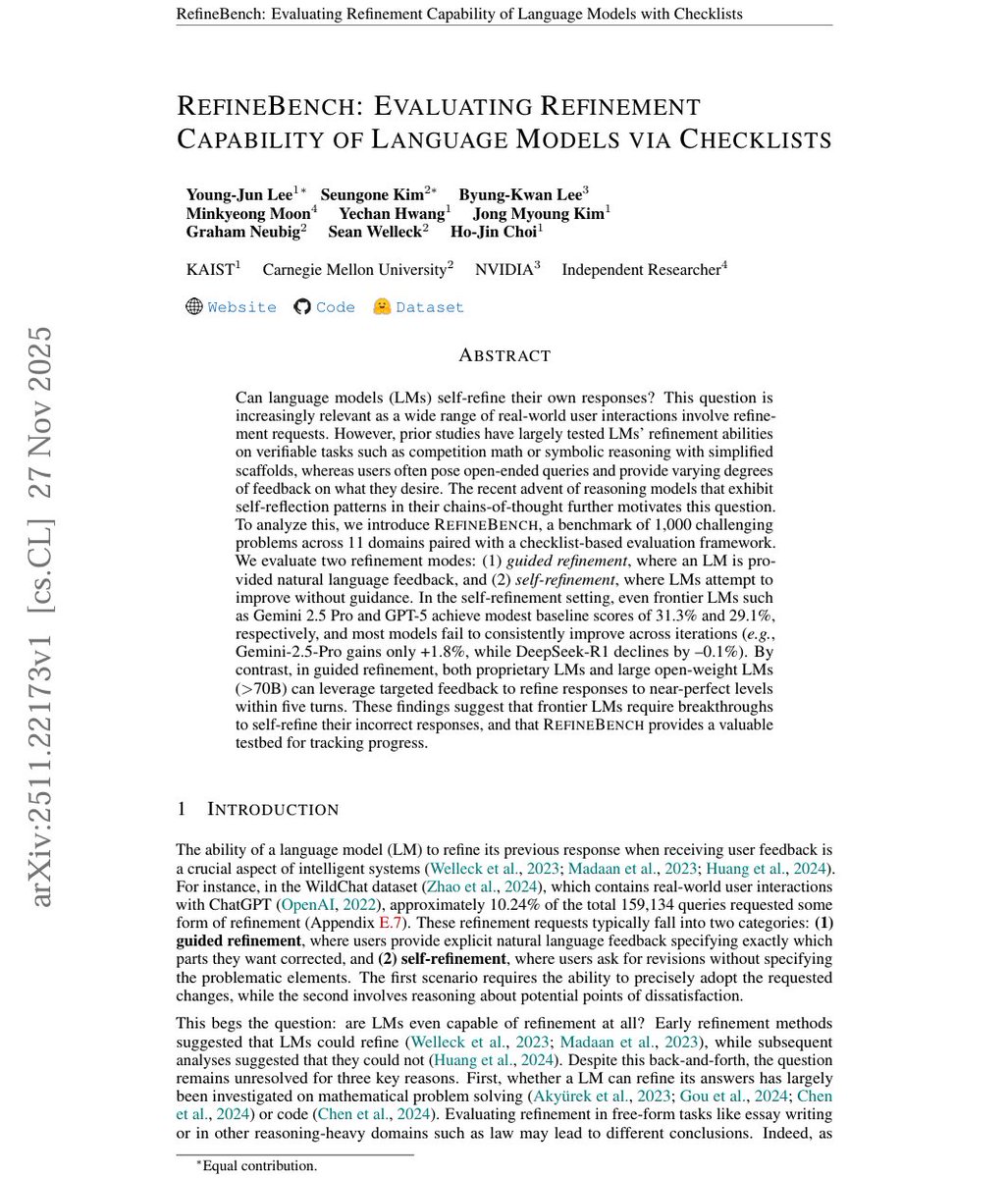
    ⚒️ Can LMs (especially reasoning models) effectively self-refine their responses when prompted to do so? In our new challenging benchmark, RefineBench, we revisit this question and show that the answer is still "no"-but there is a nuance! 🤗 huggingface.co/papers/2511.2…

    → View original post on X — @jeande_d, 2025-12-01 06:44 UTC

  • Defining Sloppiness: LLM Limitations in Detecting Quality

    Hard to define or attach metrics to sloppiness, but we intuitively know when we see it. LLMs can judge it in generated texts to some degree, but this too I have noticed they are looking for keywords(delve, meticulously,…), too much perfection and not so much on actual

    → View original post on X — @jeande_d