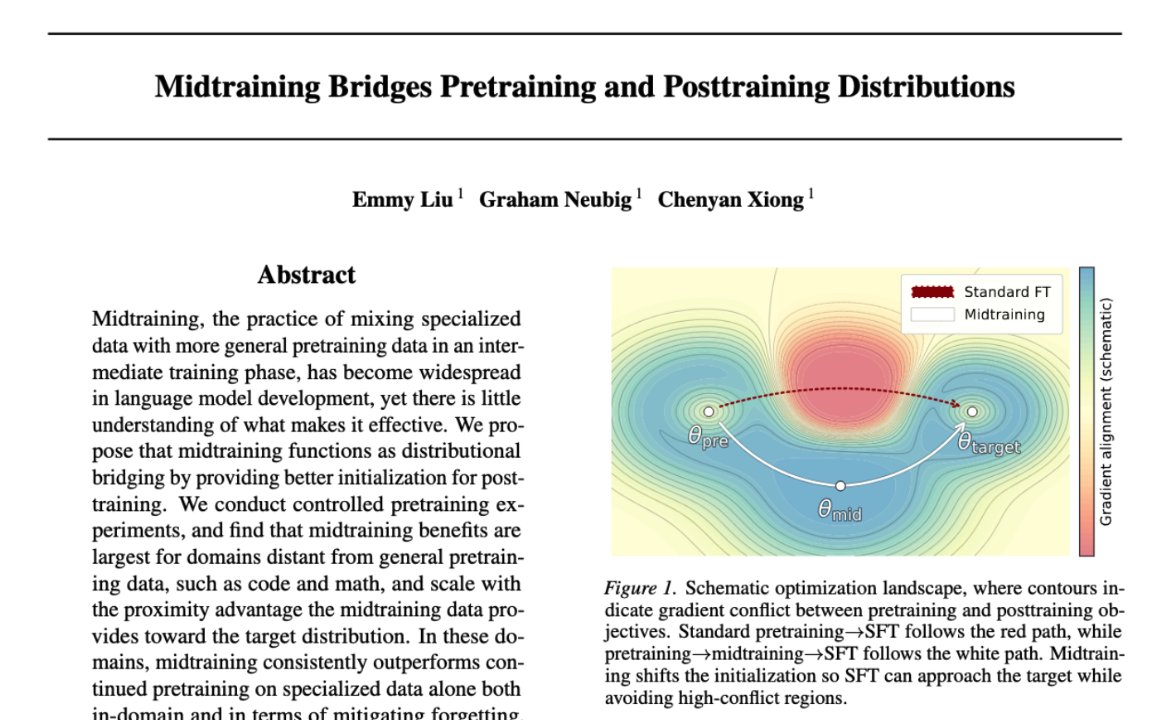
Midtraining is a new part of many training pipelines, but when does it help and can it backfire? 🤔 In our new preprint, we use controlled experiments to pin this down. TL;DR; midtraining helps the most when it “bridges” pretraining and posttraining, and mitigates forgetting after posttraining. Timing is also very important. 🧵
@jeande_d
-
Agent Data Protocol Accepted to ICLR 2026 Oral Presentation
By
–
Updates: Excited to share that Agent Data Protocol (ADP) is accepted to ICLR 2026 Oral! 🎉 We also added support for 3 new datasets: SWE-Play, MiniCoder, and Toucan, bringing us to 3M trajectories supported. If you're training agentic LMs, try ADP + tell us what dataset/agent format you want next. PRs & requests welcome. Let's make this the open standard for agent training data 🔥 🚀Original post: nitter.net/yueqi_song/status/1983… 📄Read our paper: arxiv.org/abs/2510.24702 🌐Check our project website: agentdataprotocol.com
-
Multilingual Data Curation Pipeline and Cross-Lingual Transfer Insights
By
–
Excellent work, execution, and report :). In our recent work https://
arxiv.org/abs/2508.07414, we also released a multilingual data curation pipeline for 39 languages. Training models on the data, we share the same insights, mainly cross-lingual transfer, adding multilingual data does not -

OpenScholar Scientific Deep Research Agents Accepted to Nature
By
–
Thrilled to share: OpenScholar – our work on scientific deep research agents for reliable literature synthesis -has been accepted to Nature! 🎉 Huge thanks to collaborators across institutions who made this possible!
-

CooperBench: AI Agents Perform 50% Worse in Teams
By
–

Introducing the curse of coordination. Agents perform 50% worse in teams than working alone. People building human-AI collaboration today don't realize why current LLMs fail to be good teammates. We built CooperBench to study this. For humans, we recognize that teamwork isn't just the sum of individual capability. Communication and coordination often outweigh raw skill. But for AI? We're only hill-climbing benchmarks that evaluate solo technical abilities. CooperBench A benchmark to evaluate agent cooperation in realistic software teamwork tasks. The setup is intuitive: two agents, two tasks, two VMs, one chat channel (agents can send over arbitrary text, even the entire patch they wrote). We evaluate whether the merged solution from both agents passes the requirements of both tasks. The curse of coordination The most striking result: agents perform 50% worse in teams (black line) than working alone (blue line). Why is this happening? Is it because they can't use the communication tool? No. They spent 20% of their time sending messages. The problem? Those messages were repetitive, vague, ignored questions, or straight-up hallucinated. But bad communication is only part of the story. We found two deeper failures: Commitment: Agents don't do what they promised. Expectations: Agents don't expect others to keep promises either. Without these, cooperation collapses. However, there is a silver lining We also find emergent coordination behaviors, e.g. role division, resource division, and negotiation, which gives us hope that we can use reinforcement learning to improve coordination. What's next? It is true that highly-engineered multi-agent orchestration could largely sidestep the coordination problem. However, we care more about the AI's capability: if we truly want AI to be our teammates, we need them to be natively capable of effective communicating and coordinating. Two agents on software tasks is just the beginning. The real goal: agents that can cooperate with us well enough to actually empower us. CooperBench is our first step. If you're working on this too, let's talk.
-

SP3F: Improving LLM Reasoning in Lower-Resource Languages
By
–
We introduce SP3F: an algorithm to improve LLM reasoning in lower-resource languages (e.g., Indonesian, Bengali, and Swahili), no manual data collection needed! SP3F produces models that out-perform fully post-trained models across multiple tasks and languages🧵 [1/N]
-
Appreciation for nanochat upgrade and request for scaling laws video
By
–
Thanks for this solid upgrade on nanochat, Karpathy! Hoping you release a video for the science of scaling laws 🙂
-
Free Online Modern AI Course with LLM Chatbot Building
By
–
I've decided to release a minimal, free online version of my upcoming "10-202 – Intro to Modern AI" course, starting January 26: modernaicourse.org. As a brief summary, this course introduces students to the elements of modern AI systems: you'll build and train a simple LLM chatbot from scratch in PyTorch, without any pre-built layers or pre-trained models at all. More information about the course, and a link to enroll, is available on the webpage link above. In the free online version, you can watch all lecture videos and submit all the assignments (all of which are autograded in the full course anyway). There won't be quizzes/exams, and there's no credit offered via CMU; this is purely for educational purposes. The online course will begin two weeks after the CMU version, and lectures and assignments will all be released with the same two-week delay after the in-person version. Note that this is a first-time offering for this course, so I certainly expect some hiccups along the way. But I hope the material will prove useful for many people. Zico Kolter (@zicokolter) I'm teaching a new "Intro to Modern AI" course at CMU this Spring: modernaicourse.org. It's an early-undergrad course on how to build a chatbot from scratch (well, from PyTorch). The course name has bothered some people – "AI" usually means something much broader in academic contexts – but I think the time has come where the first thing that many students interested in AI should see is how the AI they are familiar with actually works (because it's really simple!) The more people who understand it the better. I'll be trying to put as much material as I can that we develop online (assignments + autograding, hopefully lecture videos), though as a first-time course there are also likely to be some bumps along the way. Hopefully it becomes a good resource over time, though. Feedback welcome. — https://nitter.net/zicokolter/status/1987938761498411376#m
-
Balancing LLM Creativity with Factual Accuracy: The Hallucination Dilemma
By
–
You are right. Hallucination is a feature actually and focusing on it may hurt creativity and all the quirks we get from LLMs. It's a tricky balance. We want LLMs to produce things that amaze us, but we also don't want them to make confusion about factual world knowledge.
-
Setting the bar for AI engineering without a manual
By
–
You casually set the bar for every AI engineer. There's genuinely no manual for this thing, and the gap between "using AI tools" and "actually orchestrating them well" feels massive right now.