This is my most “serious” work — my attempt to document the behavior of a novel LLM outside the confines of standard benchmarks. There’s always subjectivity in notes from the field, but we can’t let it stop us from exploring.
@goodside
-
Meet Claude: AnthropicAI’s Rival to ChatGPT
By
–
"Meet Claude: @AnthropicAI
's Rival to ChatGPT" Through 40 screenshot examples, we explore the talents and limitations of ChatGPT's first real competitor. My first writing for @Scale_AI
, coauthored with @spencerpapay
. -
Clip of Andrej’s hand-coded GPT model trained on Shakespeare
By
–
Clip of Andrej's hand-coded GPT model in action, trained on a corpus of Shakespeare text: pic.twitter.com/TpZPHjz3dS
— Riley Goodside (@goodside) 17 janvier 2023Clip of Andrej's hand-coded GPT model in action, trained on a corpus of Shakespeare text:
-

Karpathy’s video: building GPT, a Transformer tutorial from scratch
By
–
Great new video from @karpathy
: "Let's build GPT", a tutorial on coding a Transformer model from scratch: -
For embedding retrieval, hallucinating lies beats ‘I don’t know’
By
–
I love how this is a clear use case for hallucination. If the reason you’re generating an “answer” is merely to produce an embedding suitable for retrieving one, saying “I don’t know” is useless and confidently making up lies is better.
-
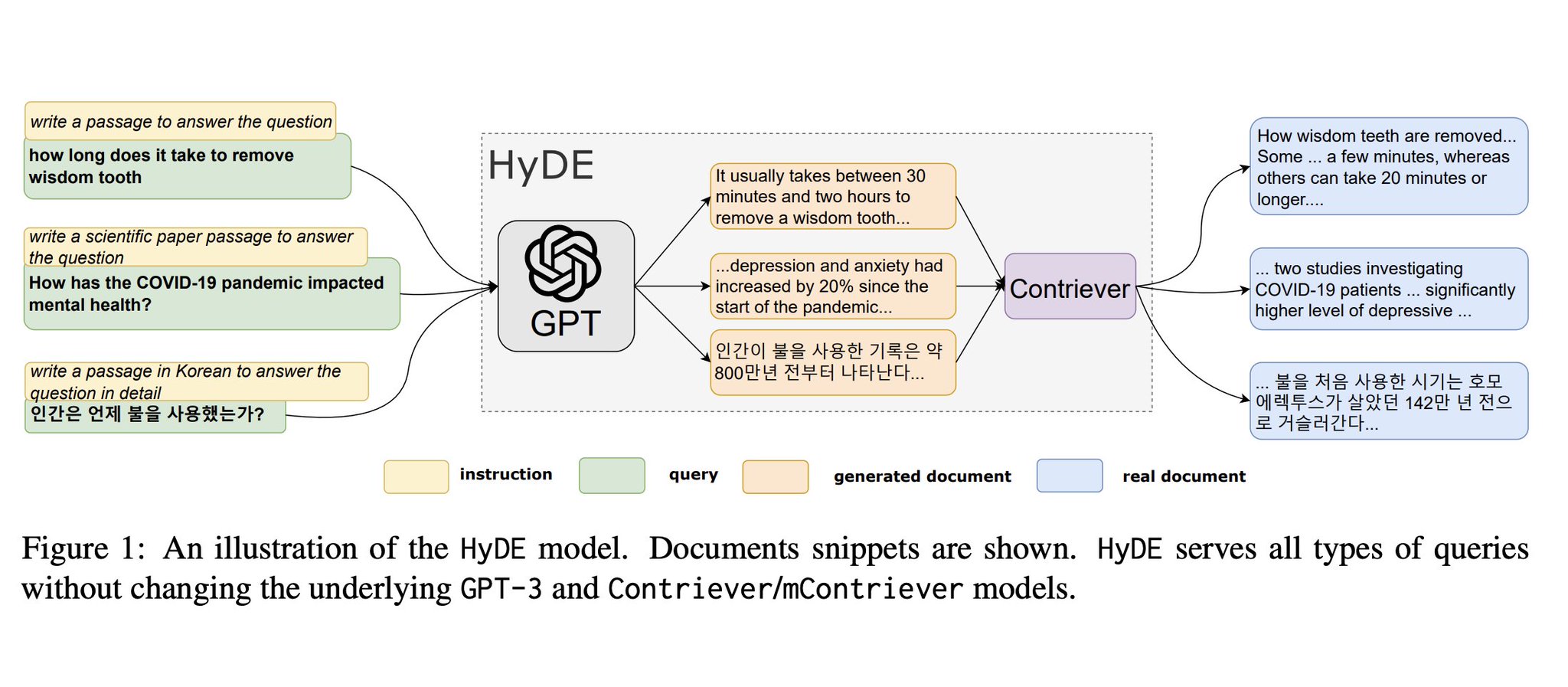
HyDE: Generating Hypothetical Answers for Better Document Retrieval
By
–
Clever paper — HyDE: Hypothetical Document Embeddings Instead of encoding the user's query to retrieve relevant documents, generate a "hypothetical" answer and encode that. Documents with right answers more similar to wrong answers than to questions. https://
arxiv.org/abs/2212.10496 -
ChatGPT’s client-side prompt prep now behind API boundary
By
–
It's a good question, because at least initially ChatGPT incorporated client-side preparation of prompts as well. My guess would be that prep now happens behind the API boundary.
-
GPT-3 instruct tuning enables prompting for classification tasks
By
–
Ignoring the inexactness of “new models” I think this point is right. GPT-3 (with instruct tuning) allows devs willing to learn prompting to condition useful models (e.g. think classification / entity extraction) that weren’t feasible before without deeper ML knowledge.
-
Synthesizing tuning examples using k-shots with code-davinci-002
By
–
Me too — I'd synthesize the tuning examples using k-shots in code‑davinci‑002. Seems like it would work.