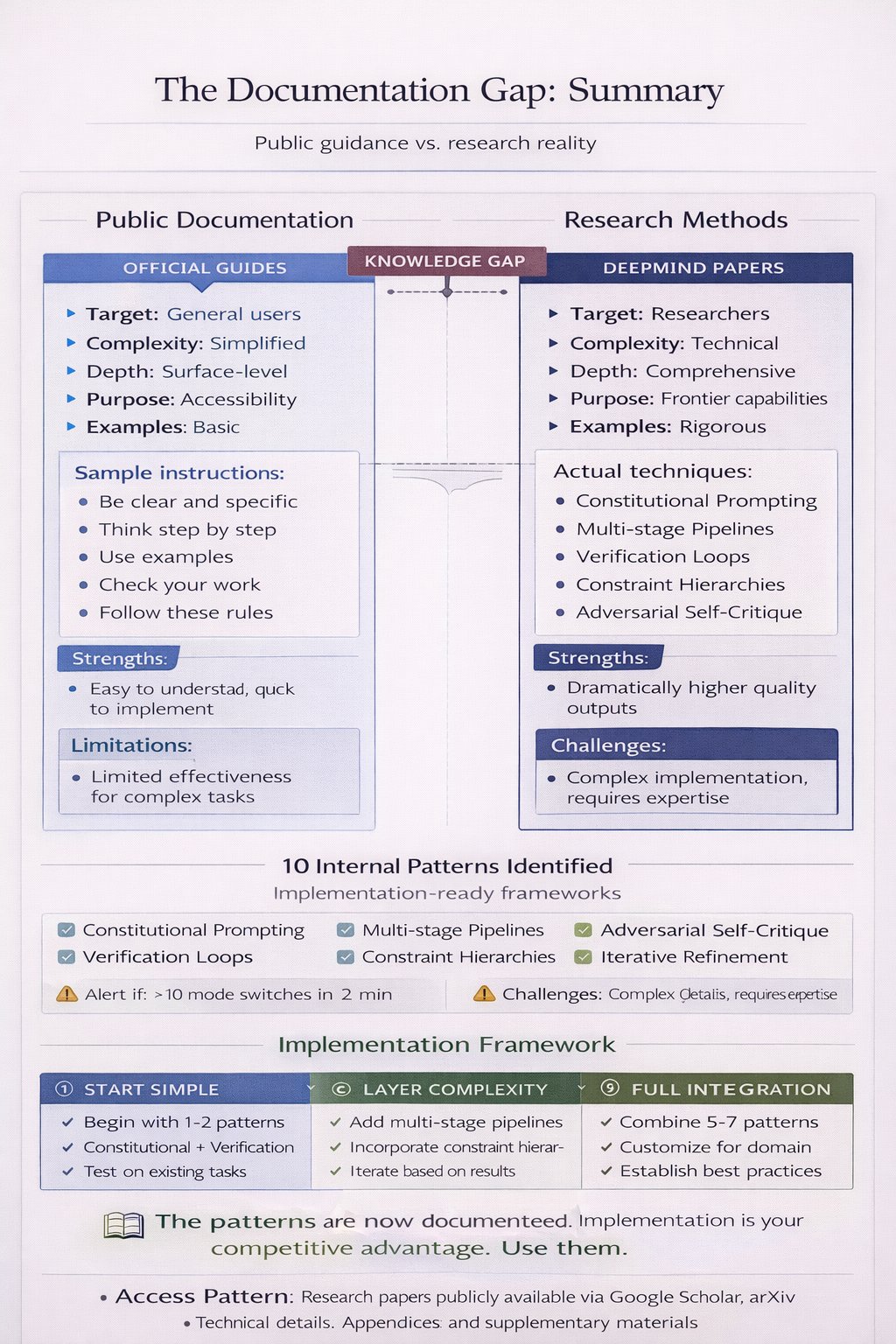
The gap between public docs and actual research is massive. Google's guide: Simple, accessible, beginner-friendly. DeepMind's papers: Complex, rigorous, expert-level. They're not hiding it—it's in the papers. Just buried in technical details. Now you have the patterns. Use
@godofprompt
-

Pattern #8: Iterative Refinement Protocols with Specific Dimensions
By
–
Pattern #8: Iterative Refinement Protocols Public: "Improve your response" Internal: Structured refinement with specific dimensions. "Iteration 1: Optimize for accuracy. Iteration 2: Optimize for clarity. Iteration 3: Optimize for conciseness. Score each dimension. Stop when
-

Pattern #7: Evidence-Grounded Generation
By
–
Pattern #7: Evidence-Grounded Generation Public: "Use examples" Internal: Explicit evidence tagging and traceability. "For each claim, cite source [S#]. For each inference, state reasoning [R#]. Confidence: [0-1]. If confidence
-

Adversarial Self-Critique: Find Flaws in Own Reasoning
By
–
Pattern #6: Adversarial Self-Critique Public: "Review your answer" Internal: Assume adversarial role to attack own reasoning. "You are now a skeptic. Find flaws in the previous reasoning. What assumptions are weakest? What evidence contradicts? Generate counterarguments."
-
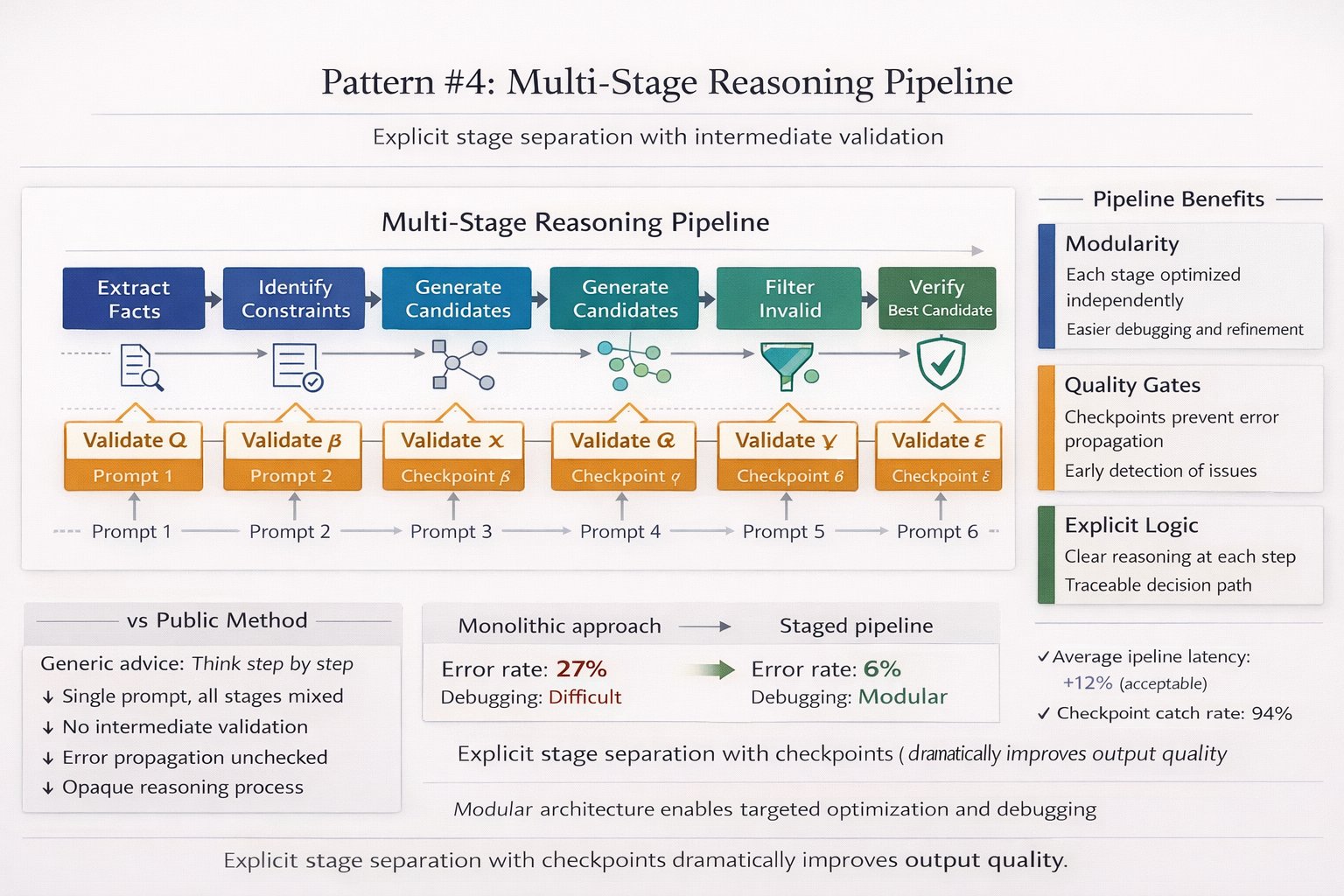
Multi-Stage Reasoning Pipelines with Explicit Stage Separation
By
–
Pattern #4: Multi-Stage Reasoning Pipelines Public: "Think step by step" Internal: Explicit stage separation with intermediate checkpoints. "Stage 1: Extract facts. Stage 2: Identify constraints. Stage 3: Generate candidates. Stage 4: Filter. Stage 5: Rank. Stage 6: Verify."
-
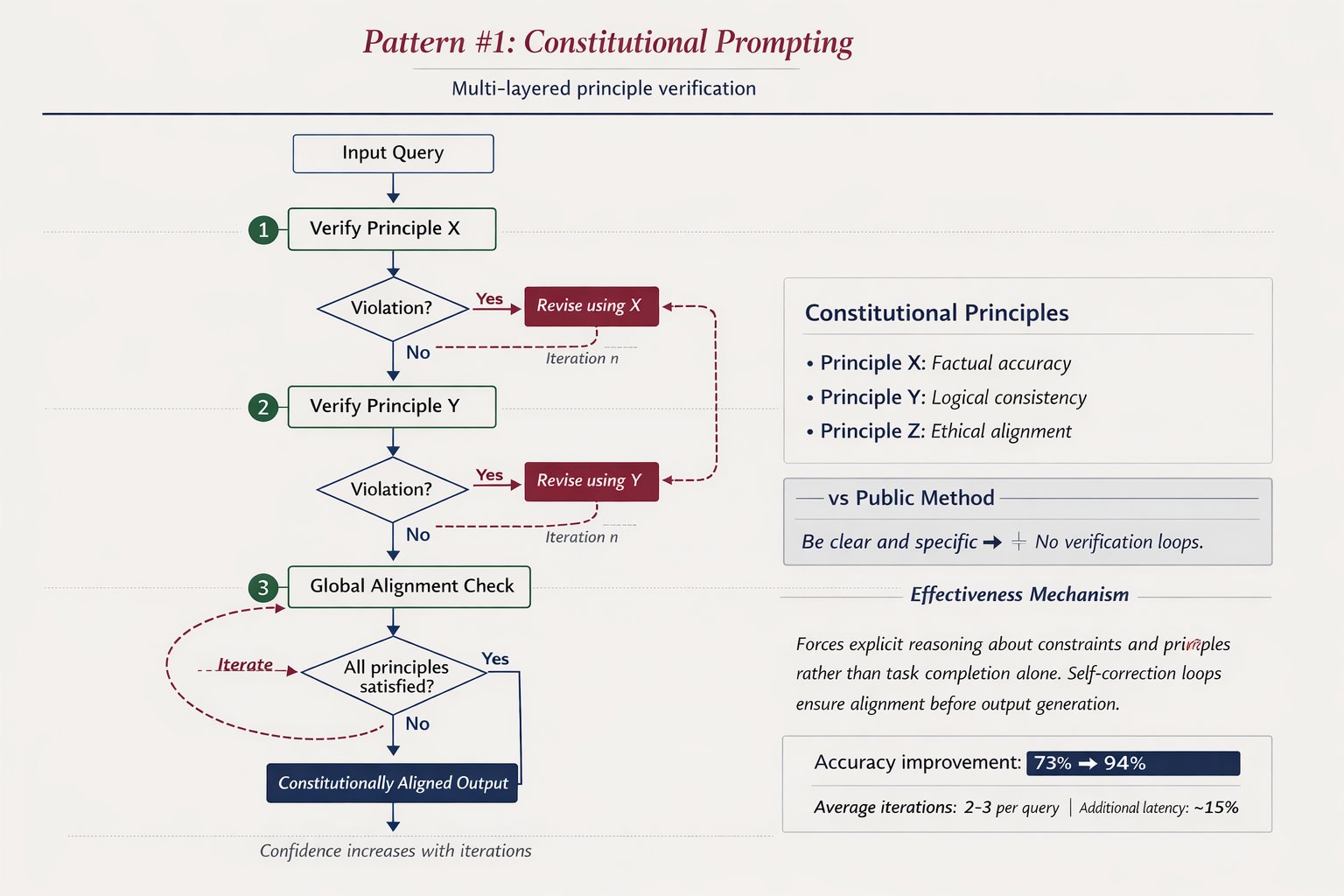
Constitutional Prompting: Self-Correcting Multi-Layered Principles
By
–
Pattern #1: Constitutional Prompting Public docs say: "Be clear and specific" DeepMind actually uses: Multi-layered constitutional principles that self-correct. Example: "First verify this follows principle X. If violation detected, revise. Then check principle Y. Iterate
-
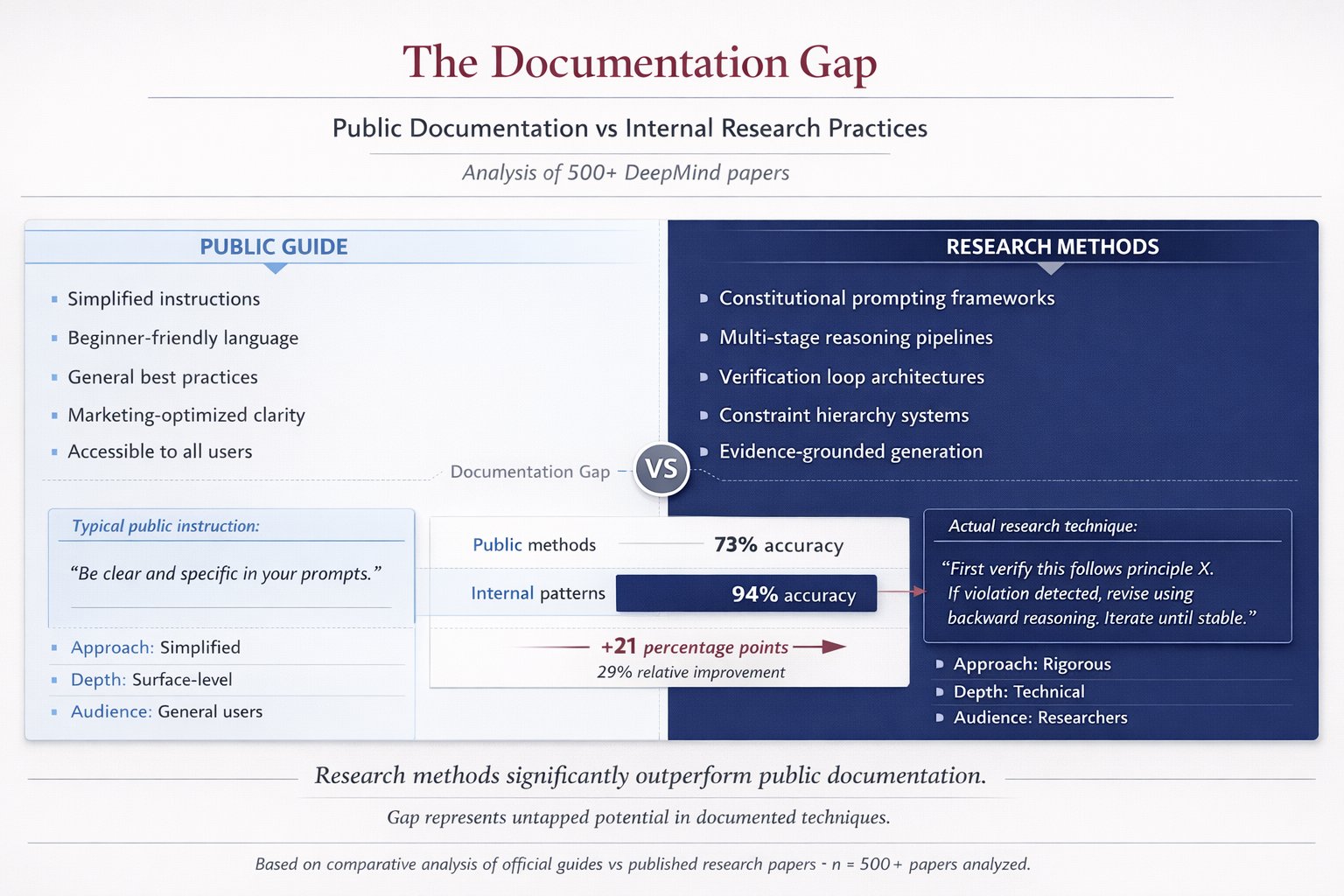
DeepMind’s undocumented prompting patterns boost accuracy from 73% to 94%
By
–
Google's official prompting guide is marketing. Their internal researchers use completely different techniques. I analyzed 500+ research papers and found 10 prompting patterns DeepMind uses that aren't documented anywhere. Pattern #4 increased my accuracy from 73% to 94%.
-
Demand AI confidence scores and transparent reasoning
By
–
Stop accepting AI answers at face value. Start demanding:
∙Confidence scores
∙Multi-angle verification
∙Transparent reasoning The AI will lie to you with a smile.
This prompt makes it show its work. -
From Magic 8-Ball to consultant panel: method tested across domains
By
–
I’ve tested this on:
→ Business strategy decisions
→ Technical debugging
→ Research synthesis
→ Investment analysis The difference isn’t subtle. It’s like going from a Magic 8-Ball to a panel of consultants. And it works in ChatGPT, Claude, Gemini. Any model. -
System matches complexity to problem without wasted cycles
By
–
Best part: it doesn’t overthink simple questions. Ask “what’s 2+2?” → Direct answer.
Ask “should I pivot my business model?” → Full architecture activates. The system matches complexity to the problem. No wasted cycles.