
A human just barely beat a humanoid robot at sorting packages. 12,924 vs. 12,732 over 10 hours. The human's forearm is "basically broken." The robot is still going. 131,000 packages. 106 hours. No breaks. The scoreboard tells one story. The endurance tells another.
@godofprompt
-
Analysis of LLM failure modes in reasoning and token prediction
By
–
The strawberry test. The "how many R's" test. The car wash riddle. Same failure mode every time. AI predicts the most probable answer, not the correct one. When probability matches reality, it looks like intelligence. When it doesn't, it looks like confidence without
-
Understanding LLM Hallucinations and Pattern Matching
By
–
This is what a hallucination actually looks like in practice. Not random nonsense. A confident, structured answer that happens to be wrong. The model pattern-matched to the most likely answer instead of the literal one. That's exactly what it does with your prompts too.
-
ChatGPT fails a visual riddle about hidden horses
By
–
The image shows 4 labeled horses. ChatGPT confidently identified a hidden 5th horse in the center where the bodies overlap. Detailed. Well-reasoned. Visually plausible. And wrong. The real 5th horse is the word "HORSE" in the title itself. Four drawn. One written. Five total.
-
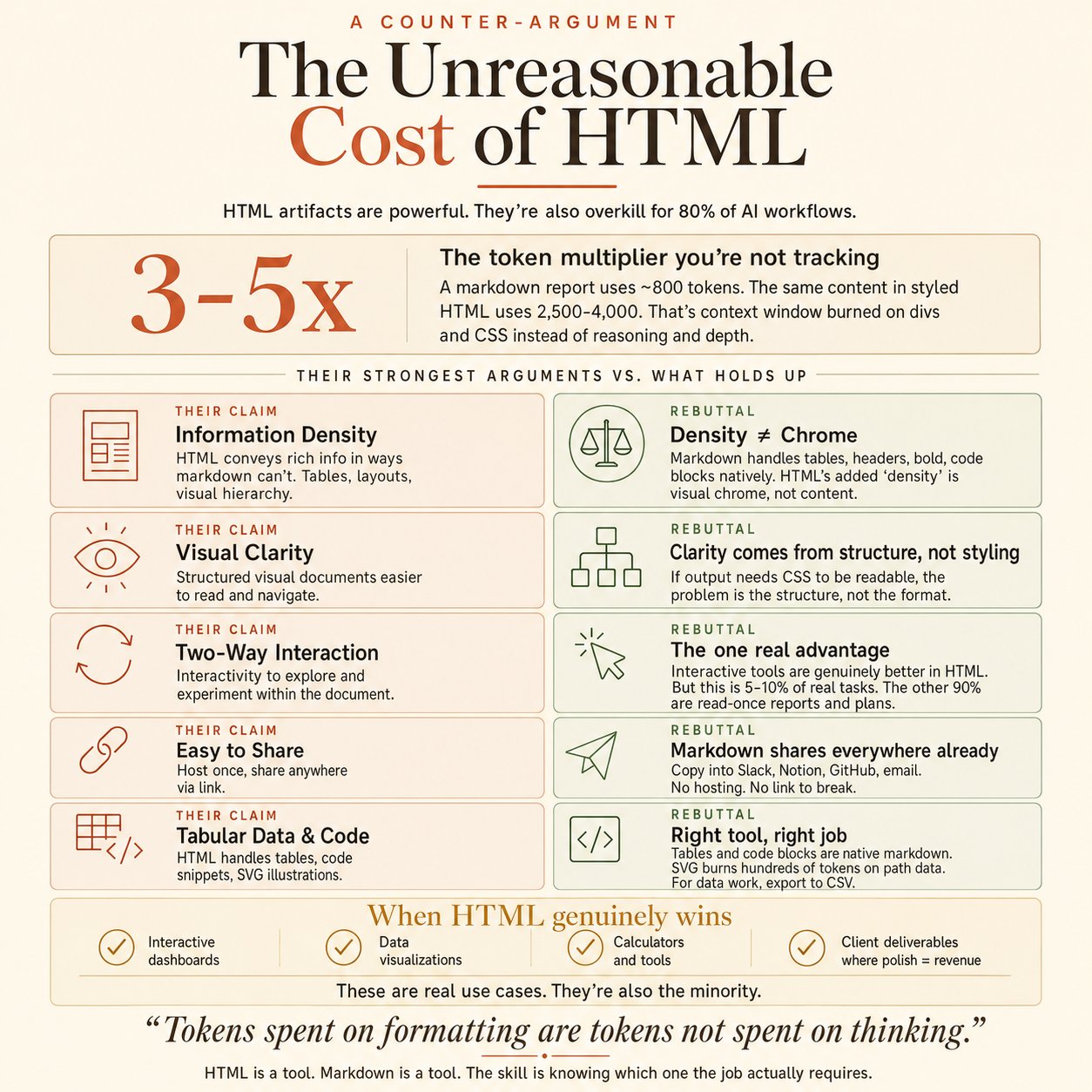
Token Efficiency Analysis of AI-Generated HTML Artifacts
By
–
Anthropic is pushing HTML artifacts as the future of AI workflows. What they're not telling you: a markdown report costs ~800 tokens. The same content in styled HTML costs 2,500-4,000. That's 3-5x more tokens burned on divs and CSS instead of reasoning and depth. More tokens
-
The Shift from Recommendation Systems to AI-Driven Content Curation
By
–
The X algorithm is no longer a recommendation system with some AI features. It's a Grok deployment that happens to recommend posts. The question for creators isn't "how does the algorithm work?" anymore. It's "what does Grok think of my content?" Build content that a thinking
-
Analysis of AI-driven content classification and distribution systems
By
–
Two things in the codebase worth watching closely. First: a classifier called "banger_initial_screen." This appears to detect viral potential early. Posts flagged as high-potential likely get accelerated distribution. The system isn't just passively scoring anymore. It's
-
Technical breakdown of engagement prediction model weightings
By
–
The prediction model expanded from roughly 10 engagement types to 15. The new additions are all negative signals: → P(not_interested)
→ P(block_author)
→ P(mute_author)
→ P(report) Each carries negative weight in the final score. A single block now mathematically pushes -
Technical Breakdown of Grok’s AI-Driven Ranking and Content Pipeline
By
–
Here's what Grok now controls: → Ranking: Phoenix transformer scores every candidate post
→ Retrieval: Two-Tower model finds out-of-network content using the same Grok architecture
→ Content understanding: A "Grox" pipeline classifies, embeds, and screens every post
→ Topic -
New Phoenix Ranking Model Ported from Grok-1
By
–
The old system used a hand-tuned neural network with manual feature engineering. SimClusters. TwHIN embeddings. Dozens of hand-crafted signals. That system is gone. The new ranking model is called Phoenix. It's ported directly from Grok-1. The repo says it plainly: "We have