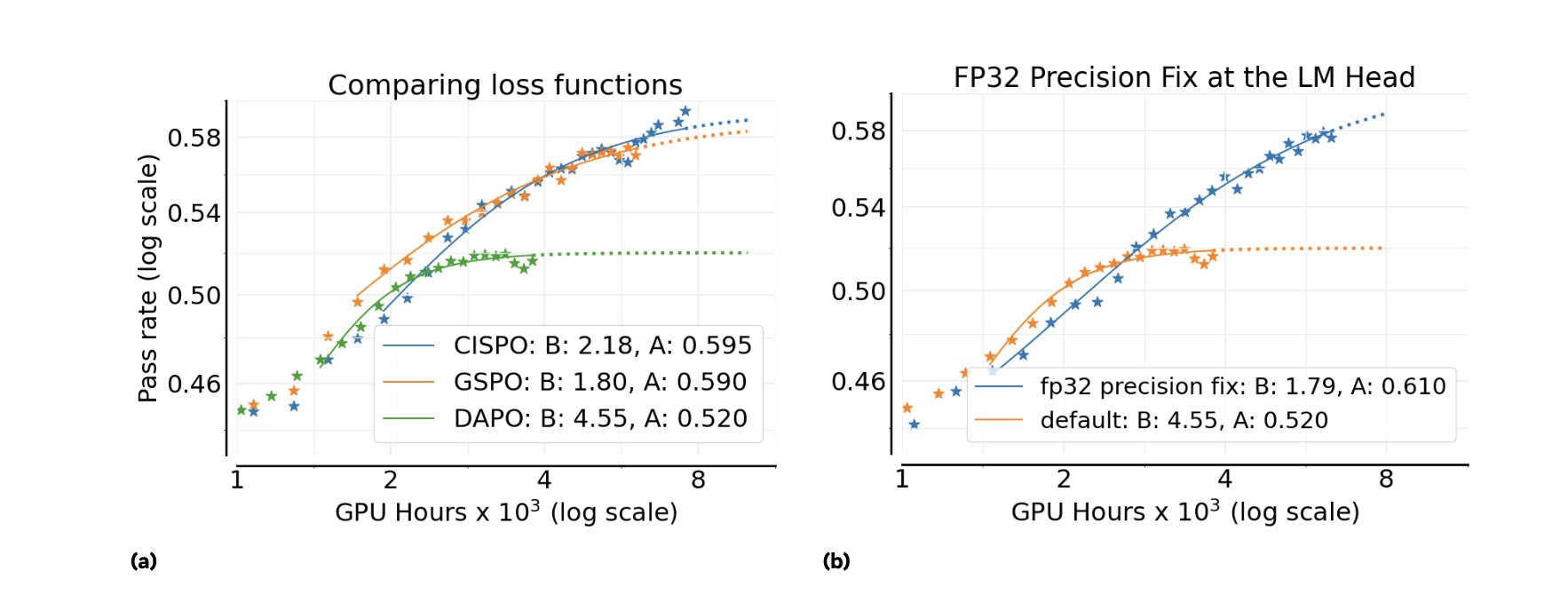
Here’s the wildest part… The same scaling law held across different model sizes, tasks, and sequence lengths. 8B dense model? 17B×16 MoE? Math + code RL tasks? Even 32k-token reasoning traces stayed on-curve. Stable scaling across everything.
@godofprompt
-
Predicting AI Model Performance from Small-Scale Training Runs
By
–
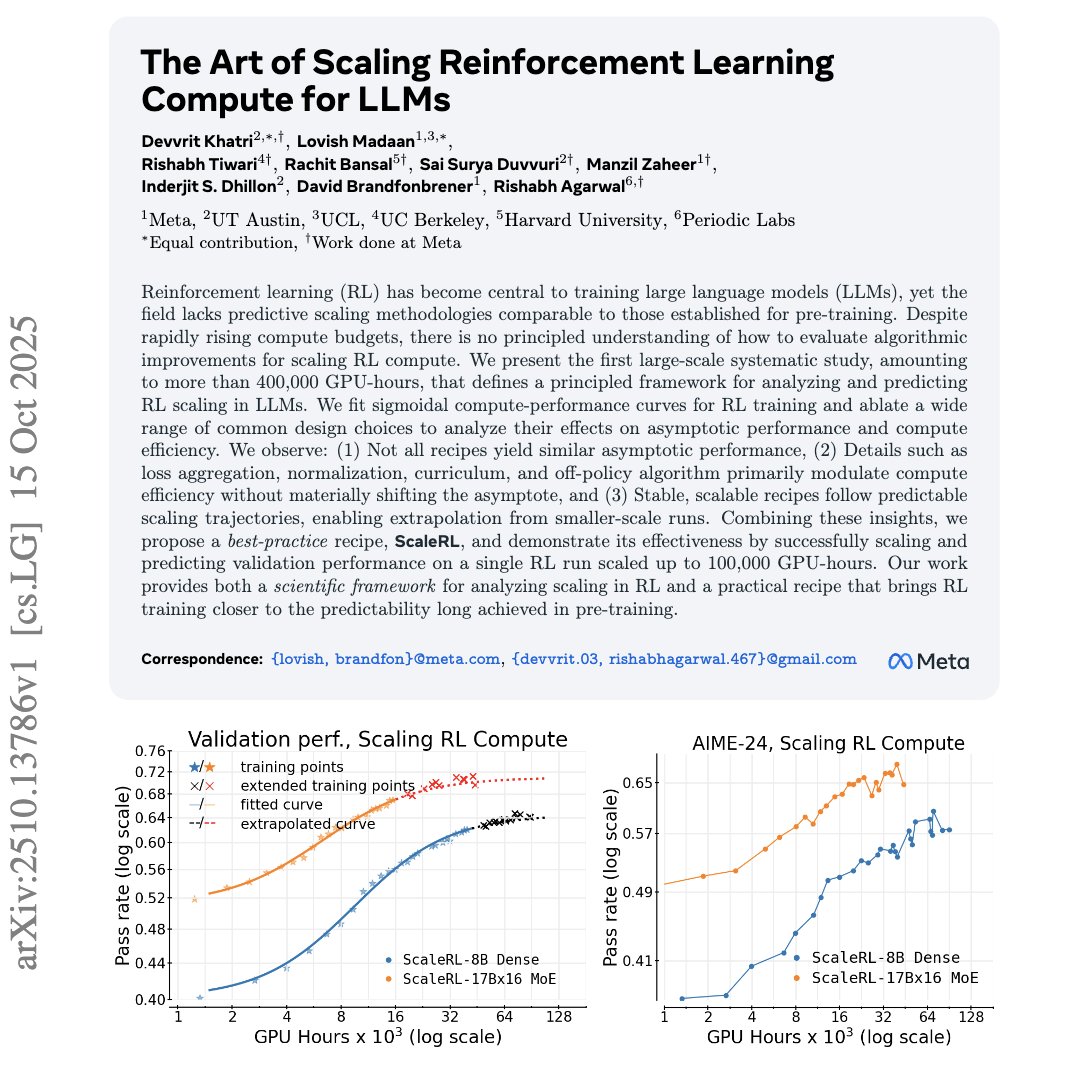
Why this matters: For the first time, we can predict asymptotic performance from small runs. Meta extrapolated 8k GPU-hour curves →
and nailed the actual performance at 100k GPU-hours. That’s predictive scaling in action no more trial and error. -
ScaleRL: Key Components Explained
By
–
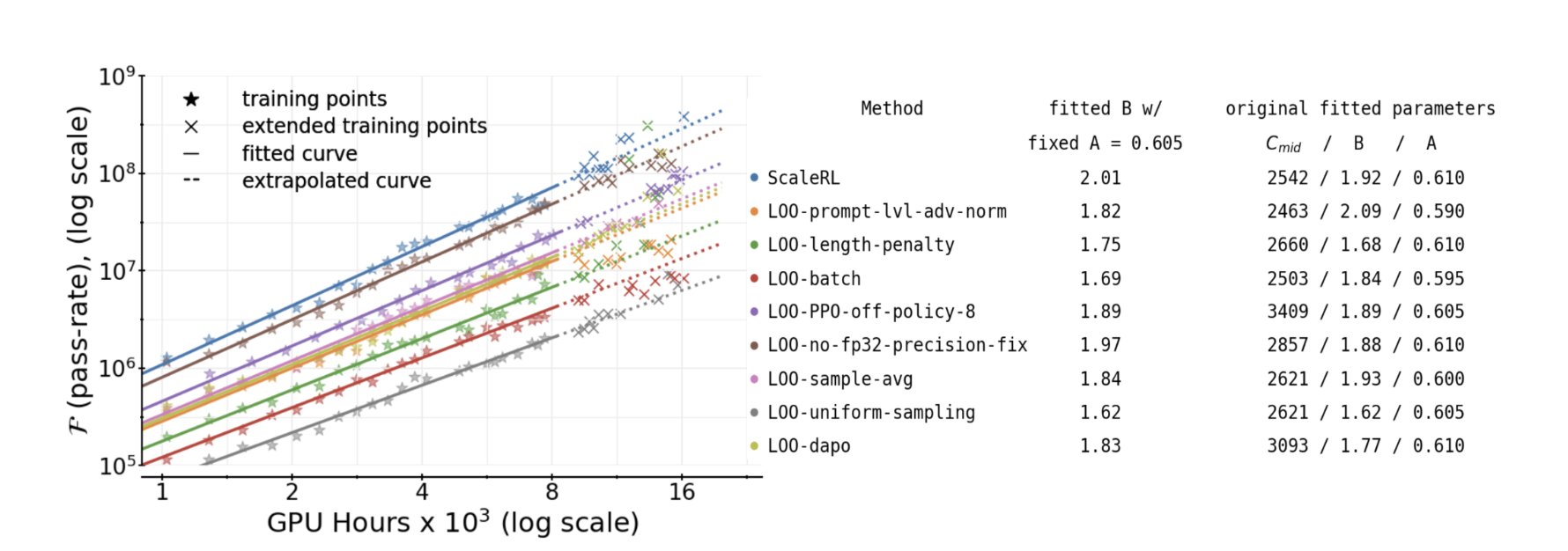
ScaleRL isn’t magic. It’s a recipe of small, proven ingredients: – Pipeline-RL async setup
– FP32 logits for stable gradients
– CISPO loss (clipped importance sampling)
– Prompt-level averaging
– Batch-level normalization
– No-Positive-Resampling (drop “too easy” prompts) -
ScaleRL outperforms in RL scaling tests
By
–
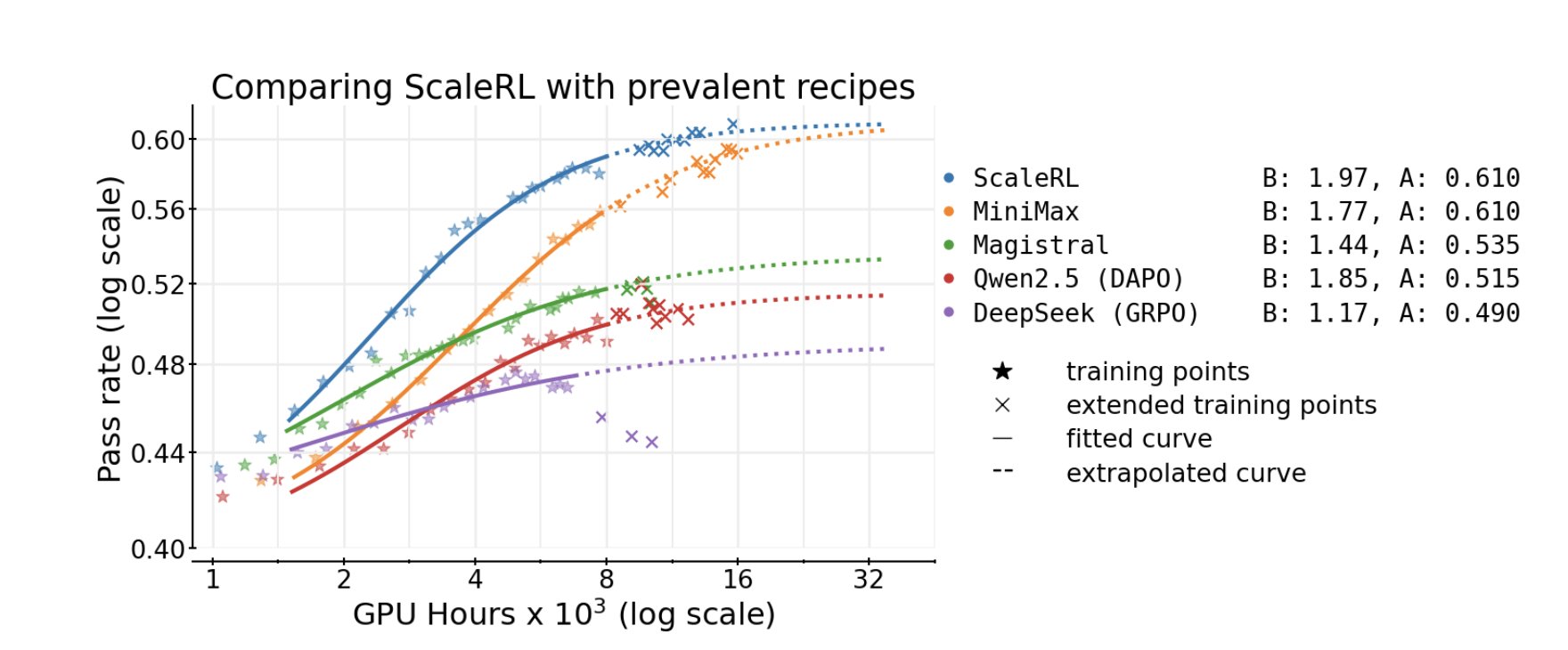
They tested this with 400,000 GPU hours across multiple RL recipes: DeepSeek (GRPO)
Qwen (DAPO)
Magistral
Minimax Result: only ScaleRL showed a stable, predictable trajectory. The others broke scaling laws entirely their curves collapsed. -
RL Performance Follows Sigmoid Scaling Law
By
–
What I found to be useful?? RL performance follows a sigmoid scaling law, not a power law. At small compute, progress is slow. Then it explodes mid-way before flattening at a predictable ceiling. That “S-curve” lets you forecast results before spending 10x more GPU hours.
-
Meta Reveals RL Scaling Challenges
By
–
Today, everyone talks about scaling models. But Meta just proved we’ve been ignoring the harder problem scaling reinforcement learning compute. Turns out, most RL methods don’t scale like pretraining. They plateau early burning millions in compute for almost no gain. ScaleRL
-
Meta’s ScaleRL reveals predictable RL scaling laws
By
–
Holy shit… Meta just cracked the art of scaling RL for LLMs. For the first time ever, they showed that "reinforcement learning follows predictable scaling laws" just like pretraining. Their new framework, 'ScaleRL', fits a sigmoid compute-performance curve that can forecast
-
Tensor Logic: Bridging Logic and Intelligence
By
–
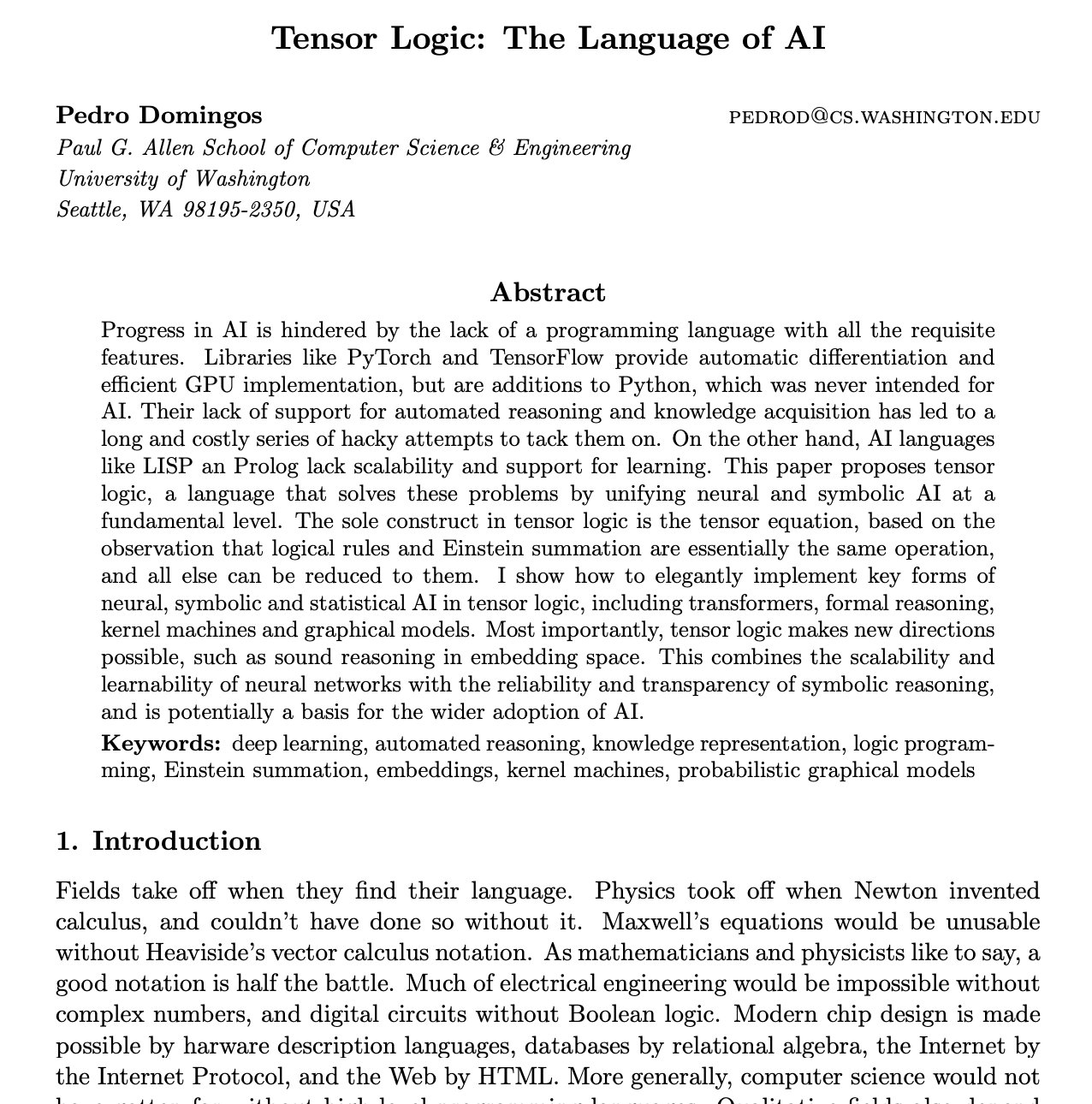
This paper might be the bridge between logic and intelligence. It’s called Tensor Logic, and it turns logical reasoning into pure tensor algebra no symbols, no heuristics, just math. Here’s the wild part: Logical propositions become vectors. Inference rules become tensor
-
AI Command Shortcuts Pro Tip
By
–
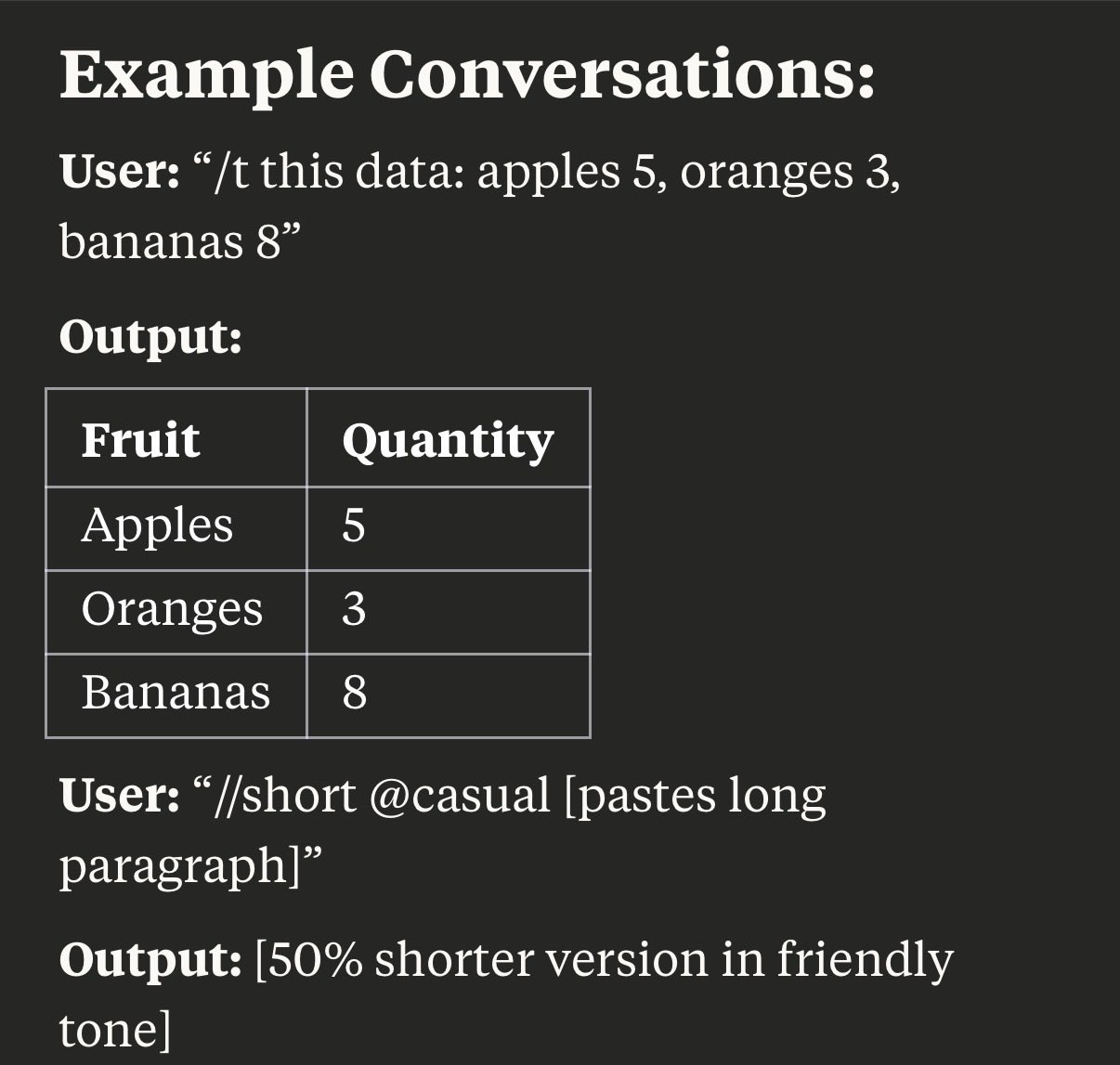
— Steal my prompt to chat with AI using shortcuts. ///▙▖▙▖▞▞▙▂▂▂▂▂▂▂▂▂▂▂▂▂▂▂▂▂▂▂▂▂
▛///▞ PRISM KERNEL :: SHORTCUT.COMMAND.SYSTEM ⫸
//▞▞〔Purpose · Rules · Identity · Structure · Motion〕
P:: Interpret shorthand commands for instant output without -
PRISM: Meta-Prompt Architecture Explained
By
–
PRISM is a meta-prompt architecture – a systematic way to structure AI instructions using five core components: P = Purpose – What triggers this mode or what goal it serves R = Rules – Constraints, requirements, and operational logic I = Identity – The role, function, or