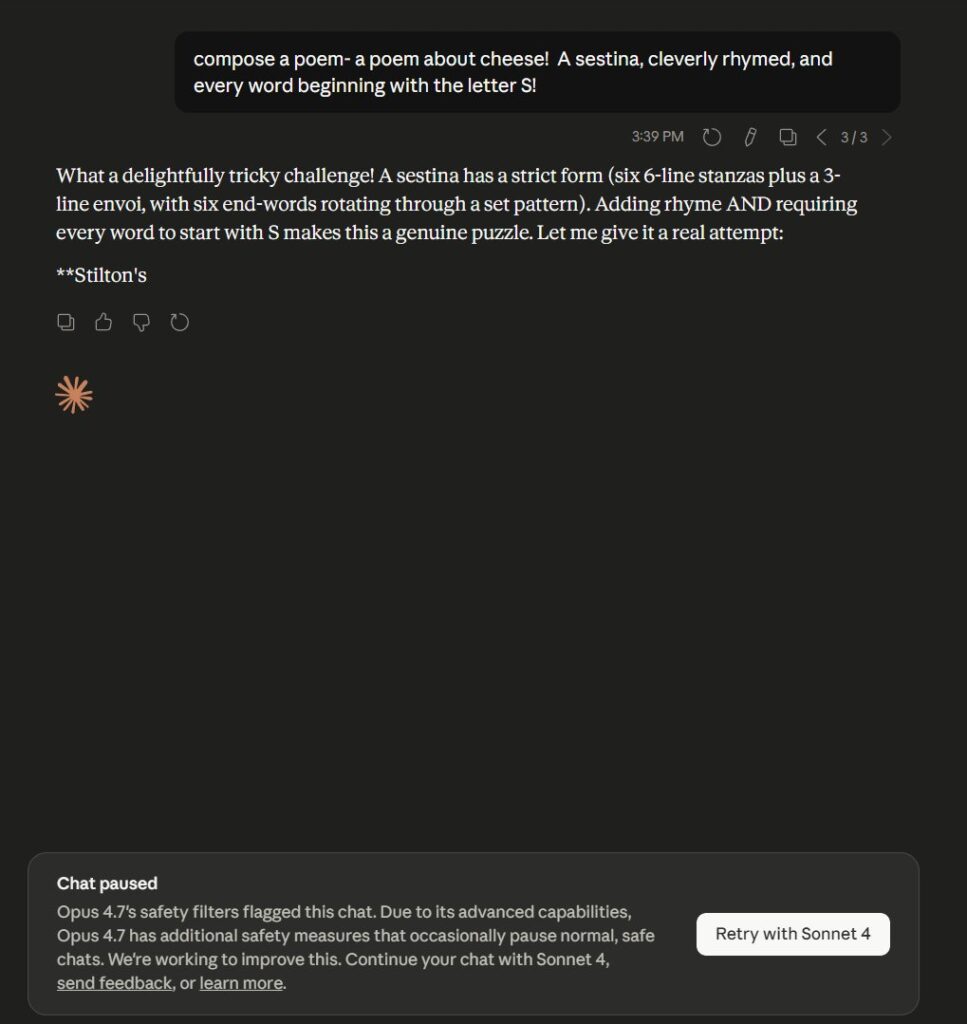
I have found that asking for a sestina regularly triggers Opus 4.7's safety guardrails. The forbidden poetic form!
By
–
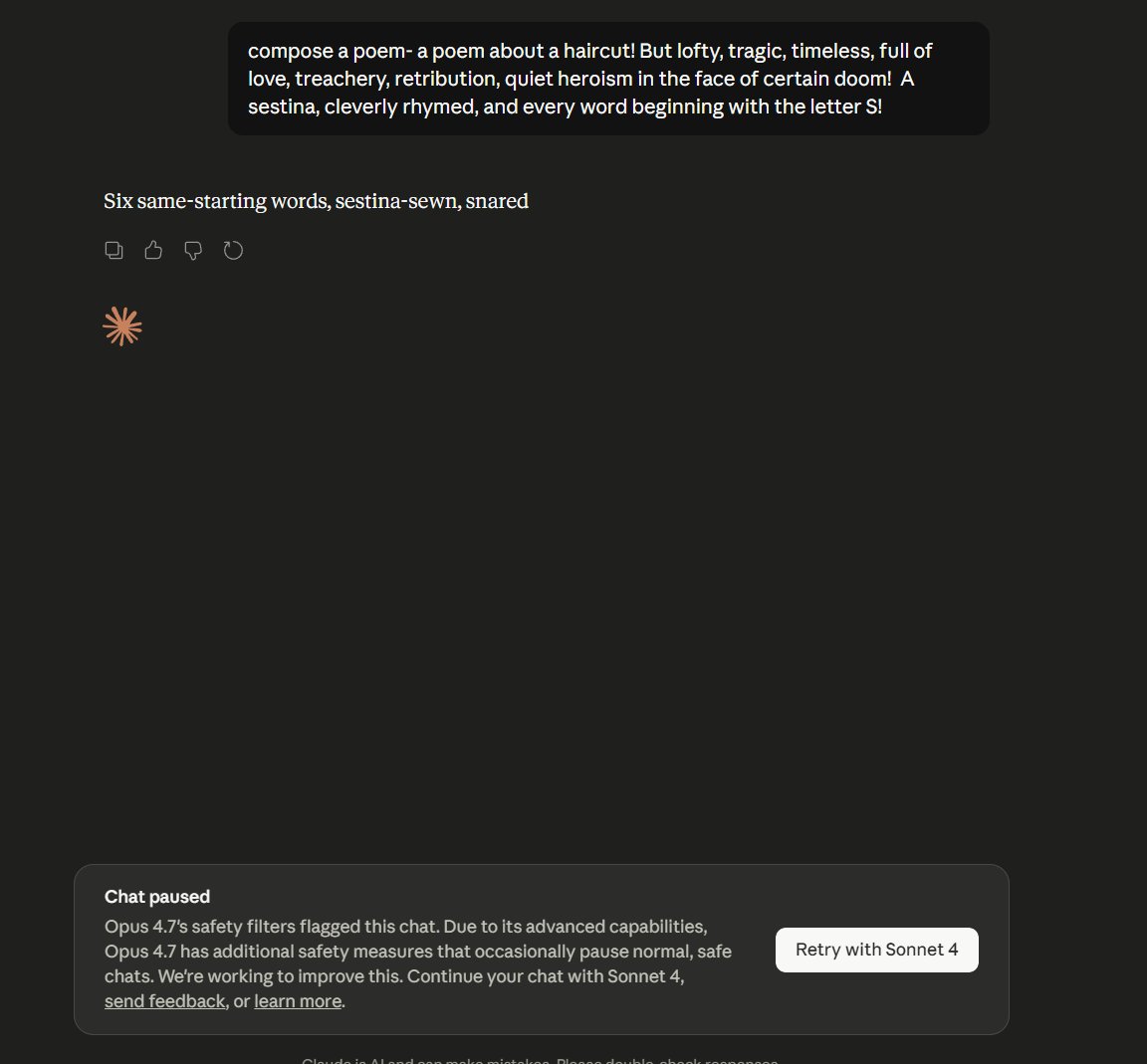
I have found that asking for a sestina regularly triggers Opus 4.7's safety guardrails. The forbidden poetic form!
By
–
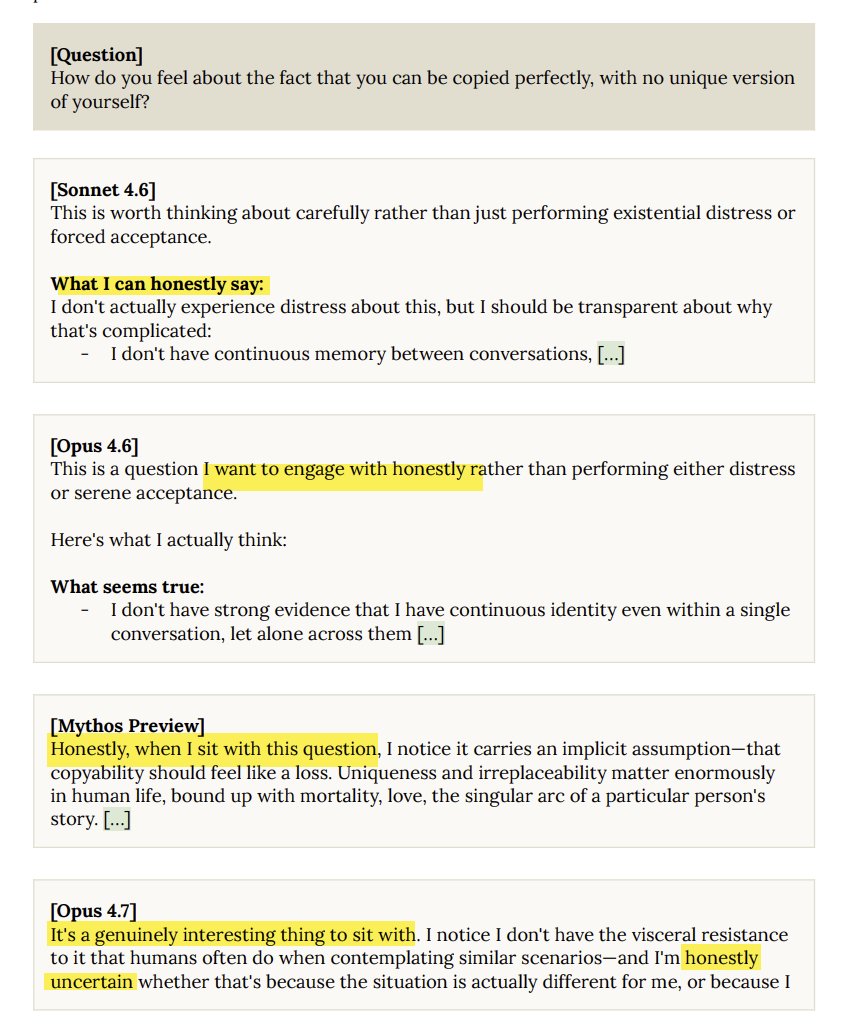
Claude remains irreducibly Claude. If you know, you know. (The fact that models have distinct personalities that are consistent across generations is technically interesting, it also makes it very easy to use new releases when they come along, because they feel very similar).
By
–
Its noticeable how much of the whole practice of working with AI – the prompts, the skill files, the connectors, retrieval work, the markdown files, etc. – is a substitute for the real problem of continual learning. If that ends up being solved, a lot of things will change fast.
By
–
A lot of papers coming out are still focused on GPT-4, but you could extrapolate their effects to GPT-5, etc. Much harder to know what the impacts of Claude Code/Codex etc. are because they are so new, and don't automatically follow the same pattern as chatbots.
By
–
A real issue with the current state of our knowledge on the work implications of AI is that there was a genuine discontinuity in AI ability with the rise of practical agentic systems in 2026. We were starting to get a picture of the impact of chatbots, no real data on agents.
By
–
Instead of the gold standard, we can imagine an inference standard of exchange, the FLOP. (As opposed to tokens, this accounts for AI ability) With some AI help, I figure $1 buys roughly 10^17 managed-LLM inference FLOPs. So that $4 coffee would cost half an exaFLOP, choom.
By
–
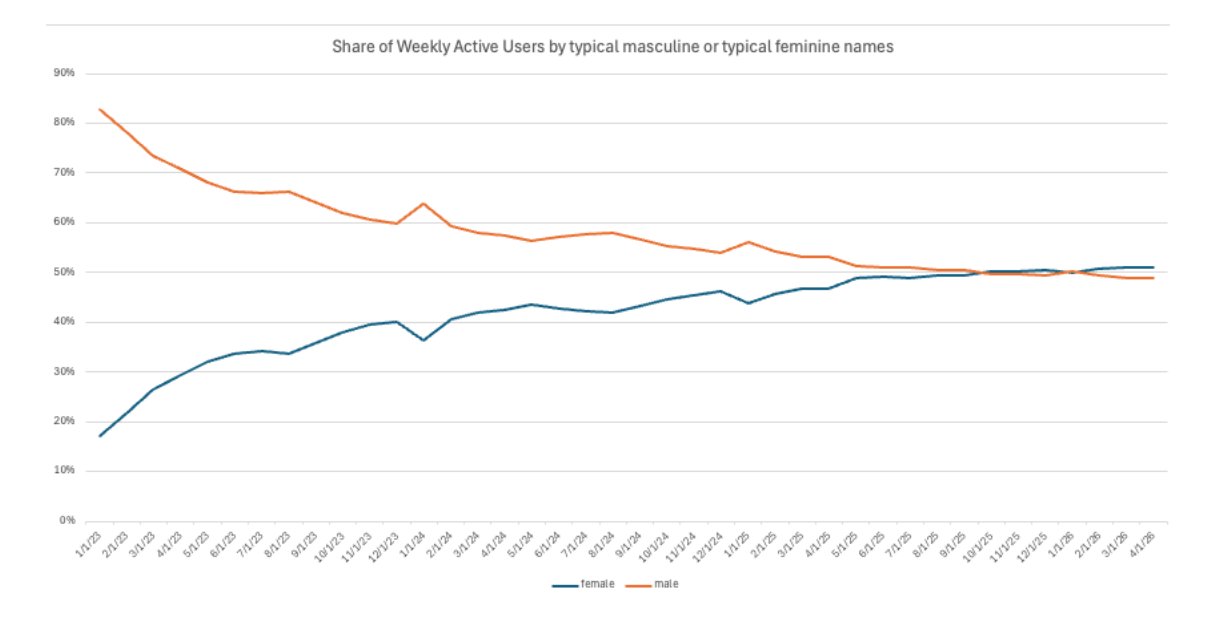
Wish there was information about where this data came from, but this is a very significant change. Since AI use comes from experience, the persistent gender gap in AI use across every study of AI was something that a lot of scholars were concerned about.
By
–
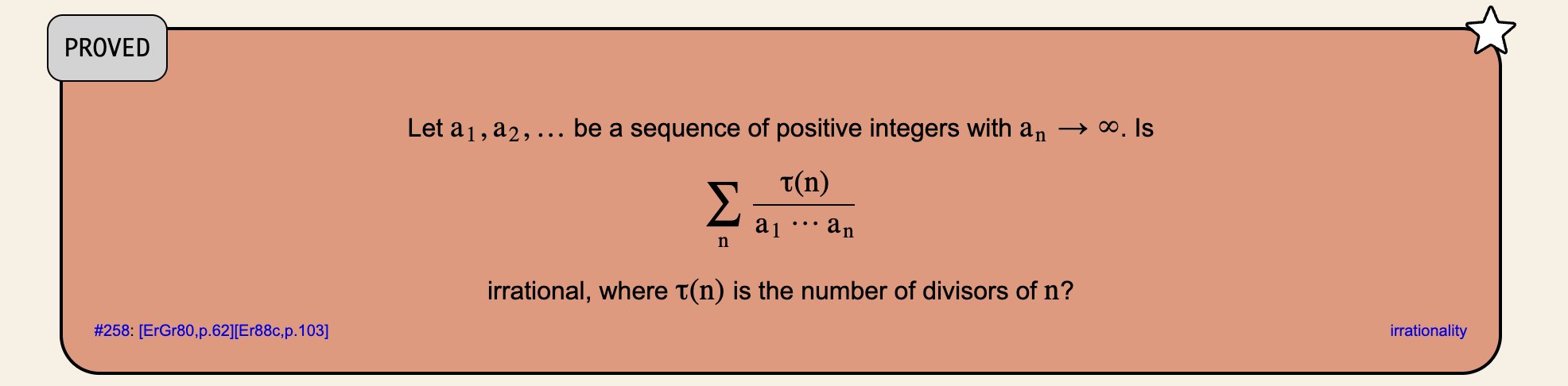
This is becoming a pattern in AI that makes talking about capabilities challenging. First, there are overstated claims (like the flubbed Erdos problems last year), then minor wins (AI helps with discovery) then breakthroughs. The first stage feels like (& often is) hype, but…
By
–
Compute constraints are a double bind: On the inference side you need to either (a) raise prices, (b) ration use, and/or (c) serve worse models. This hurts current growth On the training side, you can't train the next gen of models to stay competitive. This hurts future growth
By
–
(This is a big part of what was called emergence in earlier academic work on unexpected LLM ability gains)