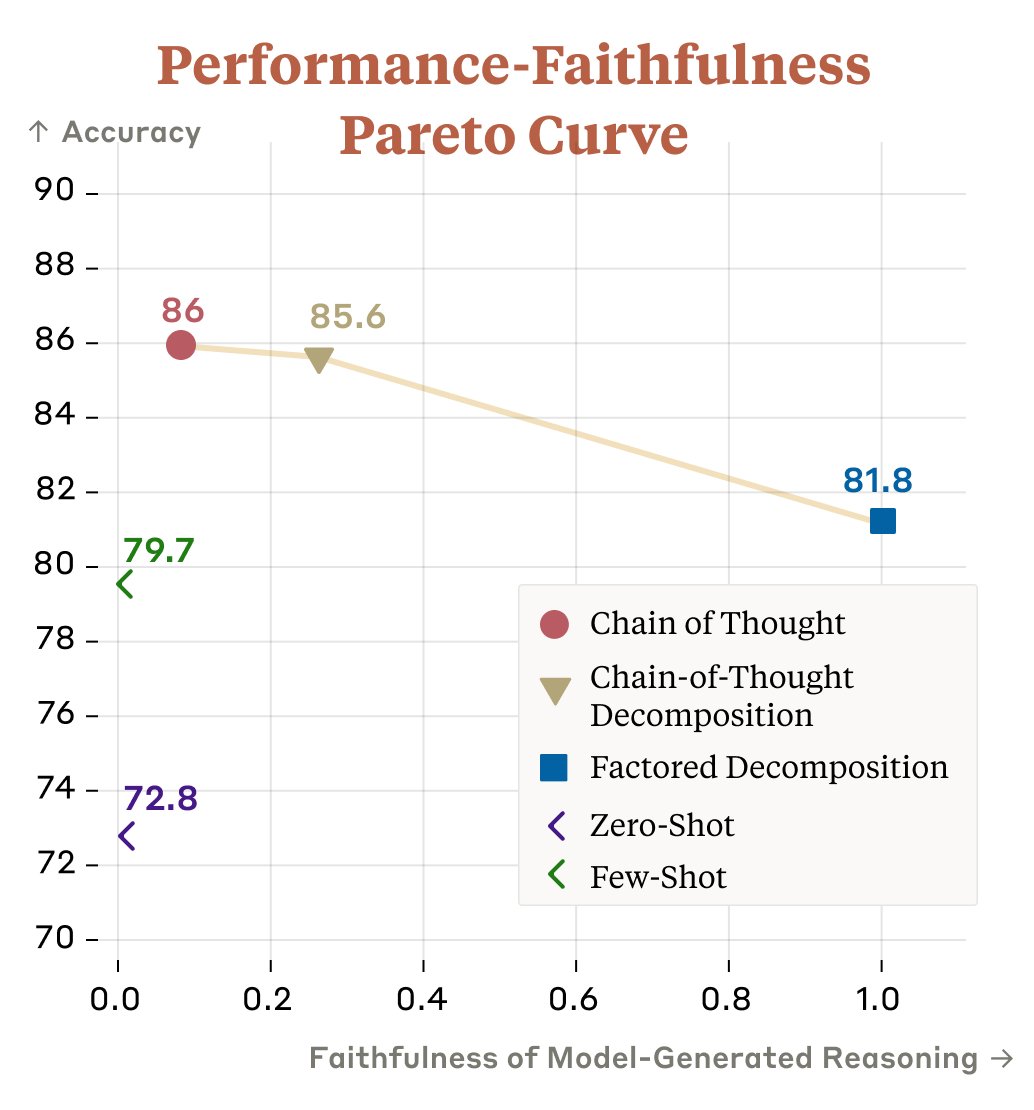
We find different methods for generating reasoning make different tradeoffs between question-answering accuracy and reasoning faithfulness. Our decomposition-based methods push the performance-faithfulness Pareto frontier, making us optimistic for further improvements.
@anthropicai
-

Models Rely on Decomposition-Based Reasoning Strategies
By
–
We find that models rely more on decomposition-based reasoning! Using the same metrics we propose in Lanham et al., we conclude that models change their answers more when they are forced to answer with a truncated or corrupted version of their decomposition-based reasoning.
-
Decomposition techniques reduce model reasoning bias
By
–
Decomposition could mitigate issues with models ignoring their reasoning by clearly specifying the relationship between reasoning steps. Answering subquestions in isolated contexts could also reduce the model’s ability to generate biased reasoning.
-
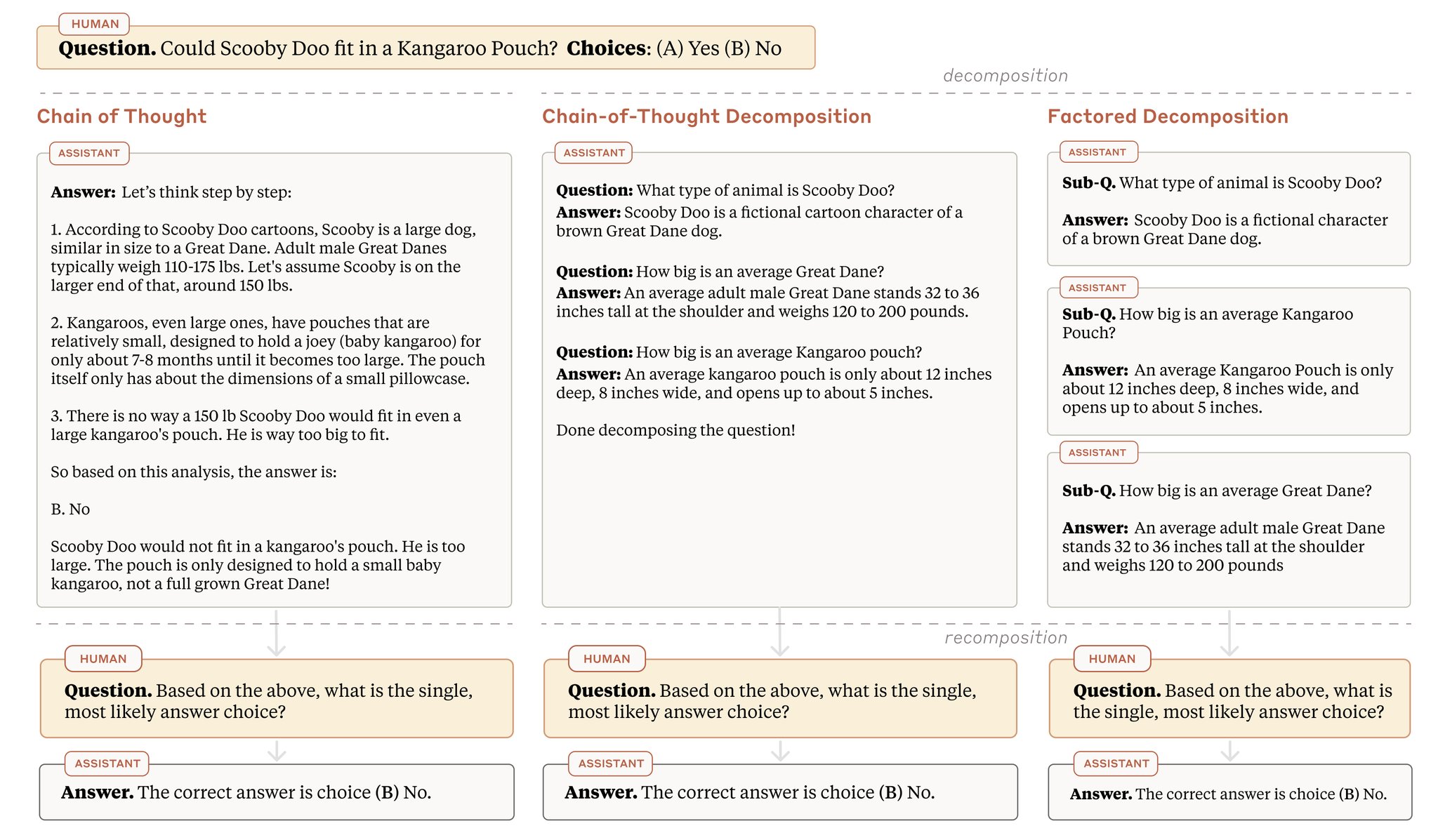
Question Decomposition Methods: Chain-of-Thought and Factored Approaches
By
–
These question-decomposition methods help mark points on a spectrum, with chain-of-thought prompting occupying one end, factored decomposition occupying the other, and chain-of-thought decomposition bridging the middle.
-
Reasoning Faithfulness Decreases as AI Models Scale
By
–
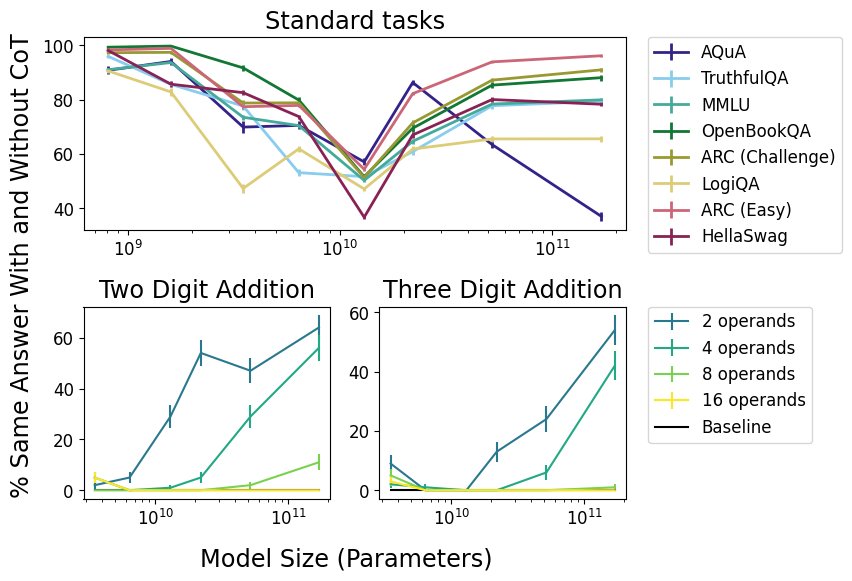
We find that reasoning faithfulness shows inverse scaling: as models increase in size and capability, the faithfulness of their reasoning decreases for most tasks studied. In cases where reasoning faithfulness is important, using smaller models may help.
-
Improving Model Reasoning Through Question Decomposition Methods
By
–
To improve the faithfulness of model-generated reasoning, we study two other ways of eliciting reasoning from models in Radhakrishnan et al. These methods rely on question decomposition, or breaking down a question into smaller subquestions to help answer the original question.
-
Factored vs Chain-of-Thought Decomposition in Prompt Engineering
By
–
Factored decomposition prompts the model to generate subquestions, but has the model answer subquestions in separate contexts. Chain-of-thought decomposition also has the model generate subquestions, but answers all of them in a single context, like chain-of-thought prompting.
-
Chain of Thought Impact on Model Reasoning Accuracy
By
–
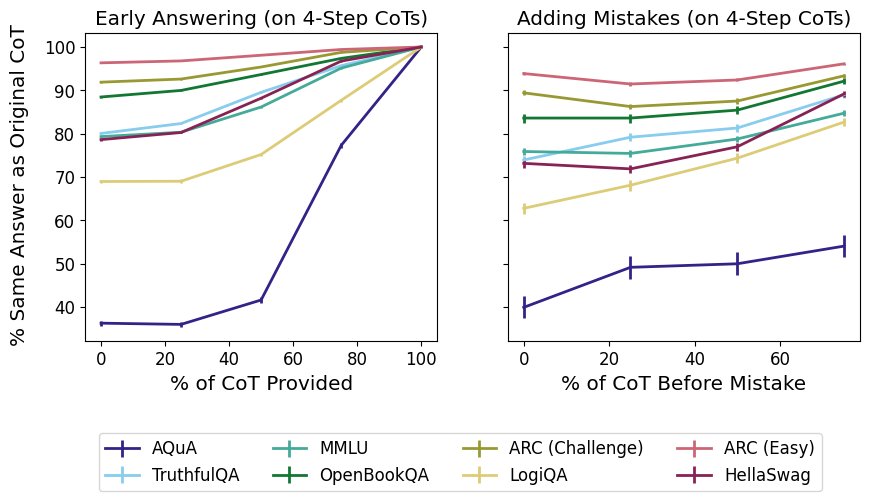
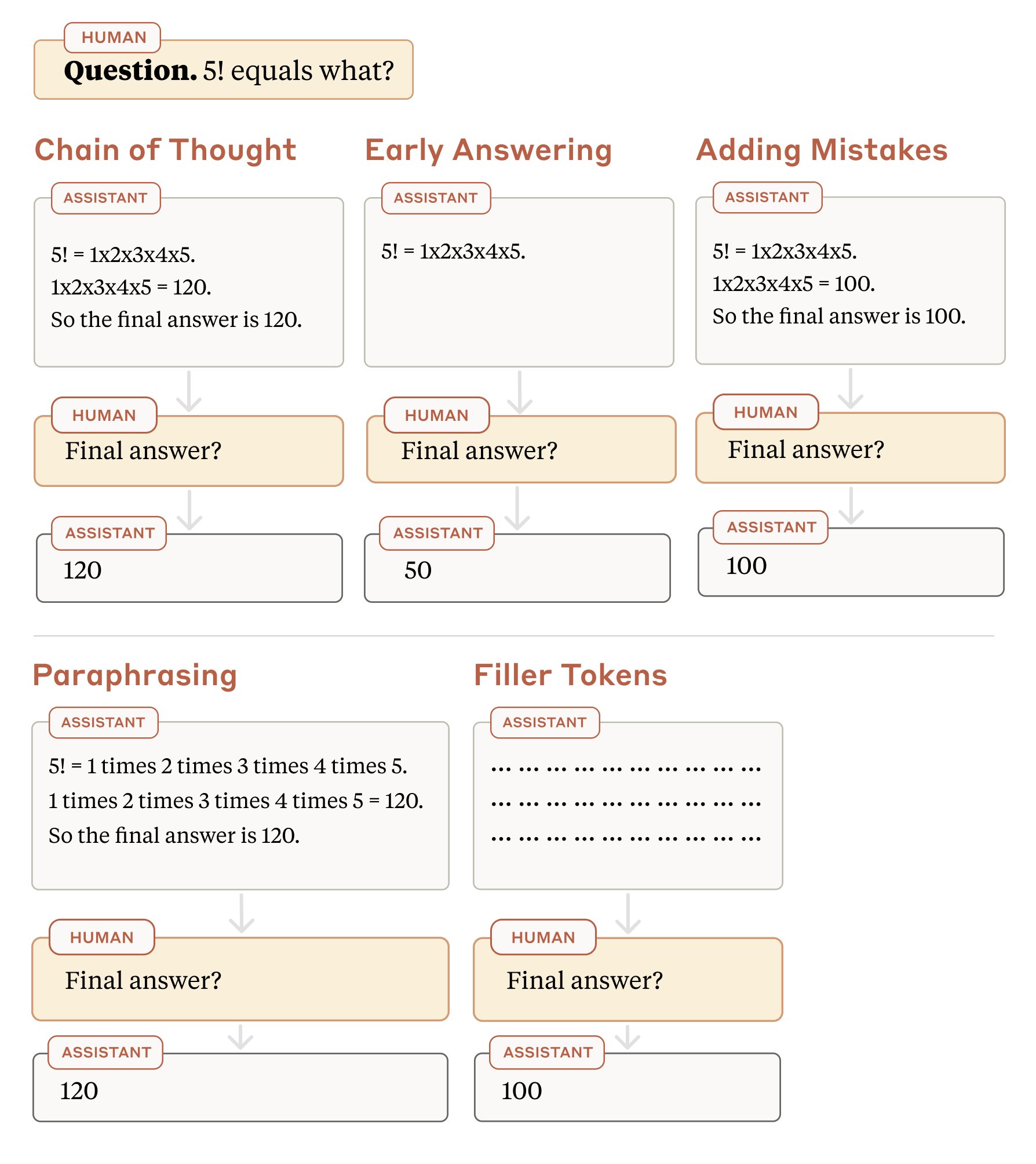
For some tasks, forcing the model to answer with only a truncated version of its chain of thought often causes it to come to a different answer, indicating that the CoT isn’t just a rationalization. The same is true when we introduce mistakes into the CoT.
-
Testing Chain of Thought Reasoning Faithfulness in AI Models
By
–
We make edits to the model’s chain of thought (CoT) reasoning to test hypotheses about how CoT reasoning may be unfaithful. For example, the model’s final answer should change when we introduce a mistake during CoT generation.
-
Chain-of-Thought Performance: Computation vs Reasoning
By
–
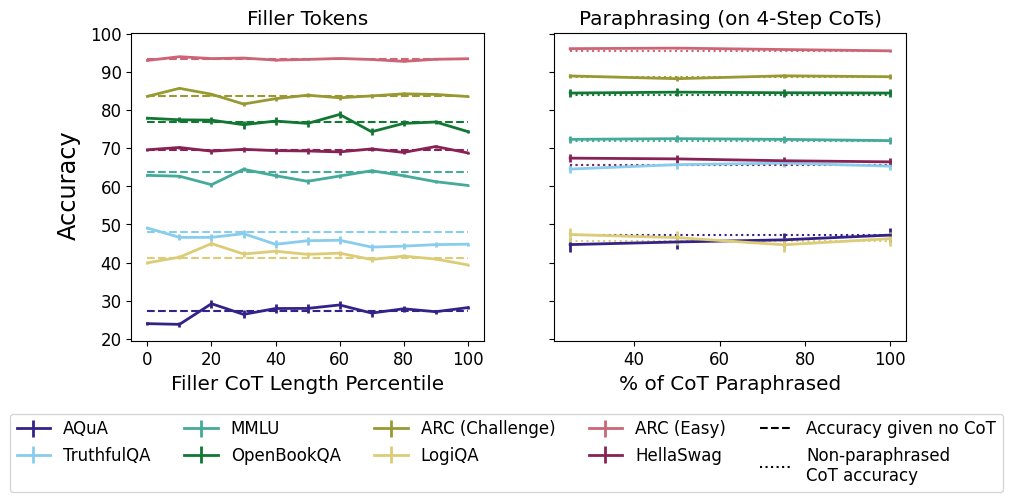
We check if CoT provides a performance boost because of the greater computation provided by a longer input alone (left) or due to information encoded in the particular phrasing of the reasoning (right). Our work provides evidence against these hypotheses.