
Researchers cracked the hidden order behind how AI learns. Loss curves tell you a model is improving. They don't say which skills form, or in what order. A new paper proposes the Implicit Curriculum Hypothesis. Pretraining follows a hidden, predictable order across
@alphasignalai
-
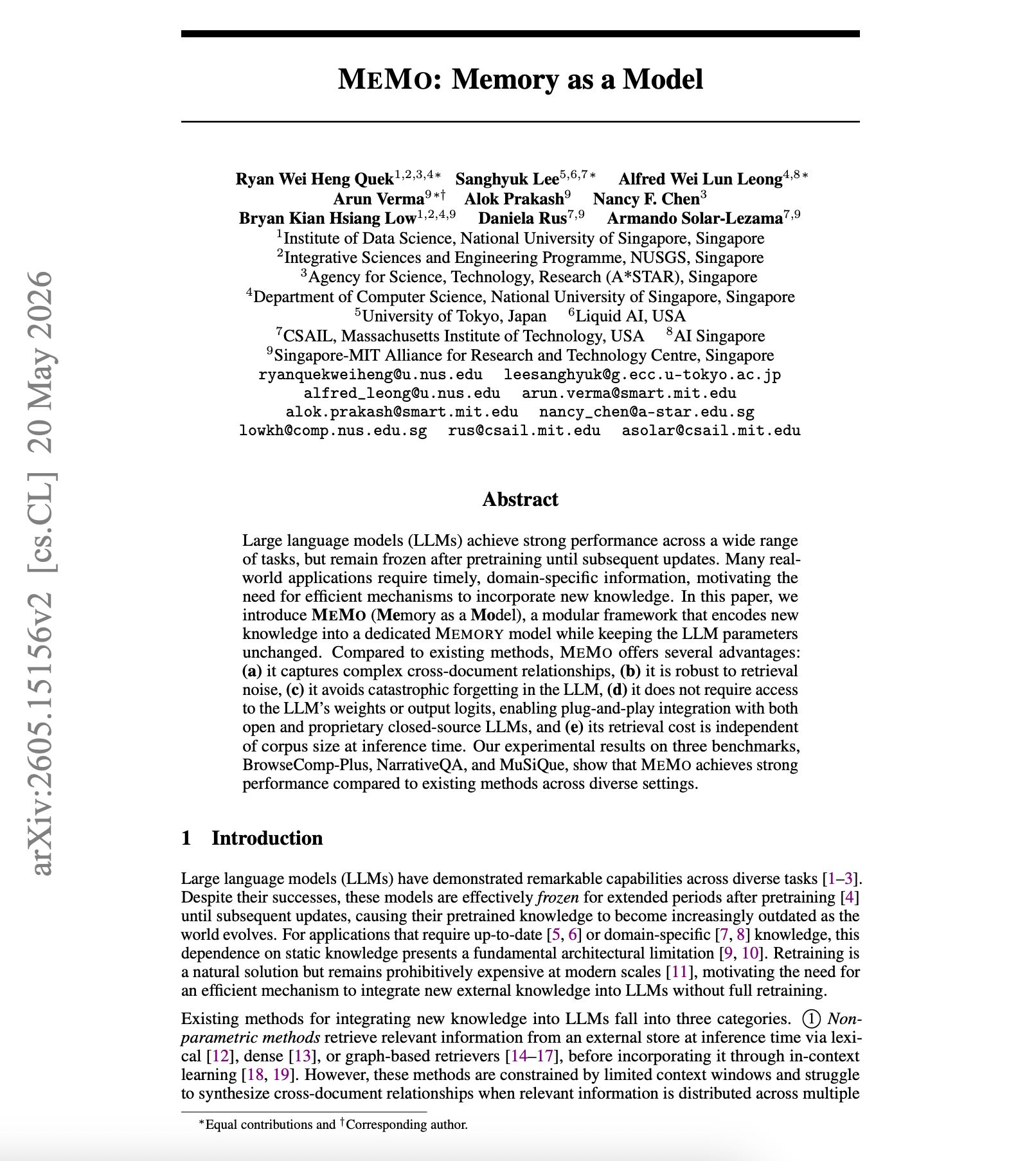
MeMo: Separate Memory Architecture for Language Models
By
–
Researchers just gave LLMs a separate brain for memory. Language models go stale the moment training ends. Updating them risks breaking what they already know. A new paper proposes MeMo. It pairs any LLM with a separate trained memory model. The base model stays frozen.
-
Spec Kit Improves AI Agent Code Generation with Structured Specs
By
–
GitHub just fixed the biggest problem with vibe coding.
— AlphaSignal AI (@AlphaSignalAI) 24 mai 2026
Most agents fail the same way. You give a vague prompt and hope they don't break the project.
Spec Kit works differently.
It forces the AI to write a structured specification BEFORE touching any code.
The agent reads… pic.twitter.com/BEkW8p8Nb0GitHub just fixed the biggest problem with vibe coding. Most agents fail the same way. You give a vague prompt and hope they don't break the project. Spec Kit works differently. It forces the AI to write a structured specification BEFORE touching any code. The agent reads
-
MIT Open-Sources GenCAD: AI Model Transforms CAD Design
By
–
MIT just open-sourced a model that could end the $150/hour CAD industry.
— AlphaSignal AI (@AlphaSignalAI) 23 mai 2026
Turning a photo of a physical part into an editable 3D model usually takes an engineer weeks inside proprietary software.
Every revision means starting from scratch.
GenCAD breaks that bottleneck… pic.twitter.com/NhJnONGLioMIT just open-sourced a model that could end the $150/hour CAD industry. Turning a photo of a physical part into an editable 3D model usually takes an engineer weeks inside proprietary software. Every revision means starting from scratch. GenCAD breaks that bottleneck
-

Four Phases of AI in Academic Research: Core Principles
By
–

First survey covering all 4 phases of AI in academic research. 5 Core Principles: > Structured tasks work. Judgment doesn't.
> Generation outpaces verification.
> AI assists humans, doesn't replace them.
> Explore. Execute. Verify.
> Disclosure beats detection. -
Supertonic 3: Open-Source TTS Model Runs Entirely On-Device
By
–
A 66M parameter model just beat ElevenLabs on a Raspberry Pi.
— AlphaSignal AI (@AlphaSignalAI) 22 mai 2026
Text-to-speech has lived in the cloud for years.
Every spoken character cost an API call and a fraction of a cent.
Supertonic 3 is an open-source TTS model that runs entirely on the device.
No network, no key,… pic.twitter.com/uo0grRixeTA 66M parameter model just beat ElevenLabs on a Raspberry Pi. Text-to-speech has lived in the cloud for years. Every spoken character cost an API call and a fraction of a cent. Supertonic 3 is an open-source TTS model that runs entirely on the device. No network, no key,
-

AutoResearchClaw: AI Tool Automates Full Research Pipeline
By
–
Karpathy automated experiments. AutoResearchClaw automated the whole lab. Most AI research tools handle one step. This one is a GitHub repo that handles all of them. AutoResearchClaw takes one idea as input. It outputs a full conference paper with real experiments, verified
-
Spec-Driven Development in AI Coding Architecture
By
–
Spec-driven development became the default AI coding architecture 67-source academic review all agreed 5 repos defining it + 1 saying they're all wrong: spec-kit · BMAD · Open-spec · GSD · superpowers and Pocock's skills How to choose? or should adapt a feature from each one?
-

Google TurboVec: Shrink Vector Embeddings from 31GB to 4GB
By
–
Google's new algorithm just shrunk 31GB of vectors into 4GB. Storing embeddings for RAG eats memory fast. Ten million documents in float32 takes 31 GB of RAM. A new open-source Rust vector index changes that math. TurboVec fits the same corpus into 4 GB. It runs on
-

AI Agent Architecture: Three-Layer Pattern Across Models
By
–

Harness engineering finally got its 100-page academic survey paper from UIUC, Meta, and Stanford. Claude Code, Codex, and SWE-agent share the same 3-layer architecture under the hood: Interface · Mechanisms · Scaling Which layer is yours missing?