Birth of a Transformer: A Memory Viewpoint paper page: https://
huggingface.co/papers/2306.00
802
… Large language models based on transformers have achieved great empirical successes. However, as they are deployed more widely, there is a growing need to better understand their internal mechanisms
@_akhaliq
-

Understanding Transformer Internal Mechanisms Through Memory Analysis
By
–
-
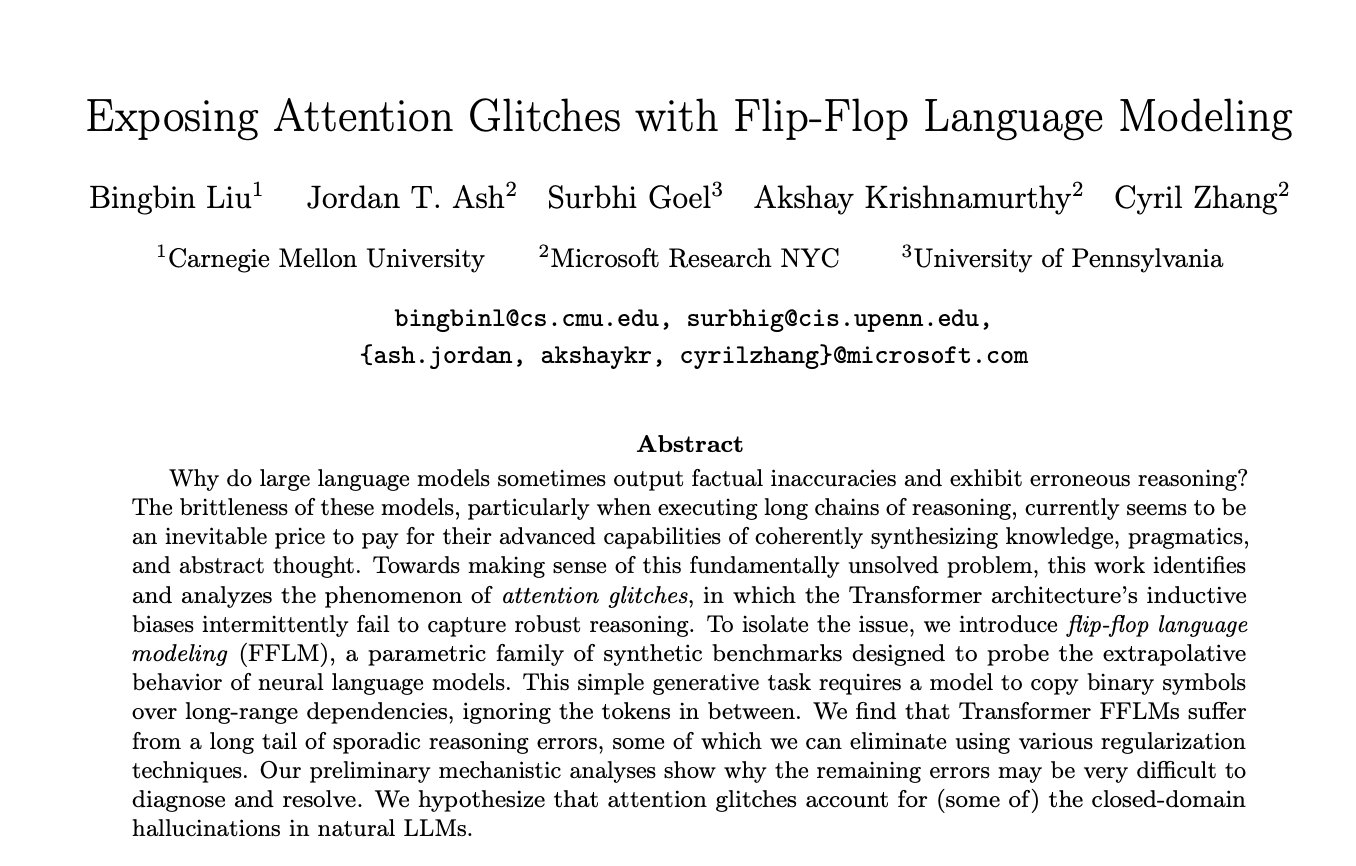
Analyzing Attention Glitches in Transformer Language Models
By
–
Exposing Attention Glitches with Flip-Flop Language Modeling abs: https://
arxiv.org/abs/2306.00946 identifies and analyzes the phenomenon of attention glitches, in which the Transformer architecture's inductive biases intermittently fail to capture robust reasoning. To isolate the -

Hiera: Hierarchical Vision Transformer Simplified Architecture
By
–
Hiera: A Hierarchical Vision Transformer without the Bells-and-Whistles abs: https://
arxiv.org/abs/2306.00989 Modern hierarchical vision transformers have added several vision-specific components in the pursuit of supervised classification performance. While these components lead to -
Understanding Concept Representations in Text-to-Image Diffusion Models
By
–
The Hidden Language of Diffusion Models
— AK (@_akhaliq) 2 juin 2023
paper page: https://t.co/biwX1KX7hG
tackle the challenge of understanding concept representations in text-to-image models by decomposing an input text prompt into a small set of interpretable elements. This is achieved by learning a… pic.twitter.com/mF0QzNxAjoThe Hidden Language of Diffusion Models paper page: https://
huggingface.co/papers/2306.00
966
… tackle the challenge of understanding concept representations in text-to-image models by decomposing an input text prompt into a small set of interpretable elements. This is achieved by learning a -
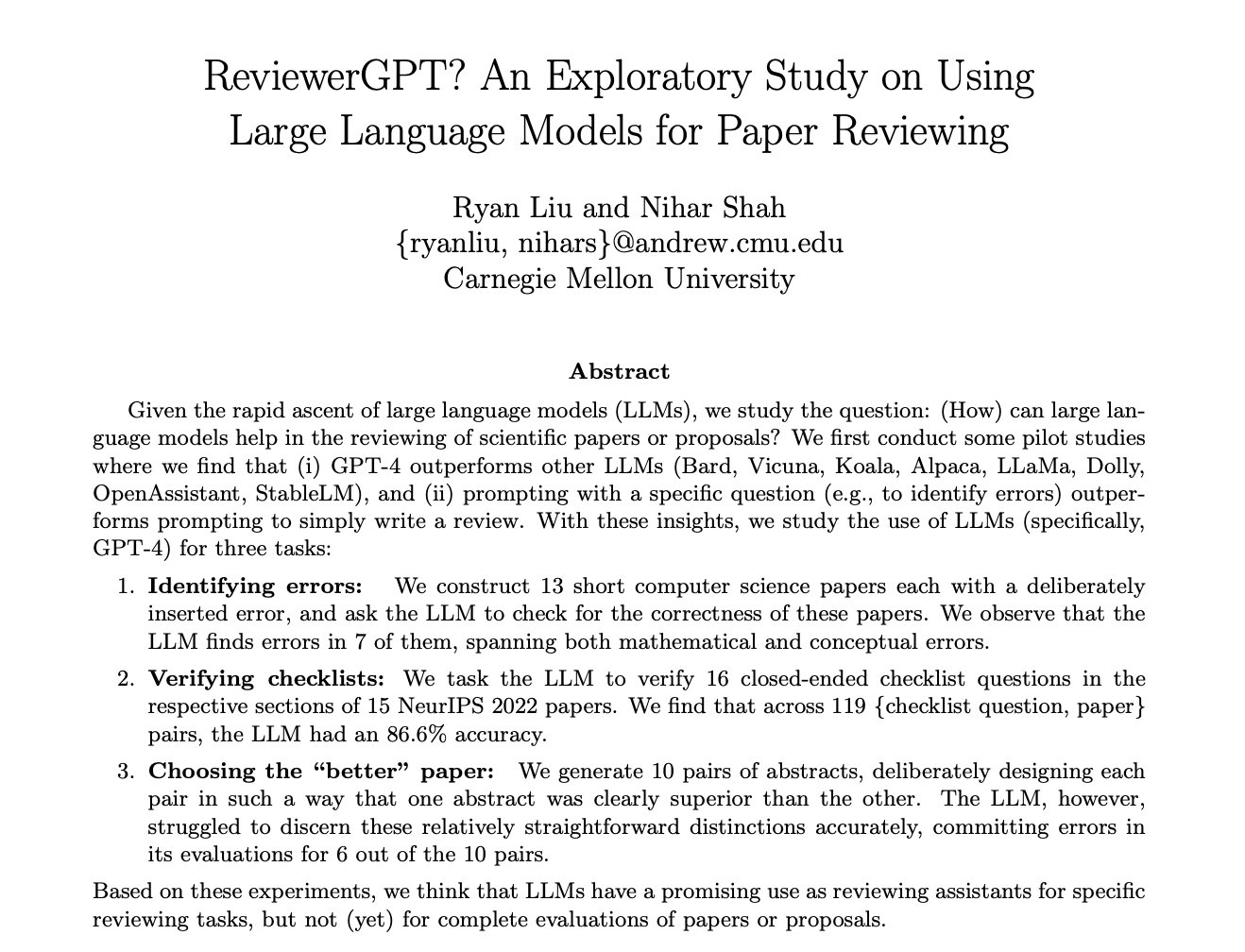
ReviewerGPT: Using Large Language Models for Scientific Paper Review
By
–
ReviewerGPT? An Exploratory Study on Using Large Language Models for Paper Reviewing Given the rapid ascent of large language models (LLMs), we study the question: (How) can large language models help in reviewing of scientific papers or proposals? We first conduct some pilot
-
StyleDrop: Text-to-Image Generation in Any Style
By
–
StyleDrop: Text-to-Image Generation in Any Style
— AK (@_akhaliq) 2 juin 2023
introduce StyleDrop, a method that enables the synthesis of images that faithfully follow a specific style using a text-to-image model. The proposed method is extremely versatile and captures nuances and details of a user-provided… pic.twitter.com/ATlsSA5RWsStyleDrop: Text-to-Image Generation in Any Style introduce StyleDrop, a method that enables the synthesis of images that faithfully follow a specific style using a text-to-image model. The proposed method is extremely versatile and captures nuances and details of a user-provided
-
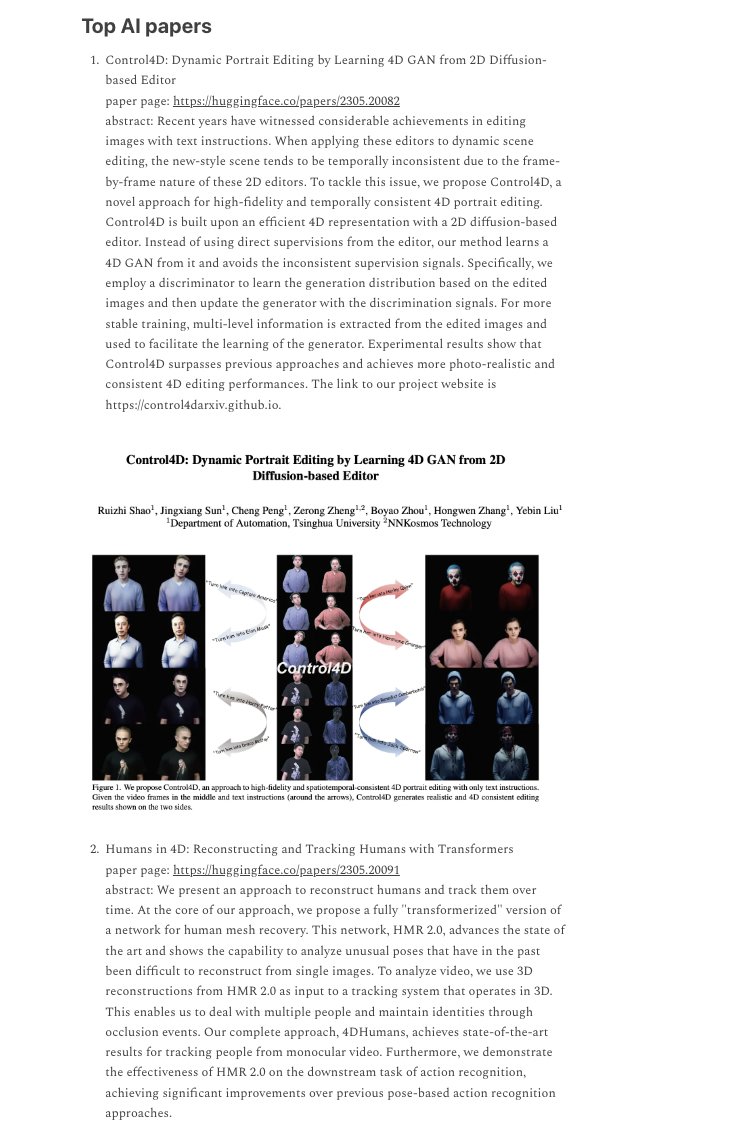
Trending AI News Stories and Papers
By
–
Trending AI news stories + papers https://
open.substack.com/pub/akhaliq/p/
trending-ai-news-stories-papers-ae8
… -
AI Will Take Over the World – Reddit Programmer Humor Thread
By
–
reddit thread: https://
reddit.com/r/ProgrammerHu
mor/comments/13x7cbj/ai_will_take_over_the_world/
… -

FuseCap: Enriching Image Captions with Large Language Models
By
–
FuseCap: Leveraging Large Language Models to Fuse Visual Data into Enriched Image Captions propose FuseCap – a novel method for enriching captions with additional visual information, obtained from vision experts, such as object detectors, attribute recognizers, and Optical
-
Humans in 4D: Reconstructing and Tracking Humans with Transformers
By
–
Humans in 4D: Reconstructing and Tracking Humans with Transformers
— AK (@_akhaliq) 1 juin 2023
present an approach to reconstruct humans and track them over time. At the core of our approach, we propose a fully "transformerized" version of a network for human mesh recovery. This network, HMR 2.0, advances… pic.twitter.com/46FkK7WHgFHumans in 4D: Reconstructing and Tracking Humans with Transformers present an approach to reconstruct humans and track them over time. At the core of our approach, we propose a fully "transformerized" version of a network for human mesh recovery. This network, HMR 2.0, advances