AI Dynamics

Global AI News Aggregator

About

TOOLS

  • How Artists Use AI Tools in Music Creation and Production
    How Artists Use AI Tools in Music Creation and Production

    How are artists using AI to make music? 🎶 That’s what our Audio Research team set out to understand when they analyzed 337 musical works. The research examines how artists are using AI tools in their creative and production process. We’re sharing the key findings, with insight on emerging AI music creation practices that artists and creative professionals can draw inspiration from. You can read the full paper and learn more here 👉 bit.ly/3INc9I0

    → View original post on X — @stabilityai, 2025-09-30 16:48 UTC

  • AI for Science: Periodic Labs Launches Autonomous Scientific Discovery Platform
    AI for Science: Periodic Labs Launches Autonomous Scientific Discovery Platform

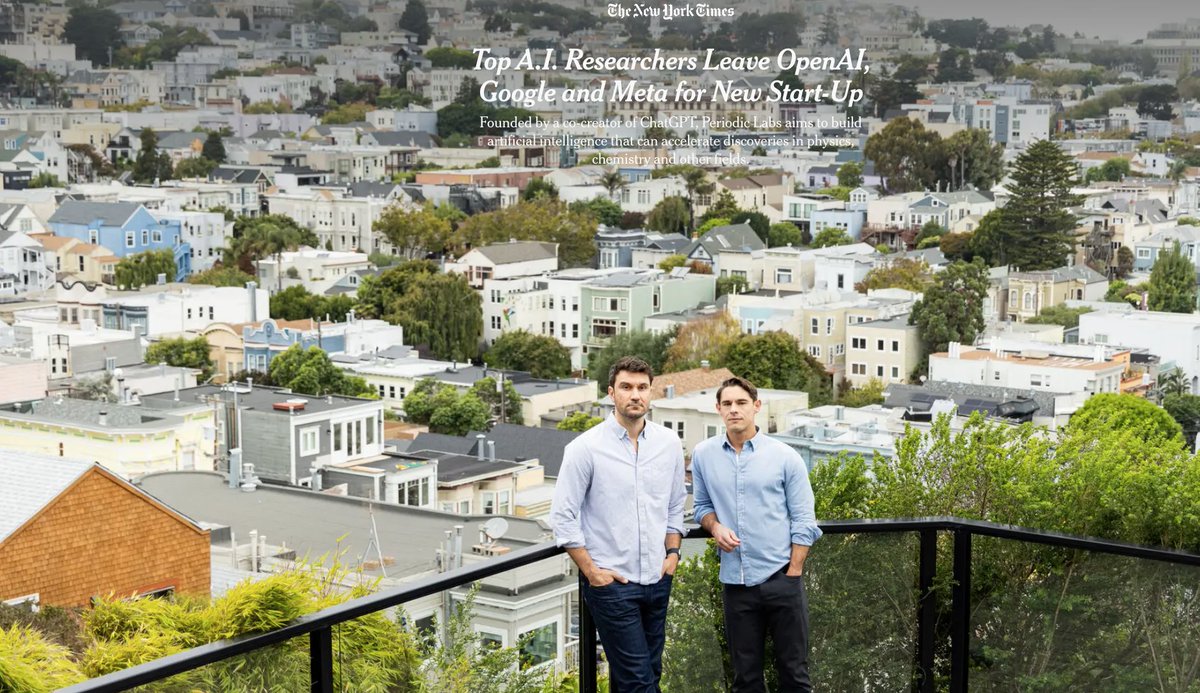
    Bullish, in the coming decades majority of compute will be spent on ai for science William Fedus (@LiamFedus) Today, @ekindogus and I are excited to introduce @periodiclabs. Our goal is to create an AI scientist. Science works by conjecturing how the world might be, running experiments, and learning from the results. Intelligence is necessary, but not sufficient. New knowledge is created when ideas are found to be consistent with reality. And so, at Periodic, we are building AI scientists and the autonomous laboratories for them to operate. Until now, scientific AI advances have come from models trained on the internet. But despite its vastness — it’s still finite (estimates are ~10T text tokens where one English word may be 1-2 tokens). And in recent years the best frontier AI models have fully exhausted it. Researchers seek better use of this data, but as any scientist knows: though re-reading a textbook may give new insights, they eventually need to try their idea to see if it holds. Autonomous labs are central to our strategy. They provide huge amounts of high-quality data (each experiment can produce GBs of data!) that exists nowhere else. They generate valuable negative results which are seldom published. But most importantly, they give our AI scientists the tools to act. We’re starting in the physical sciences. Technological progress is limited by our ability to design the physical world. We’re starting here because experiments have high signal-to-noise and are (relatively) fast, physical simulations effectively model many systems, but more broadly, physics is a verifiable environment. AI has progressed fastest in domains with data and verifiable results – for example, in math and code. Here, nature is the RL environment. One of our goals is to discover superconductors that work at higher temperatures than today's materials. Significant advances could help us create next-generation transportation and build power grids with minimal losses. But this is just one example — if we can automate materials design, we have the potential to accelerate Moore’s Law, space travel, and nuclear fusion. We’re also working to deploy our solutions with industry. As an example, we're helping a semiconductor manufacturer that is facing issues with heat dissipation on their chips. We’re training custom agents for their engineers and researchers to make sense of their experimental data in order to iterate faster. Our founding team co-created ChatGPT, DeepMind’s GNoME, OpenAI’s Operator (now Agent), the neural attention mechanism, MatterGen; have scaled autonomous physics labs; and have contributed to some of the most important materials discoveries of the last decade. We’ve come together to scale up and reimagine how science is done. We’re fortunate to be backed by investors who share our vision, including @a16z who led our $300M round, as well as @Felicis, DST Global, NVentures (NVIDIA’s venture capital arm), @Accel and individuals including @JeffBezos , @eladgil , @ericschmidt, and @JeffDean. Their support will help us grow our team, scale our labs, and develop the first generation of AI scientists. — https://nitter.net/LiamFedus/status/1973055380193431965#m

    → View original post on X — @_jasonwei, 2025-09-30 16:04 UTC

  • Designing Agentic Loops for AI-Assisted Coding Tools

    One of the new skills required to get the most out of AI-assisted coding tools – Claude Code, Codex CLI, etc – is designing agentic loops: carefully selecting tools to run in a loop to achieve a specified goal. Do this well and you can solve many coding problems with brute force.

    → View original post on X — @simonw

  • Figma MCP Tool Critique: Wrong Direction for AI Integration

    Using the Figma MCP, it’s like saying, we have a car now, but I really want to go on a horse.

    → View original post on X — @skirano

  • Claude Sonnet 4.5 Now Available in Flowise for Complex Agents

    Claude Sonnet 4.5 – the strongest model for building complex agents, is now available to be used in Flowise!

    → View original post on X — @flowiseai, 2025-09-30 15:01 UTC

  • C1: Generative UI API for Dynamic Interfaces
    C1: Generative UI API for Dynamic Interfaces

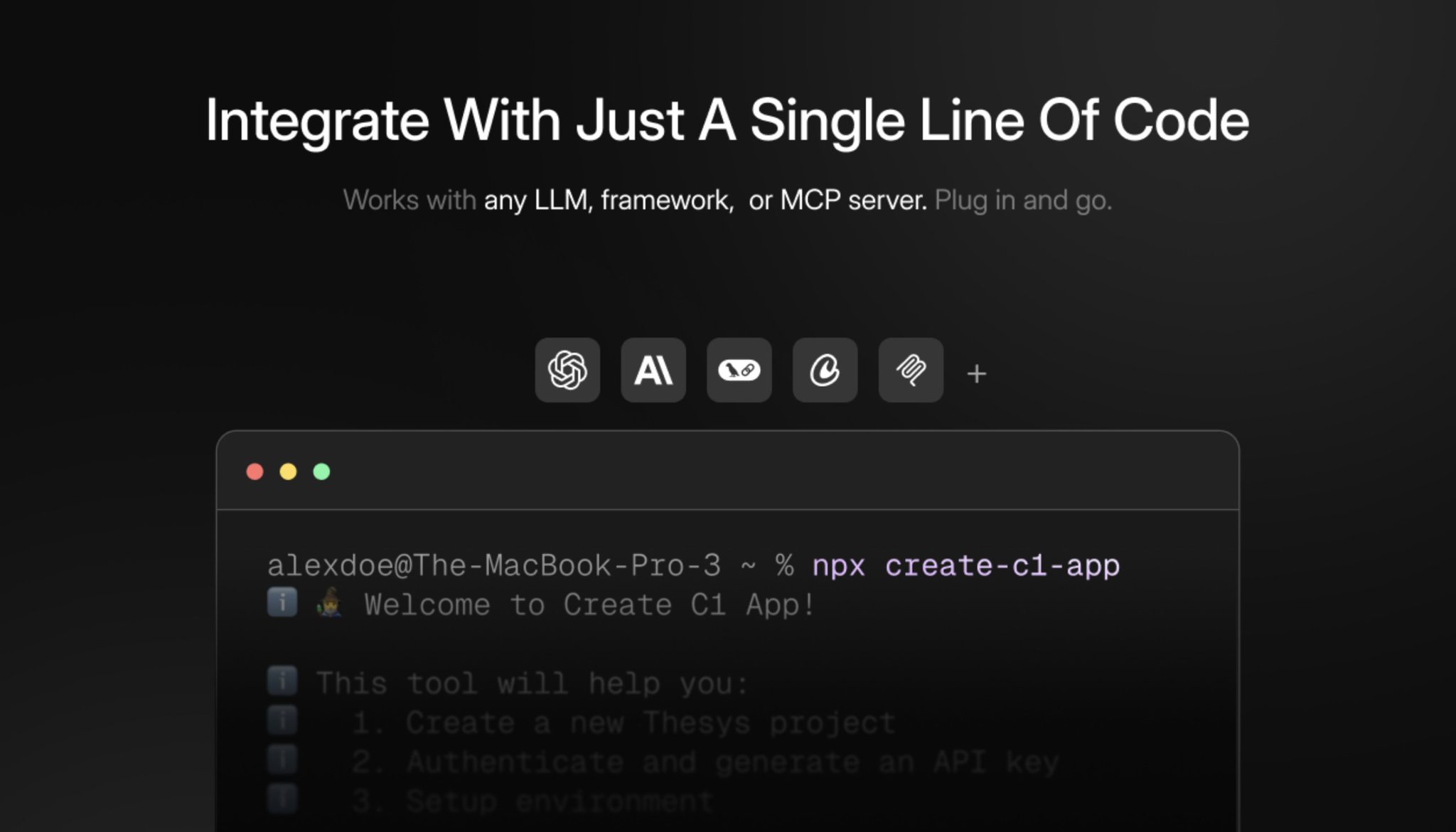
    C1 is a Generative UI API that turns your model’s output into adaptive interfaces in real time. No more text dumps. Your AI apps can now render dynamic components – forms, cards, charts – on the fly. Works with any LLM, framework, or MCP server Fully customizable to your

    → View original post on X — @godofprompt

  • Accelerate Your Journey to Autonomous Network Lifecycle Management

    Discover how you can accelerate your journey to an autonomous network lifecycle: ibm.co/6017BJdal

    → View original post on X — @ibmdata, 2025-09-30 13:00 UTC

  • IBM Network Intelligence: Agentic AI for Network Planning and Optimization

    Now is the time to move beyond basic automation. IBM Network Intelligence uses agentic AI to help you plan, build, and optimize your network for a new era of performance and efficiency.

    → View original post on X — @ibmdata, 2025-09-30 13:00 UTC

  • API Standards and Implementation Challenges in AI Development

    I agree with you, I think that's why this isn't happening yet – plus there are still new features to be invented, a standard could slow that down But as someone who implements against these APIs I can dream!

    → View original post on X — @simonw

  • OSWorld Usage Surges 45% in Four Months

    Computer use jumped 45% in four months. OSWorld: 42.2% → 61.4% The model can navigate browsers, fill spreadsheets, complete workflows without hardcoded logic. Chrome extension is live for Max users. This is production-ready.

    → View original post on X — @godofprompt